

If you are wondering how to spell Tristan correctly, the answer is straightforward: T-R-I-S-T-A-N. Six letters, ending with the letter A, not E or I. This is the standard English spelling used across the United States, United Kingdom, Canada, and Australia, and it is the form you will find on birth certificates, school records, and official documents.
For Christian parents, Tristan carries more than a correct spelling. Its themes of sorrow, endurance, and redemption echo some of the most meaningful truths in Scripture, even though Tristan itself does not appear in the Bible. This article will walk you through the name’s origins, its spiritual significance seen through a biblical lens, common spelling mistakes to avoid, and practical guidance for families choosing this name in faith.
The Correct Spelling: T-R-I-S-T-A-N

The correct spelling in English is T-R-I-S-T-A-N. No exceptions in standard usage.
Pronunciation: TRISS-tən (emphasis on the first syllable)
The name breaks into two natural parts:
- Tris (rhymes with “miss”)
- tan (like the color)
This spelling has been the standard English form for centuries, anchored by the medieval legend of Tristan and Isolde. While authentic cultural variants exist in Welsh, Portuguese, and Spanish, if you are completing legal documents or enrollment forms in an English-speaking country, T-R-I-S-T-A-N is the form to use.
Why This Spelling Matters
Getting the spelling right matters practically and personally. A misspelled name on a birth certificate can cause complications with passports, school diplomas, and legal records for years. Consistency across all official documents protects your child from unnecessary frustration.
But for Christian families, there is a deeper layer. Names carry identity, and identity matters to God. Throughout Scripture, God affirms that He knows each person by name (Isaiah 43:1). Choosing a name carefully and spelling it consistently is a small but meaningful act of honoring that identity. It is not that a misspelling changes a child’s destiny, but that getting it right reflects the intentionality and love behind the choice.
Common Misspellings and Why They Happen
Even a relatively straightforward name like Tristan gets misspelled regularly. Here are the most common errors:
| Misspelling | Why It Happens | How Common |
|---|---|---|
| Tristen | Vowel confusion, “en” sounds like “an” in speech | Very Common |
| Tristin | Phonetic guessing based on similar names | Common |
| Trystan | Trendy modern variation using “y” | Moderate |
| Tristian | Added syllable, people hear “tris-tee-an” | Moderate |
| Triston | Influenced by names like Winston or Preston | Common |
| Tristyn | Modern variation with “y” | Less Common |
| Trestan | Random vowel substitution | Rare |
It is important to distinguish between true misspellings (Tristen, Tristin, Triston) and legitimate cultural variants (Trystan in Welsh, Tristão in Portuguese). The first group are errors. The second group are authentic forms tied to specific linguistic heritage.
The Psychology Behind Spelling Errors
Most Tristan misspellings come down to one linguistic challenge: unstressed syllables. When people hear “TRISS-tən,” the final syllable sounds ambiguous. The vowel in that position is a schwa sound, which in English can be represented by A, E, I, or O. Without knowing the established spelling, people default to what feels familiar from other names they already know, such as Dustin, Austin, or Preston.
Autocorrect does not always catch name errors, which means social media announcements and informal messages become breeding grounds for spelling drift. Once a misspelling circulates in a family group chat or baby announcement post, it can stick.
Memory Trick to Never Misspell Tristan Again
Here is a simple and reliable way to remember the correct spelling:
“Tristan ends like Christian.”
Both names share the same “-an” ending. If you can spell Christian, you can spell Tristan. You can also think of classic names like Sebastian and Adrian, which all end in “-an,” never “-en” or “-in.”
Another helpful anchor: the final letter is A, just like the color “tan” at the end of the name.
Ancient Origins and Etymology: From Celtic Warriors to Arthurian Knights
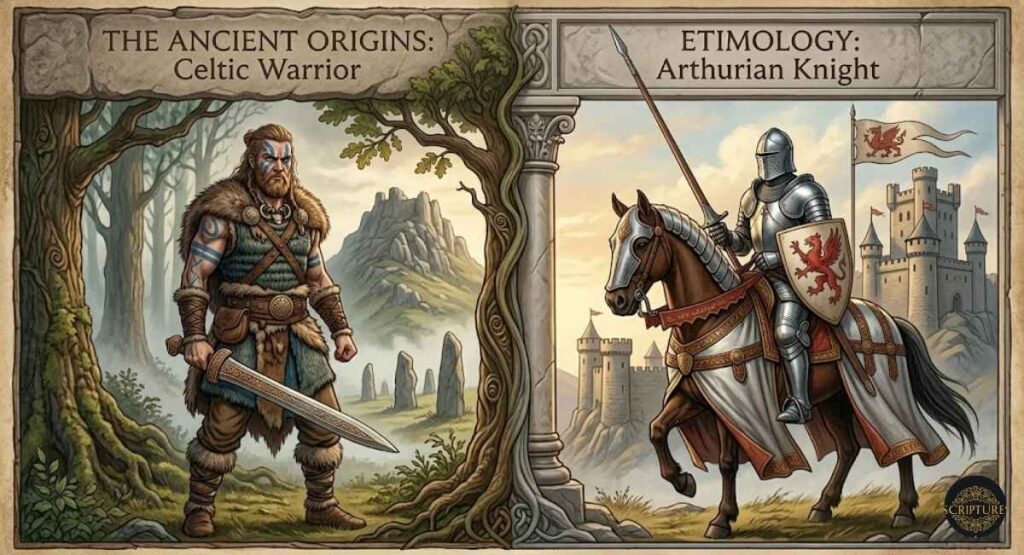
The name Tristan has a layered history, moving through Celtic, Latin, and French before arriving in the form we recognize today.
Celtic Roots: The Warrior Beginning
The earliest traceable root of Tristan is the Celtic word drust, meaning tumult or outcry. The Welsh form Trystan grew from this tradition, carrying associations with strength, nobility, and fierce courage. In the regions of Wales and early Britain shaped by Celtic culture, names like Trystan were given to warriors and leaders, men expected to stand firm under pressure.
This Celtic origin is the name’s oldest layer, predating any Latin or French influence by centuries.
Latin Transformation: Adding Sorrow to Strength
As Latin spread through Europe, the name absorbed resonance from the Latin word tristis, meaning sorrowful or melancholy. This was not deliberate etymology so much as phonetic overlap, but it profoundly shaped how medieval writers and poets understood the name.
The Latin association gave Tristan a dual character: warrior strength on one side, emotional depth and suffering on the other. For storytellers of the medieval period, this combination was irresistible.
French Refinement: The Medieval Knight Emerges
Old French literature standardized the spelling we use today. The legend of Tristan and Isolde, a tragic romance that spread across medieval Europe through the work of French troubadours and poets, locked the name into cultural memory. Tristan was portrayed as a noble knight of King Arthur’s Round Table, a man of valor undone by a forbidden love and a fateful potion.
That literary tradition cemented the spelling T-R-I-S-T-A-N, and it has remained the standard English form ever since.
Spiritual Meaning of Tristan: Redemption Through Suffering
Before exploring the spiritual significance of Tristan, one important clarification must be made clearly: Tristan is not a biblical name. It does not appear in Scripture. It does not have a Hebrew or Greek biblical root. It is not the name of any patriarch, prophet, apostle, or figure in the Old or New Testament.
This matters because some resources blur the line between cultural symbolism and actual biblical origin. Christian families deserve honesty here.
What can be said truthfully is this: the themes associated with Tristan, particularly sorrow, endurance through suffering, and eventual redemption, are deeply biblical themes. A name does not need to appear in Scripture for its meaning to resonate with scriptural truth. Christian parents can choose Tristan thoughtfully, knowing they are reflecting on truths God Himself speaks throughout the Bible.
Christian Perspective: From Mourning to Dancing
The name’s Latin association with sorrow opens a rich conversation about one of Christianity’s most beautiful promises: God redeems suffering. This is not a vague spiritual idea. It is a specific, repeated declaration of God’s character throughout Scripture.
Psalm 30:11 says, “You turned my wailing into dancing; you removed my sackcloth and clothed me with joy.” The psalmist is not speaking abstractly. He is testifying to a real, personal experience of God meeting him in grief and transforming it. The sorrow was real. The joy that followed was also real, and it came from God’s direct action.
Romans 5:3 to 5 takes this further: “We also glory in our sufferings, because we know that suffering produces perseverance; perseverance, character; and character, hope. And hope does not put us to shame, because God’s love has been poured out into our hearts through the Holy Spirit.” Paul is not romanticizing pain. He is mapping a biblical process: suffering, faithfully endured, produces something in a believer that comfort alone cannot produce. It builds character. It deepens hope.
For a child named Tristan, a Christian parent might hold this truth quietly: that whatever sorrows this child faces, God is able to transform them into something purposeful. That is not a mystical claim about the name’s power. It is a confident claim about God’s faithfulness.
Isaiah 61:3 speaks of God giving “a crown of beauty instead of ashes, the oil of joy instead of mourning, and a garment of praise instead of a spirit of despair.” This is the ultimate framework for understanding how a name rooted in sorrow can point toward redemption, not because the name itself is prophetic, but because the God who redeems sorrow is real.
Example Christian Context Sentences:
- “Tristan led the small group through a passage on suffering and hope, speaking from personal experience.”
- “After a season of loss, Tristan shared his testimony at the Sunday service, pointing others toward God’s faithfulness.”
- “In youth ministry, Tristan mentors teenagers who are walking through difficult family situations.”
- “His parents named him Tristan as a quiet prayer that God would turn every sorrow in his life into something beautiful.”
- “Tristan often says his name reminds him that hardship is not the end of the story.”
Celtic Spiritual Interpretation: The Noble Warrior Spirit
From a Celtic heritage standpoint, Tristan represents disciplined courage rather than reckless aggression. The tumult in its roots speaks to a person who can stand in the middle of chaos without losing their center.
This is a cultural and symbolic reading, not a Christian doctrinal claim. But Christian readers can appreciate it. The Bible has much to say about courage (Joshua 1:9), about standing firm under pressure (Ephesians 6:13), and about the kind of strength that does not collapse under difficulty. If a family values those qualities and sees them reflected in the name’s heritage, that is a meaningful personal connection.
Numerological Significance
Some naming resources note that Tristan corresponds to the number 7 in certain numerological systems, often associated with reflection, depth, and spiritual seeking.
Christians should approach numerology with clear discernment. Numerology is not a biblical discipline, and no number system carries doctrinal authority for followers of Christ. The Bible does not endorse numerological interpretation of names as a method for understanding spiritual identity or destiny.
If you find it interesting as a cultural curiosity, that is a personal choice. But Christian families are better served by seeking wisdom through prayer, Scripture, and godly counsel than through numerological systems when choosing a name.
Modern Spiritual Associations
In contemporary Christian and broadly spiritual circles, Tristan is increasingly associated with:
- Resilience in the face of hardship
- The wounded healer, someone who serves others from a place of personal experience with pain
- Emotional depth and compassionate listening
- The journey from grief to wholeness
Biblically, these associations find their richest expression not in abstract spirituality but in the person of Jesus Christ, who was “a man of sorrows, acquainted with grief” (Isaiah 53:3) and who, through His own suffering, brings healing and redemption to those who trust in Him. Tristan’s thematic resonance with suffering and redemption ultimately points Christian readers back to the gospel itself.
International Variations and Legitimate Alternative Spellings
Legitimate Name Variations Across Languages:
Welsh: Trystan
- Pronounced: TRY-stan
- The original Celtic form
- Authentic and culturally appropriate for families honoring Welsh heritage
- Completely legitimate, though expect frequent corrections outside Wales
Portuguese: Tristão
- Pronounced: trish-TOW
- Used in Portugal and Brazil
- The tilde changes the pronunciation significantly
- A beautiful variation for families with Portuguese roots
Spanish: Tristán
- Pronounced: tree-STAHN
- The accent mark is essential and should not be dropped
- Common in Spanish-speaking countries
Italian: Tristano
- Pronounced: tree-STAH-no
- An extended form with Italian character
- Less common but historically documented
Ancient Welsh: Drystan
- The earliest recorded form
- Rarely used today
- Historically significant for scholars of Celtic names
Gender Variations
Trista is the most recognized feminine form, gaining visibility in the early 2000s. Tristana is a rarer but elegant extended feminine version.
When Alternative Spellings Cause Problems
Choosing a variant like Trystan is a legitimate decision if you have Welsh heritage or a personal connection to that spelling. But it comes with a practical cost: consistent correction. Teachers, administrators, and automated systems will default to the standard spelling. Government forms may flag less common variants.
If you choose a cultural variant, go in with clear eyes. It is a meaningful choice, but it requires patience and consistency on the part of the whole family.
Famous People Named Tristan: From NBA Courts to TV Screens

| Name | Field | Notable For |
|---|---|---|
| Tristan Thompson | NBA Basketball | Cleveland Cavaliers championship 2016 |
| Tristan Jarry | NHL Hockey | Pittsburgh Penguins goaltender, All-Star selection |
| Tristan Wilds | Acting / Music | The Wire, 90210, Emmy-nominated performance |
| Tristan Prettyman | Music | Singer-songwriter, demonstrates unisex usage |
| Tristan Tzara | Poetry / Art | Founded the Dada movement, adopted Tristan as pen name |
Athletes
Tristan Thompson brought the name consistent mainstream visibility through his NBA career and the Cleveland Cavaliers’ 2016 championship run. Tristan Jarry demonstrates the name’s reach into other major sports, showing it works for driven, competitive personalities across athletic disciplines.
Entertainment
Tristan Wilds showed the name’s range across dramatic television, from the gritty realism of The Wire to mainstream teen drama. His Emmy-nominated work gave Tristan a recognizable, respected face in entertainment.
Historical Figures
Tristan Tzara, born Samuel Rosenstock, chose Tristan as his pen name and went on to found the Dada movement, one of the most radical artistic revolutions of the twentieth century. His choice of the name reflects something intentional: he wanted a name that carried weight and edge.
Fictional Characters
The legendary Tristan of Arthurian romance remains the name’s most culturally enduring representation. The story of Tristan and Isolde has been retold in operas, novels, films, and video games for centuries. This literary legacy keeps the name feeling timeless rather than dated.
Nicknames and Shortened Forms: What People Actually Call Tristan
Most Common Nicknames:
Tris is by far the most widely used nickname. It is clean, strong, one syllable, and works naturally from childhood through adulthood. Most Tristans who go by a nickname use this one.
T is the ultra-casual option, used by close friends and teammates in informal settings.
Tan is occasionally used, though it can feel slightly awkward in some regions.
Trist is rare but carries a certain quiet sophistication.
Context Matters
In professional settings, most Tristans use their full name. It carries natural authority and distinction. On a business card or in a formal email signature, Tristan stands well on its own.
Socially, Tris tends to dominate. It is friendly without being diminutive, casual without losing the name’s character.
For Christian families, some parents choose a nickname that still carries the dignity of the full name. Tris does this naturally. There is no obligation to shorten the name if the family prefers Tristan in full.
Popularity and Trends: When Tristan Peaked and Where It Stands Now
Historical Popularity Data:
| Era | U.S. Ranking | Trend |
|---|---|---|
| 1970s | Outside Top 500 | Rarely used |
| 1980s | Climbing steadily | Rising |
| 1990s | Broke into Top 100 | Surging |
| Early 2000s | Peak near #68 (2003) | Peak popularity |
| 2010s | Top 200 range | Gradual decline |
| 2020s | Lower top few hundred | Stabilizing |
What Drove the Surge?
The name’s rise in the 1990s and early 2000s came from several directions. Brad Pitt’s portrayal of Tristan in Legends of the Fall (1994) gave the name a strong cinematic association. Romance novels and television dramas picked it up throughout that decade. Parents were looking for names that felt distinctive but not invented, and Tristan fit exactly that space.
Current Standing in 2025
Recent U.S. baby name data places Tristan in the lower top few hundred nationally. It has passed its peak but has not faded. This is genuinely a favorable position for many parents: familiar enough that people know how to say it, uncommon enough that your child will likely be the only Tristan in the classroom.
In Wales, Trystan maintains steady usage reflecting regional Celtic heritage pride. In Brazil and Portugal, Tristão remains a culturally recognized form.
The Unisex Question: Is Tristan a Boy Name or a Girl Name?
Tristan is primarily a masculine name in English usage. The large majority of people named Tristan are male, and the name carries a masculine weight in its history, from Celtic warriors to Arthurian knights.
That said, some parents do use Tristan for daughters, particularly those drawn to its strong, understated character. It is not unheard of, but it is uncommon enough that people will typically assume a Tristan is male without additional context.
If you want a clearly feminine form, Trista is the most recognized option in English. Tristana is a rarer but elegant alternative. Both carry the name’s essence while reading as distinctly feminine.
How to Use Tristan in Sentences: Real-World Examples
Formal/Legal Contexts:
- “Tristan James Holloway is listed as the primary applicant on the enrollment form.”
- “Please confirm that Tristan is the correct spelling before we finalize the certificate.”
Educational Settings:
- “Tristan was selected to represent his class in the regional debate.”
- “Congratulations to Tristan for earning the top score on this semester’s exam.”
Social Media/Casual:
- “Celebrating Tristan today, best person I know.”
- “Tristan just posted the most incredible video, go watch it.”
Christian/Spiritual Contexts:
- “Tristan gave a testimony about walking through grief and finding God faithful on the other side.”
- “In our youth group, Tristan has become someone the younger students genuinely look up to.”
- “His parents named him Tristan as a prayer, believing God would turn every sorrow into something purposeful.”
Professional Communications:
- “I am forwarding this proposal to Tristan in communications for review.”
- “Tristan will lead the presentation at next month’s board meeting.”
Note the consistent capitalization and consistent spelling throughout. Never shift between Tristan and Tristen in the same document.
Practical Guidelines: Official Records and Documentation
Birth Certificates
In the United States, a birth certificate locks in the spelling permanently unless you pursue a legal name correction, which involves court fees typically ranging from a hundred and fifty to five hundred dollars depending on the state.
Before signing, bring a printed card with the exact spelling. Say it clearly to the hospital staff: “T-R-I-S-T-A-N, ending in A-N.” Do not assume the nurse or clerk will default to the correct spelling. Verify every document before it is finalized.
School Enrollment Forms
When enrolling, include a brief spelling note at the top of the form if your child has a name that is frequently misspelled. Something simple works: “Please note the spelling: Tristan, T-R-I-S-T-A-N.” Teachers appreciate the upfront clarification and it prevents errors from compounding over a school year.
When Misspelling Happens on Official Documents
If you discover a misspelling on an official document after it has been issued, address it as quickly as possible. Requirements for correction vary by state and country, but generally involve a court petition, proof of the error, and updated identification documents. Catching the error before leaving the hospital or office is always easier than correcting it later.
International Travel Considerations
Passports must exactly match the birth certificate. If a child’s birth certificate says Tristan but informal documents have drifted toward Tristen over the years, you may face complications at border control.
The simplest protection is choosing your spelling from the beginning and maintaining it consistently across every document, formal and informal alike.
Frequently Asked Questions
Is Tristan in the Bible?
No. Tristan does not appear in the Bible. It is not a Hebrew, Greek, or Aramaic name found in Scripture. However, the themes the name carries, sorrow, endurance, and redemption, are deeply biblical, and Christian parents can thoughtfully connect the name to those scriptural truths.
What does the name Tristan mean spiritually?
Spiritually, Tristan is most often associated with transformation through suffering. Its Latin root connects to sorrow, while its Celtic origin points toward warrior courage. From a Christian perspective, these themes reflect the biblical truth that God redeems pain and turns mourning into joy, as expressed in Psalm 30:11 and Romans 5:3 to 5.
Why is Tristan so often misspelled?
The final syllable of Tristan contains a schwa sound, an unstressed vowel that can sound like A, E, or I in natural speech. Without knowing the established spelling, people write what they hear, producing common errors like Tristen or Tristin.
Is Trystan an acceptable spelling?
Yes, Trystan is the authentic Welsh form of the name, rooted directly in Celtic linguistic heritage. It is a legitimate variant for families honoring Welsh ancestry. Outside of Wales and Welsh cultural contexts, however, it will require frequent correction in English-speaking countries.
How popular is the name Tristan in 2025?
Recent U.S. baby name data places Tristan in the lower top few hundred. It peaked near the 68th position in 2003 and has gradually declined since, reaching a stable range. It remains a recognized, well-regarded name without being overused.
Can Tristan be used as a girl’s name?
It can be, though Tristan is primarily masculine in English usage. The feminine form Trista is more commonly used for girls. Tristana is a rarer but elegant extended feminine option.
Is Tristan a good Christian baby name?
Tristan is not a directly biblical name, but it can be a meaningful choice for Christian families. Its themes of sorrow, endurance, and redemption connect naturally to core biblical truths about how God transforms suffering. Christian parents who choose Tristan thoughtfully and prayerfully are honoring those themes, not misappropriating Scripture.
What is the Christian meaning of Tristan?
The Christian meaning of Tristan is best understood symbolically, not scripturally. The name’s connection to sorrow and its deeper resonance with redemption can reflect the biblical pattern found throughout Scripture: that God meets people in their grief, shapes them through difficulty, and brings beauty from ashes (Isaiah 61:3).
Conclusion
How to spell Tristan correctly comes down to six letters: T-R-I-S-T-A-N. The name ends with A-N, consistent with classic names like Sebastian and Christian. Avoid common errors like Tristen, Tristin, or Triston, and verify the spelling on every official document from the very beginning.
Tristan is not a name found in the Bible, and Christian families are best served by knowing that clearly. But the themes it carries, sorrow refined into strength, endurance shaped by grace, and redemption through suffering, are among the most beautiful threads running through all of Scripture. A child named Tristan can grow up understanding that hardship is never the final word, because the God who turns mourning into dancing (Psalm 30:11) is faithful and present in every season of life.
If you are a Christian parent choosing this name prayerfully, you are not naming your child after a biblical figure. You are naming them after a theme God Himself holds dear: that broken things can become beautiful, and that suffering, surrendered to God, produces something no comfortable life alone ever could.