

If you have been searching for the Tristan meaning in Hebrew, here is what you need to know right away. Tristan is not a Hebrew name, and it does not appear anywhere in the Bible. Its roots are Celtic and Old French, and it has historically carried the meaning of sorrow or sadness, made famous through the medieval legend of Tristan and Isolde. There is no direct Hebrew etymology behind it.
That said, many Christian families today choose this name with genuine faith and love. While Tristan carries no literal Hebrew meaning, it is possible to reflect on the name through a biblical lens, drawing on Scripture’s rich themes of endurance through suffering, redemption, peace, and faithfulness in Christ. That is exactly what this article will help you do, with honesty and spiritual depth.
Is Tristan Mentioned in the Bible?
No. Tristan does not appear anywhere in the Bible. It is absent from the Old Testament, the New Testament, and every recognized apocryphal text across Christian traditions. This is simply a fact worth stating clearly and without apology.
But here is what every Christian parent also needs to hear: the absence of a name from Scripture does not disqualify it from being a meaningful or God-honoring choice. Faithful believers throughout church history have carried names like Arthur, Eleanor, and Brandon without any biblical connection, and they have lived lives that powerfully honored God.
What God cares about is not the origin of your child’s name but the character and faith that name will be spoken over throughout a lifetime. A name becomes sacred through the life lived beneath it. Parents who want to honor God in naming their child can do so by speaking faith, prayer, and purpose over any name they choose.
The Hebrew Meaning and Origin of the Name Tristan
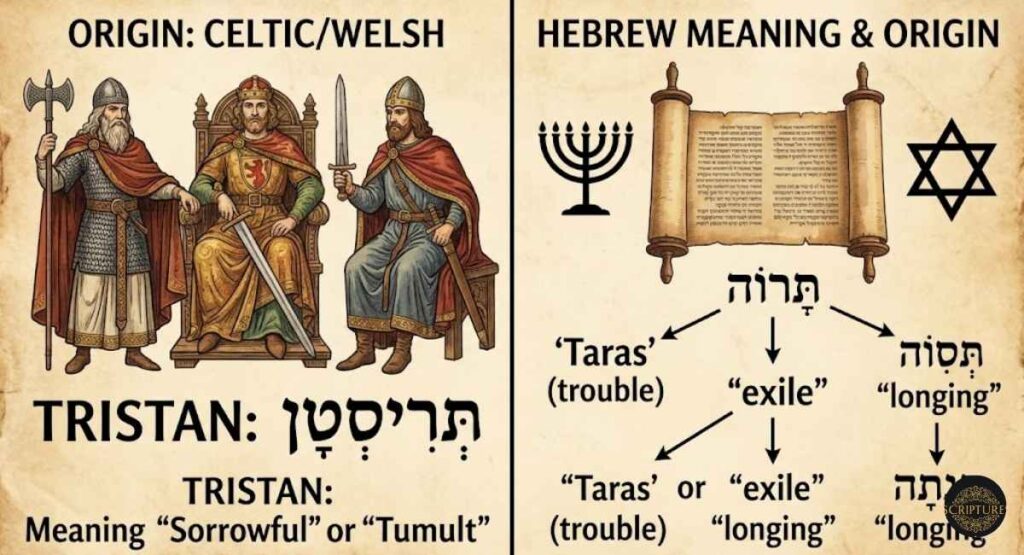
Tristan has no Hebrew origin. It does not derive from the Hebrew language, and it holds no place in Jewish naming traditions or Scripture. Its most widely accepted roots trace back to Celtic and Pictish cultures of ancient Britain, where it likely developed from older forms such as Drust or Drustan, carrying associations with tumult, noise, or commotion. Through Old French literary tradition, the name later became associated with sorrow, largely through the romance of Tristan and Isolde.
It is worth understanding how differently Hebrew names function in Scripture. In the biblical world, a name was not simply a label. It reflected covenant, character, divine purpose, or a defining moment in someone’s story. Names containing El or Yah pointed directly to God. Names like Hannah meant grace or favor. Names like Ezra meant help. Naming in Hebrew culture was an act of faith and declaration.
Tristan carries none of that linguistic heritage. However, if a parent is searching for Hebrew names with thematically similar qualities, names like Oz, which means strength, or Amatz, meaning to be strong and courageous, carry some of the warrior-like resonance that Tristan evokes through its legendary associations. These are not direct equivalents. They are simply approximate symbolic parallels worth considering.
Bible Verses That Reflect Tristan’s Meaning

Though Tristan holds no biblical origin, the themes woven into its meaning and history are deeply present in Scripture. Sorrow, courage, endurance, and faithful love are not foreign to God’s Word. They are central to it. Below are verses that speak powerfully into the life of anyone bearing this name.
Psalm 34:18 says that the Lord is close to the brokenhearted and saves those who are crushed in spirit. This verse speaks directly into Tristan’s association with sorrow. God does not stand far from those who grieve. He draws near.
Joshua 1:9 carries God’s personal command to be strong and courageous, grounded not in human ability but in the promise that God goes with us wherever we go. This is not a motivational slogan. It is a covenant declaration spoken to a people stepping into unknown territory.
2 Corinthians 12:9 contains Paul’s discovery that God’s grace is sufficient and that divine power is made perfect in human weakness. This verse reframes suffering not as defeat but as the very ground where God’s strength is revealed.
Lamentations 3:22 to 23 declares that God’s mercies are new every morning and that His faithfulness is great. For anyone whose name carries an association with sorrow or struggle, these words are a daily anchor.
Ephesians 6:12 reminds believers that the true battle is not against flesh and blood. This verse reframes the warrior imagery in Tristan’s legacy into something spiritually meaningful and eternally purposeful.
Biblical and Spiritual Significance of Tristan in Hebrew
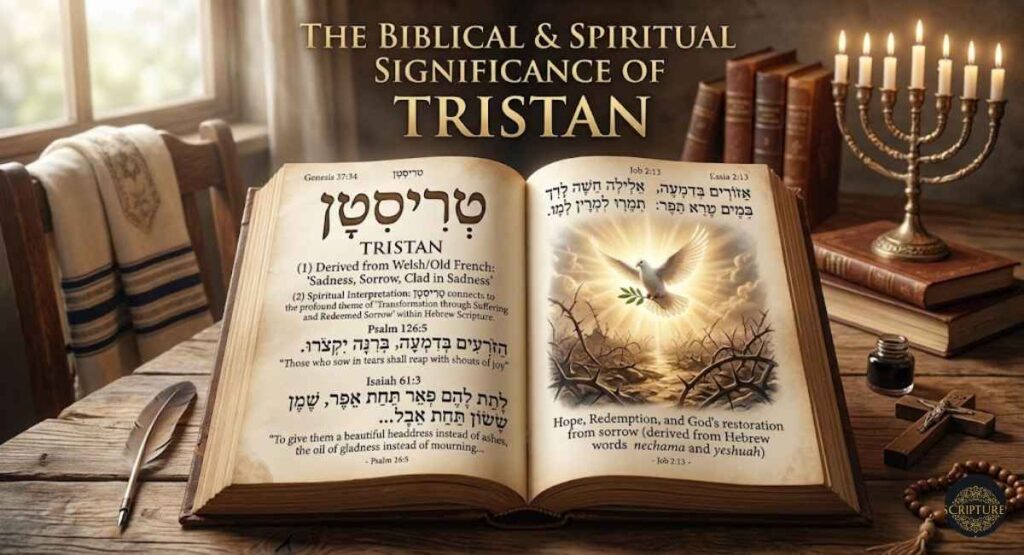
Let this be said clearly: what follows is symbolic Christian reflection, not literal Hebrew etymology. Tristan carries no direct meaning in the Hebrew language or biblical text. But Christians have always reflected on life, names, and identity through the lens of Scripture, and that practice is both legitimate and spiritually enriching.
When we hold the themes associated with Tristan alongside the truths of God’s Word, something beautiful emerges.
Sorrow to Strength
Sorrow is not the end of the story in Scripture. It is often the beginning of something deeper. Joseph was sold into slavery by his own brothers, and his grief became the path to saving nations. Hannah wept in the temple until she could weep no more, and God heard her and opened her womb. David wrote laments that still echo across millennia. Paul discovered in his weakness that grace was not just sufficient but transforming.
The journey from sorrow to strength is one of the most repeated patterns in God’s redemptive story. For anyone named Tristan, this biblical theme offers a powerful identity anchor. Your sorrow does not define you. God’s faithfulness does.
Tumult to Peace
Tristan’s older Celtic meaning of tumult or riot points to inner chaos and unrest. Scripture does not ignore this reality. It addresses it directly. Philippians 4:6 to 7 invites believers to bring everything to God in prayer and thanksgiving, with the promise that God’s peace, which surpasses human understanding, will guard both heart and mind in Christ Jesus.
This is not the peace the world offers. It is peace that holds when circumstances are falling apart. For someone living in turmoil, this is not a cliche. It is a lifeline.
Warrior to Servant
The warrior imagery connected to Tristan’s name finds its highest biblical expression not in conquest but in humble, Spirit-led service. Ephesians 6:12 makes clear that the Christian’s battle is spiritual, fought with truth, righteousness, faith, and prayer, not with worldly force or dominance.
Jesus is the model. He is called the Lion of Judah, yet He entered Jerusalem on a donkey. He is the King of Kings, yet He washed His disciples’ feet. True biblical strength is not about overpowering others. It is about laying down your life in love and obedience.
Passionate Love to Divine Love
The legend of Tristan and Isolde is built on intense, consuming romantic passion. Scripture elevates love far beyond emotional intensity. First Corinthians 13 describes love as patient, kind, not self-seeking, not easily angered, and enduring through all things. This is agape love, covenant love rooted in commitment and self-giving sacrifice, not in feeling.
John 3:16 shows what that looks like in its fullest form. God so loved the world that He gave. The greatest love in history was not romantic. It was sacrificial, obedient, and eternal. For anyone named Tristan, this is a higher calling than any medieval legend could offer.
Loyalty to Faithfulness
Loyalty is central to Tristan’s legendary character. But God’s faithfulness is in a category entirely beyond human loyalty. Lamentations 3:22 to 23 declares that His compassions never fail and are new every morning. His faithfulness is not contingent on our performance. It holds even when we falter.
Scripture calls believers to reflect that faithfulness in their own lives, in marriage, in friendship, in church community, and in their walk with God. For someone named Tristan, loyalty is not just a literary trait. In the hands of a faithful God, it becomes a spiritual calling.
Is It a Good Christian Name?
Yes. Tristan is a good Christian name, and any parent choosing it for their child can do so with a clear conscience and a believing heart. A name does not need to appear in Scripture to be spiritually acceptable. What matters is not etymology but how the name is stewarded in faith.
Here are a few simple questions worth asking when choosing any name:
- Does this name conflict with Christian convictions or carry meaning that would dishonor God?
- Can this name be spoken over in prayer with faith and expectation?
- Can you raise your child with a Christ-centered identity regardless of the name’s cultural or literary history?
If the answer to these is yes, then the name is one you can choose with joy. Tristan can absolutely be spoken over in blessing. It can be carried with courage, humility, and devotion. The name itself is not the point. The life lived beneath it is.
Tristan in Legends vs Christian Truth
The medieval legend of Tristan and Isolde is one of the most famous romantic stories in Western literature. It is also morally complex in ways that deserve honest reflection for Christian families.
The legend glorifies a love that is driven by fate, that justifies betrayal of a marriage covenant, and that ends in tragedy without redemption. These elements stand in direct contrast to biblical truth.
| Aspect | Tristan Legend | Biblical Truth |
|---|---|---|
| Love | Uncontrollable romantic fate | Covenant commitment rooted in choice and sacrifice |
| Marriage | An obstacle to passion | A sacred covenant reflecting Christ and the Church |
| Loyalty | To romantic feeling above all duty | To God first, then to covenant relationships |
| Morality | Relative, justified by love | Absolute, grounded in God’s Word |
| Suffering | Romanticized and noble | Purposeful when endured for righteousness in Christ |
| Resolution | Tragic death | Repentance, forgiveness, and transformation through Christ |
Christian families can appreciate literary heritage without adopting its moral framework. Knowing the legend’s flaws actually equips parents to speak a more powerful story over a child named Tristan, one of redemption, covenant love, and identity rooted in Christ rather than in fate.
Tristan Name Symbolism and Interpretation in Hebrew Culture
Tristan has no established place in Hebrew naming tradition, historically or symbolically. This is not a weakness of the name. It simply reflects its true origin, which is Celtic and European, entirely outside the Hebrew linguistic and cultural world.
In Hebrew culture, names were deeply intentional. They reflected the character of God, the memory of His acts, the prayer of a parent, or the destiny declared over a life. Names like Elijah meant my God is the Lord. Names like Nathaniel meant God has given. This tradition of theologically meaningful naming is rich and profound.
Tristan simply does not fit within that framework by language or history. Any symbolic meaning connected to Hebrew themes, such as sorrow, endurance, or strength, should be understood as modern Christian devotional reflection, not authentic Hebrew etymology. Recognizing this distinction is not a limitation. It is the kind of intellectual honesty that builds trust and serves readers well.
Frequently Asked Questions
What does the name Tristan mean in Hebrew?
Tristan has no direct meaning in Hebrew. It is not a Hebrew name and does not derive from the Hebrew language in any way.
Is Tristan a Hebrew name?
No. Tristan originates from Celtic and Old French roots, not from Hebrew. It has no connection to the Hebrew language or Jewish naming traditions.
Does Tristan appear in the Hebrew Bible?
No. Tristan does not appear anywhere in the Hebrew Bible, the New Testament, or any recognized biblical text.
Is there a Hebrew name similar to Tristan?
There is no direct Hebrew equivalent. Names like Oz or Amatz, meaning strength and courage, share some of the warrior-like spirit associated with Tristan, but they are not equivalent in meaning or origin.
What Hebrew word is sometimes linked to Tristan’s meaning?
Some loosely connect it to the Hebrew concept of yagon, meaning sorrow or grief, due to Tristan’s Old French association with sadness, though this is a thematic parallel, not an etymological link.
Can Tristan have a spiritual meaning in Hebrew context?
Yes, through symbolic Christian reflection. Themes of sorrow transformed into strength, and tumult resolved into peace, resonate with deep biblical truths, even though Tristan is not a Hebrew name.
Is Tristan acceptable as a biblical or Hebrew-inspired name?
Yes. Many faithful Christians carry names with no biblical origin and live deeply God-honoring lives. What matters is character, faith, and how the name is spoken over in love and prayer.
What Hebrew Bible theme matches the name Tristan?
The biblical theme of lament turning into hope fits most naturally, as seen in the Psalms, Lamentations, and the lives of Joseph and Hannah.
Is the meaning of Tristan negative in Hebrew thought?
No. In Hebrew Scripture, sorrow is not the final word. Grief leads to encounter with God, and mourning often becomes the soil in which faith grows deepest.
What is a blessing for someone named Tristan in a biblical sense?
May Tristan walk in strength and gentleness, endure every trial with faith, love deeply and faithfully, and know that the God who redeems all sorrow holds every chapter of his life with unfailing grace.
Conclusion
The tristan meaning in hebrew is simply this: there is none. Tristan is not a Hebrew name. It does not appear in the Bible. It carries no direct biblical or Hebrew etymological meaning. These are facts worth stating plainly, because truth builds trust, and Christian readers deserve honesty above all.
And yet, for parents who love this name and want to raise their child in faith, there is something genuinely beautiful here. The themes woven through Tristan’s history, sorrow, endurance, passionate loyalty, and warrior courage, are themes that God’s Word speaks into with great power and grace. You do not need a name to be biblical in origin to raise a child who is biblical in character.
God shapes identity through the Word, through community, through prayer, and through the long, faithful work of discipleship. A name is a beginning, not a boundary. Whatever name you choose, you can speak faith over it, pray Scripture into it, and trust that God’s purposes will unfold in the life of the child He has given you.
May every Tristan be known not for sorrow but for the strength that comes from walking closely with a faithful and redemptive God.