


Have you ever paused to wonder why the name Lily feels so spiritually weighty? It is more than a beautiful flower. In Scripture, the lily carries layers of meaning that speak directly to the human soul. The lily name meaning in the Bible is rooted in purity, divine care, humility, and unshakeable hope. Whether you encountered this name in prayer, in a dream, or on the pages of your Bible, there is a reason it caught your attention.
The biblical meaning of lily is not accidental. God wove this flower into His Word with intention, using it to teach His people timeless lessons about faith, provision, and the beauty of a life surrendered to Him. This article unpacks every layer of that meaning clearly, scripturally, and with pastoral depth.
Biblical Meaning of the Lily in the Bible
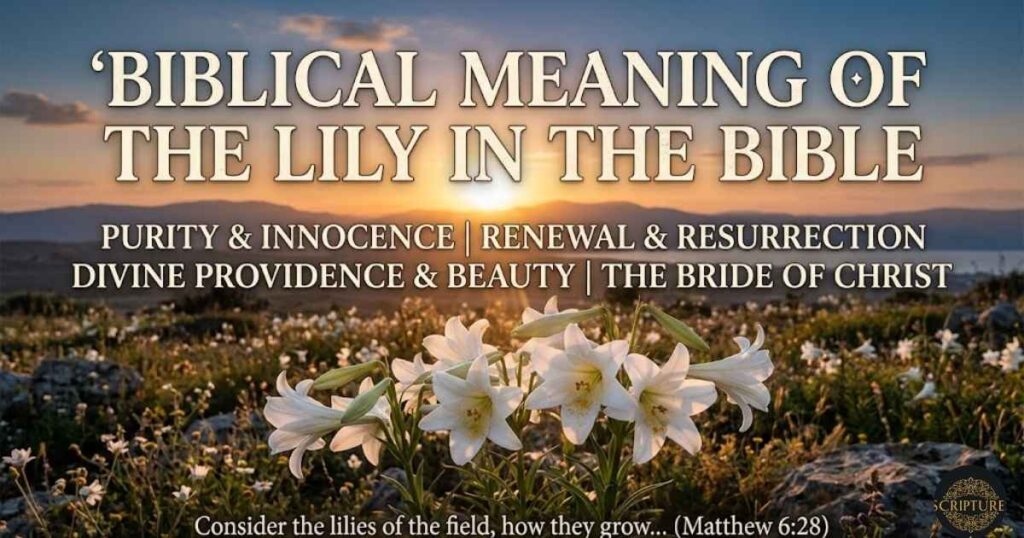
The word lily appears in both the Old and New Testaments. In Hebrew, it is written as shushan or shoshan, meaning “whiteness.” This lily Hebrew meaning shushan points directly to the flower’s most prominent quality: its radiant, unstained appearance. Scholars note that the shoshan meaning in Hebrew connected it to joy and rejoicing, rooted in the Hebrew verb sus, meaning to exult. A flower whose very name sings.
In the lily Old Testament meaning, the word shushan was broad enough to include the lotus, iris, tulip, and anemone. It appeared in the architectural design of Solomon’s Temple (1 Kings 7:19-22), where lily-shaped ornaments crowned the great pillars. This was no decoration. It was a statement of divine beauty embedded into the House of God.
In the lily New Testament meaning, the Greek word krinon is used in Matthew 6:28 and Luke 12:27, where Jesus points to the lilies in Galilee during His Sermon on the Mount. These were likely the vibrant scarlet Turk’s-cap lily or the brilliant anemone, flowers so striking they rivaled the glory of Solomon himself.
Key Bible Verses About the Lily at a Glance
| Bible Verse | Book | Core Meaning |
|---|---|---|
| Matthew 6:28-29 | New Testament | God’s provision and trust |
| Song of Solomon 2:1-2 | Old Testament | Purity and beauty among thorns |
| Hosea 14:5 | Old Testament | Spiritual renewal and restoration |
| 1 Kings 7:19, 22 | Old Testament | Sacred beauty in God’s Temple |
| Song of Solomon 5:13 | Old Testament | Sweetness and devotion |
This table shows how lily symbolism in Scripture is woven consistently through both Testaments, from temple architecture to the teachings of Jesus.
Lily as a Symbol of Purity
The lily as a symbol of purity in the Bible is one of its most enduring associations. Its white petals became a visual language for a heart made clean before God. When Song of Solomon 2:2 describes the beloved as “a lily among thorns,” it is not merely romantic poetry. It is a portrait of spiritual purity standing firm in a broken world.
Purity symbolism in the Bible was never passive. In Scripture, purity meant active holiness, a deliberate choice to remain unstained. The lily, blooming untouched among thorns and weeds, pictures exactly that. Innocence in the Bible symbolism is not fragility. It is the quiet strength of a soul that has chosen God.
This is also why Christian symbolism of lily includes the Virgin Mary in church art and iconography. The lily became her flower because she embodied spiritual purity meaning at its deepest level. For anyone bearing the name Lily, this connection is a calling, not just a label.
Lily and God’s Provision
The most famous teaching about lilies comes directly from Jesus. In Matthew 6:28-29, He says during the Sermon on the Mount: “Consider the lilies of the field, how they grow; they neither toil nor spin, yet I tell you, even Solomon in all his glory was not arrayed like one of these.”
The Matthew 6:28-29 meaning is a lesson in trust in God Bible lesson that cuts through every generation. If God clothes the wildflowers of Galilee with such splendor, how much more will He clothe, feed, and sustain His beloved children? This is God’s provision Bible meaning made visible in a flower.
The lilies of the field meaning goes deeper than material provision. It speaks of divine care meaning Bible. God does not forget. He does not overlook. He tends to the smallest details of His creation, including the flowers that last only a season. His care for you, made in His image, is infinitely greater.
- God clothes the lily without it asking
- God sustains the lily without it laboring
- God beautifies the lily beyond human craftsmanship
- God does the same for every soul who trusts Him
This passage is the heartbeat of faith and trust in God in the New Testament.
Lily as Beauty Without Pride
One of the most quietly profound lessons the lily teaches is this: it is stunning, yet it strains for nothing. It does not compete. It does not perform. It simply blooms as God designed it. This is the biblical picture of beauty without pride Bible teaches.
In a culture obsessed with status and appearance, the lily is a rebuke and a refuge. True beauty, Scripture shows, is not manufactured. It flows from God’s presence. The Song of Solomon 2:1 meaning, where the beloved declares “I am the lily of the valleys,” is an expression of grace-given identity, not self-promotion.
Humility in the Bible is not self-deprecation. It is an accurate view of oneself before God. The lily does not shrink. But neither does it boast. It holds its beauty lightly because it knows where that beauty comes from. That is the standard Scripture calls every believer to.
Positive Meaning of the Lily Name
The name Lily, though not a personal name found in Scripture, carries rich biblical associations that give it deep spiritual weight. Parents who choose this name often instinctively reach toward what it represents:
- Purity of heart and inner devotion
- God’s loving provision over one’s life
- Graceful strength that does not depend on striving
- Hope and renewal through every season
- Spiritual beauty that is God-given, not self-made
The Christian meaning of lily name ultimately points a person toward a life that is rooted in God’s care. Like the flower itself, a person named Lily is called to bloom where God plants them, without anxiety, without pride, and without losing their essential nature.
The Lily in Christian Art and Church Tradition
One important dimension of lily biblical symbolism that deepens our understanding is how the Church has carried this symbol through centuries of faith. In Christian art, the lily became one of the most recognizable emblems of sacred meaning.
White lilies were placed in paintings of the Annunciation, the moment the Angel Gabriel appeared to Mary. They represented her moral purity and willing obedience to God’s call. This connection reinforced the biblical flower symbolism lily as a marker of holiness set apart for divine purpose.
During Easter, the white Easter lily became a universal symbol of resurrection symbolism lily in the Church. Just as the lily bulb is buried in cold ground and rises in spring, Christ descended into death and rose in glorious new life. The parallel is powerful, and churches around the world continue this tradition.
In stained glass, hymns, and altar arrangements, the Christian faith symbols associated with the lily have remained consistent: purity, resurrection, obedience, and God’s presence symbolism. This is not mere decoration. It is centuries of the Church bearing witness to the same truths found in Scripture.
Spiritual Significance and Symbolism
Lily as Spiritual Rest
One of the most comforting spiritual meanings carried by the lily is rest. The lily does not rush. It does not toil. It grows at exactly the pace God intended. Jesus used this image precisely because His followers were anxious, striving, and exhausted.
Lily meaning peace and spiritual rest calls believers to release their grip. To stop performing and start trusting. God’s guidance symbolism through the lily is gentle: you do not have to earn your place in this world. You already have one, given by the God who clothes the flowers of the field.
Spiritual purity meaning in this context is also about stillness before God. A pure heart is a restful heart. One that is not fractured by double-mindedness or driven by fear. The lily, rooted and quiet, is its living picture.
Symbol of Renewal and Hope
Hosea 14:5 holds a promise that few believers quote enough: “I will be like the dew to Israel; he shall blossom like the lily.” Here, God Himself promises spiritual renewal. The lily becomes the image of a restored people, restored by God’s own faithfulness.
Renewal and hope Bible meaning through the lily is specific. It is not generic optimism. It is the hope in the Bible symbolism that emerges from a direct promise of God’s intervening love. When Israel was broken and wayward, God’s word was: you will bloom again. Like a lily.
Lily meaning resurrection and growth connects directly to this theme. Every spring, the lily rises from dormancy. Every season of spiritual drought can be followed by a season of flourishing. This is not wishful thinking. It is the biblical pattern of God’s redemption.
Personal Faith Connection
The lily spiritual significance becomes deeply personal when a believer sees it not just as a theological concept but as a daily reminder. Every time you see a lily, it is an invitation to ask: Am I trusting God today? Am I resting in His care?
Spiritual growth symbolism in the lily is gradual and organic. Faith is not instant. It develops root by root, petal by petal, season by season. The lily meaning guidance and reassurance is that God is not in a hurry, and neither should you be.
Patience and trust in God are not passive. They are the active posture of a soul that has decided God is enough. The lily embodies that posture every single day it grows.
Biblical Interpretations in Dreams or Real Life
Peaceful or Bright Lilies
Dreaming of lilies meaning in a biblical context is generally positive and spiritually significant. A lily dream symbolism of bright, open, radiant lilies often signals:
- Peace and divine comfort entering a season of your life
- A fresh start, a clean heart, or a new beginning from God
- God’s reassurance that He sees you and is providing for you
- A call toward spiritual purity and deeper devotion
The biblical dream interpretation lily also suggests that God may be drawing you closer to Himself. Spiritual meaning of flowers in dreams in Scripture is always connected to their symbolic meaning in waking life. A bright lily in a dream may be God’s quiet voice, reminding you that He is present.
Lily meaning hope during hard times is especially relevant here. When life feels uncertain, God often sends quiet signs of His nearness. The lily in a dream can be one of those signs.
Wilted or Hidden Lilies
A wilted lily dream biblical meaning carries a different but equally important message. It is not necessarily a warning. More often, it is a gentle call to self-examination:
- Have you drifted from your first love with God?
- Is anxiety or self-reliance crowding out faith?
- Is there an area of life that needs spiritual renewal?
A hidden or buried lily in a dream may point to spiritual awakening symbolism, something beautiful that God is preparing to bring forth in your life that is not yet visible. Like the lily bulb in winter, God is working beneath the surface.
The key with lily meaning aligning with God’s will is to respond to these impressions with prayer, not fear. God’s message through the lily is always rooted in care, never in condemnation.
Practical Lessons and Faith Insights
The biblical lessons from nature that the lily teaches are not merely academic. They are lived theology. Here is how they translate into daily faith:
1. Release anxiety, embrace trust. When worry rises, return to the teaching of Matthew 6:28-29 explanation lilies. God’s provision is not contingent on your striving.
2. Cultivate inner purity. Lily meaning inner purity and faith reminds you that God cares more about the condition of your heart than the appearance of your life.
3. Grow at God’s pace. Spiritual growth symbolism in the lily teaches patience. Do not despise seasons of quiet growth. God is at work.
4. Bloom where you are planted. Lily symbolism spiritual awakening calls you to trust that God has placed you exactly where you need to be for this season.
5. Let beauty come from God. Lily meaning God’s love and grace is the reminder that your worth is not self-manufactured. It is given by a God who sees you as valuable.
6. Find rest in faith. Faith-based life lessons from the lily are simple: you do not have to earn God’s love. You only have to receive it, like a lily receives rain.
7. Align with God’s will. Lily meaning aligning with God’s will means surrendering control and trusting His perfect plan, even when you cannot see the full picture.
Frequently Asked Questions
What does lily mean in the Bible?
The biblical meaning of lily flower refers to purity, divine provision, beauty, and spiritual trust, most directly taught by Jesus in Matthew 6:28-29 and in the Song of Solomon.
What is the Hebrew meaning of lily?
The lily Hebrew meaning shushan translates as “whiteness,” rooted in the Hebrew word for joy and rejoicing, reflecting both the flower’s appearance and its spiritual connotation.
What does it mean to dream of white lilies?
Dreaming of white lilies meaning in a biblical context typically signals peace, spiritual purity, divine comfort, or a new beginning God is preparing for you.
Is lily mentioned in the Old Testament?
Yes. Lily in Old Testament symbolism appears in the Song of Solomon, Hosea 14:5, and in the architectural designs of Solomon’s Temple, each carrying spiritual weight.
What did Jesus teach about lilies?
Jesus teaching about lilies meaning was a call to radical trust. He used the lily to show that God’s care for creation is so complete that His children need not worry about provision.
What does a wilted lily mean spiritually?
A wilted lily dream biblical meaning gently invites self-reflection, a call to return to God, renew your faith, and realign your heart with His will.
Are lilies connected to the resurrection?
Yes. Resurrection symbolism lily is strong in Christian tradition. The lily rises from buried bulbs each spring, mirroring Christ’s resurrection and the believer’s promise of new life.
What does the name Lily mean spiritually in Christianity?
The spiritual meaning of lily in Christianity encompasses purity, grace, trust in God, and beauty that flows from divine care rather than human effort.
Conclusion
The lily name meaning in the Bible is a portrait of how God speaks through creation. A simple flower becomes a profound teacher, a gentle symbol that carries deep truths about purity, provision, humility, and hope. From the lily Old Testament meaning in the Song of Solomon and Hosea to the Sermon on the Mount lilies in Matthew 6:28-29, God has consistently used this flower to point His people back to faith.
If the name Lily belongs to you, or someone you love, let it be a daily reminder: you are seen by God, sustained by His care, and called to bloom with beauty that comes only from Him. Like the lily, you do not have to toil for your worth. You only have to trust the One who created you, tends to you, and calls you beautiful.
Rest in that truth. Grow in that grace. Bloom in His time.