

Keeping your Python environment current is no longer optional for organizations that depend on stable applications and modern infrastructure. If you plan to upgrade oxzep7 python, a structured approach helps reduce downtime, improve performance, and strengthen security.
Whether Oxzep7 is a custom runtime, internal framework, or specialized application stack, a successful oxzep7 python upgrade requires careful planning, testing, and deployment. Modern Python releases provide significant benefits, including improved execution speed, better memory handling, enhanced security controls, and broader support for current libraries.
This guide explains the complete python upgrade process, including preparation, testing, deployment, and optimization techniques for building scalable python systems while maintaining reliability.
What Does Upgrade Oxzep7 Python Mean?

The term upgrade oxzep7 python refers to moving an Oxzep7 based application, runtime, or environment from an older Python release to a newer supported version.
This often includes:
- Updating the python interpreter version
- Performing a python environment upgrade
- Applying dependency updates
- Completing python compatibility fixes
- Modernizing outdated code
- Improving software reliability
- Strengthening secure python infrastructure
A successful upgrade is not simply installing a new version of Python. It involves dependency lifecycle management, testing, validation, deployment planning, and long term maintenance.
Why You Should Upgrade Oxzep7 Python
Organizations often delay upgrades because legacy systems appear stable. However, running outdated environments increases operational and security risks.
Security Improvements
Modern Python releases include critical python security patches and python security improvements that protect applications against newly discovered vulnerabilities.
Benefits include:
- Reduced exposure to unpatched vulnerabilities
- Better security hardening
- Enhanced cryptographic functions
- Improved python security configuration
- Greater attack surface reduction
A well executed secure python migration helps maintain compliance and supports modern secure software development practices.
Performance Enhancements
One of the biggest reasons to perform a python version upgrade is improved speed and efficiency.
Modern versions deliver:
| Area | Benefit |
|---|---|
| Startup Time | Faster application launch |
| Memory Usage | Better memory handling |
| CPU Efficiency | Improved processing speed |
| Async Operations | Better async performance |
| Concurrency | Enhanced concurrency improvements |
These improvements contribute directly to application scalability and better user experiences.
Compatibility With Modern Libraries
Many new packages no longer support outdated Python versions.
Upgrading ensures:
- Access to modern python libraries
- Better package compatibility
- Improved library support
- Fewer dependency issues
- Enhanced runtime compatibility
Maintaining compatibility helps future proof applications and reduces upgrade complexity later.
Long-Term Maintainability
An outdated environment accumulates technical debt.
Benefits of modernization include:
- Better codebase maintainability
- Increased developer productivity
- Easier software maintenance
- Stronger code quality improvements
- Effective technical debt reduction
Organizations that upgrade regularly experience fewer disruptions and lower maintenance costs.
How to Identify Your Current Oxzep7 Python Version
Before beginning any python modernization initiative, determine the current runtime version and installed dependencies.
Perform the following checks:
- Verify the active Python version.
- Review installed packages.
- Inspect deployment configurations.
- Examine environment variables.
- Analyze application dependencies.
Environment Assessment Table
| Assessment Area | Purpose |
|---|---|
| Runtime Version | Identify upgrade target |
| Dependencies | Detect compatibility issues |
| Configuration Files | Review settings |
| Deployment Scripts | Validate automation |
| External Services | Check integration compatibility |
This upgrade readiness assessment reduces unexpected failures later in the migration.
Pre-Upgrade Checklist for Oxzep7 Python
Preparation is the foundation of every successful upgrade.
Audit the Current Environment
Begin with a complete environment audit.
Review:
- Installed packages
- Current runtime version
- System integrations
- Existing deployment workflows
- Infrastructure dependencies
This process supports software compatibility auditing and dependency auditing.
Important areas include:
- development environment
- production environment
- python staging environment
- Existing custom python runtime
- Third party integrations
Backup Everything
Before changing any production system, create comprehensive backups.
Your backup strategy should include:
- backup source code
- database backup
- configuration backup
- Deployment scripts
- Documentation
Using a version control system such as Git helps preserve project history and supports recovery if issues arise.
Benefits include:
- Reliable rollback options
- Reduced migration risk
- Better disaster recovery
- Improved operational confidence
Review Release Notes
Every upgrade should start with a careful review of python release notes.
Look for:
- New features
- Security updates
- Breaking changes
- API modifications
- Known limitations
Pay close attention to:
- deprecated python syntax
- Removed functions
- Compatibility warnings
- Updated standard libraries
This review forms an essential part of change impact analysis.
Create a Test Environment
Never upgrade production first.
Build a dedicated python test environment that mirrors production.
A proper environment should include:
- Identical dependencies
- Similar hardware configuration
- Matching operating system settings
- Representative application data
Benefits:
- Safer validation
- Accurate testing
- Better issue detection
- Reduced deployment risk
Using a python staging environment allows teams to verify behavior before release.
Step-by-Step Process to Upgrade Oxzep7 Python
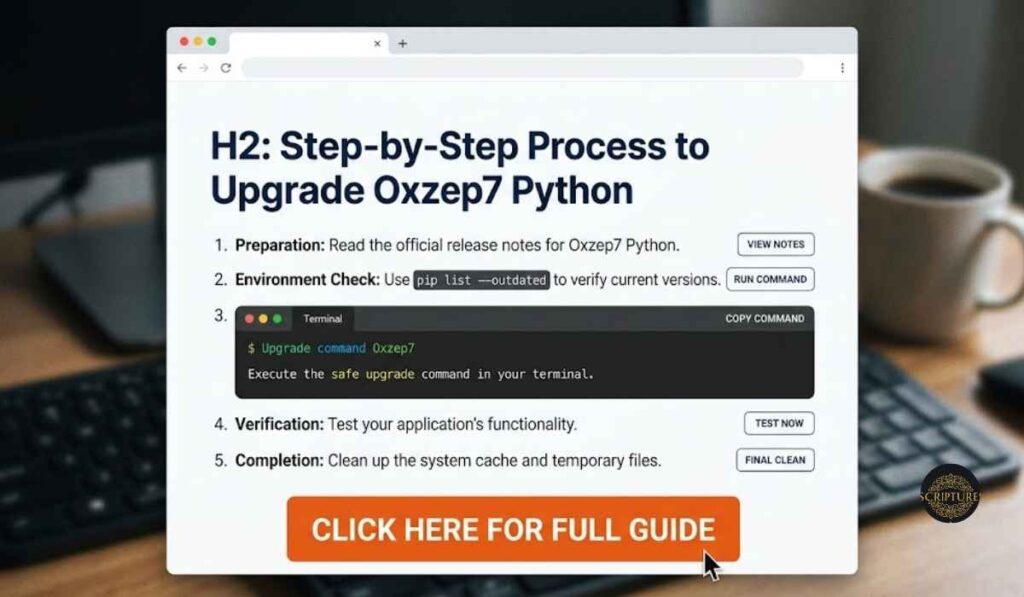
Once planning is complete, follow a structured migration workflow.
Install the Target Python Version
The first technical step is installing the desired Python release.
Common python installation methods include:
- Native installation
- Docker images
- pyenv python management
- conda environment management
Many organizations prefer parallel python installation to avoid disrupting existing applications.
Recommended Installation Comparison
| Method | Advantage |
|---|---|
| Native Install | Simple setup |
| Pyenv | Flexible version control |
| Conda | Environment isolation |
| Containers | Consistent deployments |
A controlled installation approach minimizes migration risk.
Create a Fresh Virtual Environment
Avoid reusing older environments.
Instead, create a clean virtual environment for testing and deployment.
Benefits include:
- Better environment isolation
- Reduced package conflicts
- Cleaner dependency tracking
- Improved troubleshooting
A modern python virtual environment setup is considered a core python best practices recommendation.
Key advantages:
- Predictable deployments
- Better package control
- Easier maintenance
- Stronger security
Reinstall Dependencies
After creating the environment, reinstall required packages.
Most projects rely on a requirements.txt file.
The typical process includes:
- Review dependencies
- Validate versions
- Execute pip install requirements
- Test package compatibility
This stage focuses heavily on python dependency management.
Perform:
- dependency tree analysis
- dependency resolution
- package version management
- Security validation
Proper dependency handling reduces future maintenance problems.
Update Oxzep7-Specific Components
Many Oxzep7 deployments contain custom modules or framework extensions.
Review:
- Internal libraries
- Framework integrations
- Runtime settings
- Configuration files
- Deployment scripts
Areas requiring attention often include:
- python framework upgrade
- code compatibility review
- legacy code modernization
- Runtime configurations
This stage frequently requires python code refactoring to support modern python syntax.
Run Automated Tests
Testing validates that the upgrade works as expected.
A complete testing strategy should include:
- python unit testing
- integration testing python
- compatibility testing
- regression testing
- Manual validation
Benefits of automated python testing:
- Faster feedback
- Better quality assurance
- Reduced production risk
- Improved deployment confidence
Testing should be integrated into CI/CD pipelines and broader continuous integration workflows.
Comprehensive validation ensures the application remains stable after migration.
Common Challenges During an Oxzep7 Python Upgrade
Even with careful planning, teams often face obstacles during an oxzep7 python upgrade. Understanding these challenges beforehand helps create a smoother migration path.
Dependency Conflicts
One of the most common upgrade issues involves dependency conflicts in python.
Older projects frequently depend on package versions that no longer work with newer Python releases. These incompatibilities can create installation failures and unexpected runtime behavior.
Common causes include:
- Outdated libraries
- Unsupported packages
- Broken transitive dependencies
- Missing package updates
Package Conflict Resolution Checklist
| Issue | Solution |
|---|---|
| Version mismatch | Upgrade package versions |
| Unsupported library | Use maintained alternatives |
| Dependency loop | Perform dependency tree analysis |
| Missing package | Update installation sources |
To minimize risk:
- Conduct dependency auditing
- Review package release history
- Test upgrades incrementally
- Verify library compatibility
Proper package conflict resolution reduces deployment delays and improves stability.
Deprecated Syntax
A major challenge in every python version transition is handling deprecated python syntax.
Older codebases may contain:
- Removed functions
- Legacy imports
- Outdated exception handling
- Unsupported language constructs
Warning signs include:
- deprecation warnings
- Build failures
- Runtime exceptions
Recommended actions:
- Perform legacy code refactoring
- Adopt modern python syntax
- Update coding standards
- Conduct a complete code compatibility review
Modernization improves maintainability while supporting future upgrades.
Environment Variable Changes
Configuration issues can easily break applications after migration.
Review all environment variables python configurations before deployment.
Areas requiring validation:
- Database credentials
- API keys
- Runtime settings
- Service endpoints
- Security policies
A complete system configuration review should include:
- Configuration files
- Secrets management
- Infrastructure settings
- Deployment variables
Strong configuration management practices help prevent production incidents.
Performance Regressions
Although upgrades often improve speed, occasional performance regressions can occur.
Potential causes:
- Inefficient package updates
- Framework behavior changes
- New memory allocation patterns
- Configuration differences
To detect issues:
- Run python performance benchmarks
- Perform cpu profiling python
- Conduct memory profiling python
- Compare historical metrics
Benchmarking before and after migration helps identify regressions early.
Rollback and Recovery Planning for Oxzep7 Python Upgrades
Every enterprise upgrade strategy should include a documented recovery plan.
A strong python rollback strategy protects business operations when unexpected issues occur.
Essential Rollback Components
| Component | Purpose |
|---|---|
| Source Code Backup | Restore previous release |
| Database Snapshot | Recover application data |
| Configuration Backup | Revert settings |
| Dependency Archive | Restore working packages |
| Deployment Scripts | Repeat rollback process |
A complete rollback plan should define:
- Recovery triggers
- Decision makers
- Rollback procedures
- Validation steps
- Communication workflow
Organizations that prepare for failure often complete upgrades more successfully.
Effective upgrade risk management is not about avoiding problems. It is about recovering quickly when problems occur.
Best Practices for a Successful Upgrade Oxzep7 Python Strategy
Following proven practices significantly improves migration outcomes.
Automate Where Possible
Automation reduces manual errors and improves consistency.
Focus on:
- deployment automation
- automated deployment
- Test execution
- Package validation
- Environment provisioning
Modern teams integrate upgrades into CI/CD pipelines to accelerate releases.
Benefits include:
- Faster deployments
- Better repeatability
- Reduced human error
- Improved quality control
Automation supports long term software lifecycle management.
Upgrade Incrementally
Avoid large version jumps whenever possible.
Instead, use incremental upgrades.
Advantages include:
- Easier troubleshooting
- Reduced compatibility risks
- Faster validation
- Better change control
A structured upgrade roadmap allows teams to evaluate impacts gradually rather than introducing massive changes at once.
Document the Process
Documentation is frequently overlooked but critically important.
Create detailed upgrade documentation covering:
- Upgrade steps
- Package changes
- Configuration updates
- Test results
- Recovery procedures
Good documentation supports:
- development team documentation
- Knowledge transfer
- Compliance requirements
- Future maintenance
Organizations with strong documentation generally experience fewer upgrade related problems.
Monitor After Deployment
The upgrade is not complete after deployment.
Continuous monitoring helps identify hidden issues before they affect users.
Monitor:
- Response times
- Error rates
- Resource utilization
- Application logs
- Database performance
Key monitoring activities include:
- python deployment monitoring
- production monitoring
- performance monitoring
- log analysis
- Anomaly detection
Post deployment monitoring ensures long term operational success.
Post-Upgrade Optimization Tips
Once the migration is complete, focus on maximizing performance and reliability.
Optimize Application Performance
A successful upgrade creates opportunities for additional tuning.
Areas to evaluate:
- application performance tuning
- python performance optimization
- code optimization
- resource optimization
- i/o optimization
Optimization activities may include:
- Query improvements
- Caching enhancements
- Refactoring inefficient code
- Improved asynchronous processing
These actions help improve python performance while supporting scalability goals.
Leverage Modern Python Features
New Python releases provide features designed to improve productivity and efficiency.
Examples include:
- Enhanced typing support
- Better asynchronous execution
- Improved error handling
- Updated standard libraries
These standard library enhancements often reduce code complexity and improve maintainability.
Strengthen Infrastructure Security
After migration, review security controls.
Focus on:
- Access policies
- Encryption standards
- Dependency security
- Runtime configurations
Benefits include:
- Better infrastructure security improvements
- Stronger secure deployment practices
- Reduced dependency security gaps
- Enhanced compliance readiness
Validate Long-Term Stability
Conduct ongoing upgrade validation activities.
Recommended checks:
- Load testing
- Security testing
- Reliability reviews
- Capacity assessments
Long term validation ensures sustainable software scalability improvements and consistent user experience.
Frequently Asked Questions
What is the safest way to upgrade Oxzep7 Python?
Use a dedicated python staging environment, perform comprehensive testing, maintain backups, and follow a documented software upgrade strategy.
How long does an Oxzep7 Python upgrade take?
The timeline depends on project size, dependencies, and compatibility requirements. Small projects may take hours, while enterprise migrations can take weeks.
Why do dependency conflicts occur during upgrades?
Dependency conflicts in python happen when packages require incompatible versions of libraries or runtime components.
Should I create a new virtual environment during the upgrade?
Yes. A clean virtual environment reduces package contamination and improves deployment reliability.
What testing should be performed after upgrading?
Run python unit testing, integration testing python, regression testing, compatibility testing, and manual validation before production deployment.
How can I reduce upgrade risks?
Perform migration planning, create backups, review release notes, maintain a rollback plan, and execute extensive testing.
Is automation important for Python upgrades?
Yes. Automation improves consistency, reduces manual errors, and supports efficient continuous integration workflows.
What should be monitored after deployment?
Monitor performance metrics, application logs, memory usage, response times, and error rates through ongoing production monitoring.
Conclusion
A successful upgrade oxzep7 python project requires far more than installing a newer interpreter. Organizations must combine planning, testing, security reviews, dependency management, documentation, and monitoring to ensure a smooth transition.
By following a structured python migration checklist, conducting a thorough upgrade readiness assessment, and implementing proven python upgrade best practices, teams can modernize legacy environments without disrupting operations.
The most successful migrations focus on security, reliability, and scalability simultaneously. Through proper python environment management, comprehensive testing, and continuous monitoring, organizations can build future-proof python applications, strengthen enterprise python infrastructure, and support long term growth.
Whether you manage a small application or a complex production platform, a carefully executed secure python upgrade provides measurable benefits in performance, maintainability, security, and operational stability. Investing in modernization today creates a stronger foundation for tomorrow’s software ecosystem.