
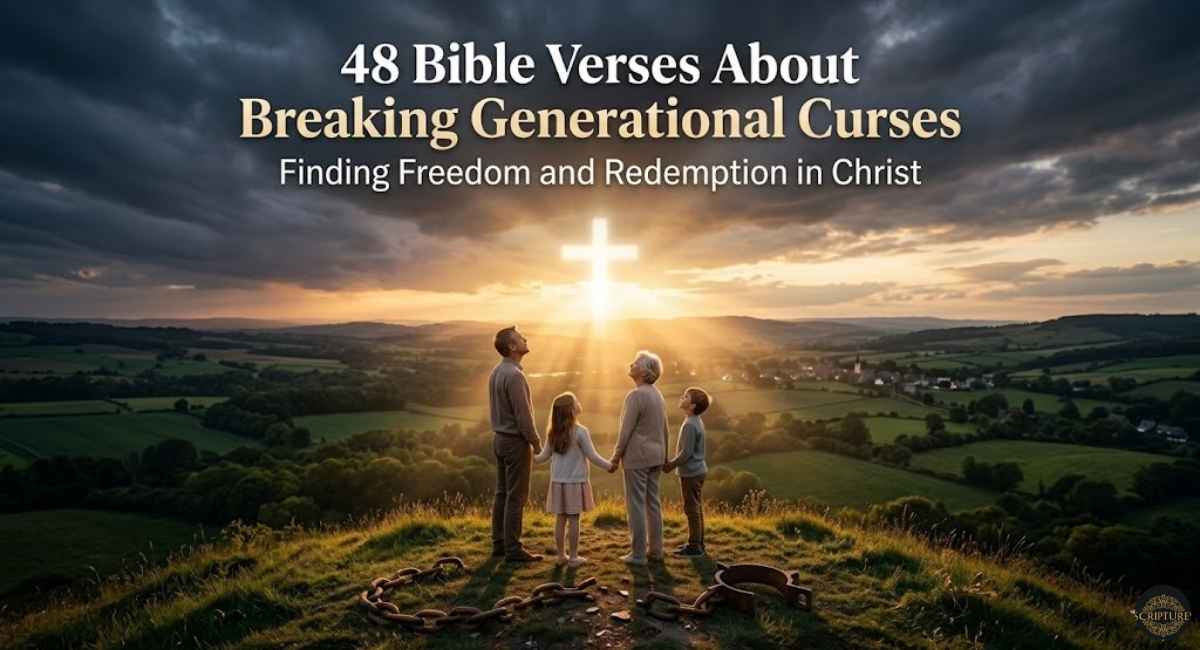
Many people carry invisible weight from their family history. Patterns of addiction, broken relationships, fear, and shame repeat across generations, and it can feel like no amount of effort will ever break the cycle. If you have ever looked at your family and wondered whether you are destined to repeat what came before you, you are not alone, and more importantly, you are not without hope.
Scripture does not teach that you are spiritually doomed by your ancestors. The Bible acknowledges that sin has consequences that ripple across generations, but it draws a sharp line between inherited consequences and personal guilt. In Christ, every chain can be broken, every cycle can end, and every family line can be redirected by grace.
Understanding Generational Curses: Biblical Truth vs. Cultural Myth

When God declared in Exodus 20:5 that He visits “the iniquity of the fathers on the children to the third and fourth generation,” He was not pronouncing a magical curse that bypasses personal choice. He was describing the natural consequence of covenant unfaithfulness, the way sin creates environments, habits, and spiritual poverty that children inherit by proximity and example, not by divine punishment alone.
Ezekiel 18 corrects any misreading directly. God declares with unmistakable clarity that the soul who sins is the one who dies, not the child, not the grandchild. Personal responsibility is central to biblical theology. The prophet Jeremiah echoes this in chapter 31, pointing ahead to the New Covenant where every person stands before God on the basis of their own faith and repentance, not their family tree.
The fullest answer to generational bondage is found in Galatians 3:13, where Paul writes that Christ became a curse for us, redeeming us from every legal and spiritual debt the law could demand. Culture often exaggerates generational curse language, turning it into superstition, fear, and spiritual fatalism. But the Gospel reframes identity entirely. You are not what your family was. You are who Christ says you are, and that declaration overrides every inherited pattern.
Bible Verses About Breaking Generational Curses

Galatians 3:13 “Christ redeemed us from the curse of the law by becoming a curse for us.” This is the theological foundation of every discussion about generational curses. Christ did not simply reduce our spiritual debt. He absorbed it completely. Whatever curse the law could pronounce, He bore it in full, and His resurrection declares that the curse has no lasting power over those who belong to Him.
2 Corinthians 5:17 “If anyone is in Christ, he is a new creation. The old has passed away; behold, the new has come.” The phrase “new creation” is not metaphorical encouragement. It is a covenantal declaration. In Christ, you receive a new identity, a new spiritual lineage, and a new future. The patterns of the past are not erased from memory, but they are stripped of their authority over who you are becoming.
Romans 8:1 “There is therefore now no condemnation for those who are in Christ Jesus.” Condemnation is the voice that says your family’s failures define your destiny. Scripture silences that voice. The believer in Christ does not stand under judgment for ancestral sin. They stand in the righteousness of Christ, fully accepted and spiritually free.
John 8:36 “So if the Son sets you free, you will be free indeed.” Jesus did not say you might be free or partially free. He said free indeed, meaning completely, authentically, and permanently. This verse speaks directly to the finality of the freedom He provides. No spiritual inheritance can override what Christ has accomplished.
Ezekiel 18:20 “The soul who sins shall die. The son shall not suffer for the iniquity of the father.” God makes the principle of personal accountability explicit here. Children are not spiritually condemned for what their parents did. This verse dismantles the fatalistic reading of generational curses and reminds us that divine justice is never arbitrary.
Jeremiah 31:29-30 “In those days they shall no longer say: The fathers have eaten sour grapes, and the children’s teeth are set on edge. But everyone shall die for his own iniquity.” Jeremiah was prophesying a coming era of New Covenant clarity, where personal faith and personal repentance would replace collective family guilt. That era arrived with Jesus Christ, and every believer now lives under its terms.
Exodus 20:5-6 “I the Lord your God am a jealous God, visiting the iniquity of the fathers on the children to the third and fourth generation… but showing steadfast love to thousands of those who love me and keep my commandments.” The passage that is most often used to teach fear actually contains an extraordinary promise of mercy. God’s love extends to thousands of generations. His blessing is exponentially greater than any consequence of sin. Covenant faithfulness is the most powerful inheritance you can pass to your children.
Deuteronomy 7:9 “Know therefore that the Lord your God is God, the faithful God who keeps covenant and steadfast love with those who love him and keep his commandments, to a thousand generations.” God’s covenantal faithfulness is not limited by your family’s past. When you turn to Him, you become the beginning of a new generational story, one defined by His love, not by inherited failure.
Deuteronomy 30:19 “I have set before you life and death, blessing and curse. Therefore choose life, that you and your offspring may live.” This verse places transformation in the realm of personal choice. God does not force blessing on passive people. He invites active decision, deliberate repentance, and intentional obedience. Choosing life is choosing a new legacy.
Romans 6:14 “For sin will have no dominion over you, since you are not under law but under grace.” Dominion implies ownership and control. Paul is saying that sin has lost its legal right to govern your life. Under grace, the patterns that once controlled your family no longer have authority over you. This is spiritual freedom with legal weight.
Colossians 2:13-14 “And you, who were dead in your trespasses… God made alive together with him, having forgiven us all our trespasses, by canceling the record of debt that stood against us.” Every spiritual debt, ancestral or personal, was nailed to the cross. The record is not simply overlooked. It is canceled, erased, and replaced with the righteousness of Christ. Nothing from the past holds legal standing against the believer.
1 Peter 1:18-19 “You were ransomed from the futile ways inherited from your forefathers… with the precious blood of Christ.” Peter explicitly connects redemption to inherited patterns. The blood of Christ is the price paid not just for personal sin but for the futile ways passed down through family lines. This verse is a direct answer to generational bondage.
Ephesians 1:7 “In him we have redemption through his blood, the forgiveness of our trespasses, according to the riches of his grace.” Redemption in the New Testament means the purchase of freedom from bondage. Grace here is described as rich, meaning it is not a minimal payment but an abundant provision far exceeding every spiritual debt.
Isaiah 43:18-19 “Remember not the former things, nor consider the things of old. Behold, I am doing a new thing.” God is not indifferent to your past. He is intentionally moving you beyond it. The invitation here is not to pretend the past did not happen but to stop letting it set the ceiling for what God can do. New beginnings are not just possible. They are promised.
Isaiah 54:17 “No weapon formed against you shall succeed, and you shall refute every tongue that rises against you in judgment.” The word formed implies intentional crafting. Whatever has been aimed at your family line, whether spiritual, relational, or circumstantial, God’s protective word stands against it. You are covered, not cursed.
Proverbs 26:2 “Like a fluttering sparrow or a darting swallow, an undeserved curse does not come to rest.” This verse carries enormous pastoral comfort. A curse pronounced without divine backing has no place to land. If you are in Christ, you are standing on ground that rejects what does not come from God.
Numbers 23:23 “There is no enchantment against Jacob, no divination against Israel.” God’s covenant people are spiritually protected. What was true of Israel in the wilderness is true of every believer in Christ. No spiritual force can override the covering of God on a life that belongs to Him.
Romans 8:37 “In all these things we are more than conquerors through him who loved us.” More than conquerors means not merely surviving but overcoming with surplus. The love of Christ is the source of every victory, including victory over patterns and strongholds inherited from your family.
Romans 12:2 “Do not be conformed to this world, but be transformed by the renewing of your mind.” Transformation begins in the mind. Generational patterns are often sustained by inherited mindsets, beliefs, and emotional habits. The renewing of the mind through Scripture is the practical mechanism by which spiritual freedom becomes daily reality.
Hebrews 8:12 “For I will be merciful toward their iniquities, and I will remember their sins no more.” God does not simply forgive and then keep a quiet record. He removes the memory entirely. This is the radical mercy of the New Covenant, where the past is not held over the believer, not by God and not by any spiritual authority.
Psalm 103:12 “As far as the east is from the west, so far does he remove our transgressions from us.” East and west never meet. This is a poetic declaration of infinite separation between the believer and their sin. What God removes, He removes completely. No family sin can bridge that distance.
Micah 7:18-19 “Who is a God like you, pardoning iniquity… He will again have compassion on us; he will tread our iniquities underfoot. You will cast all our sins into the depths of the sea.” God does not place sins on a shelf for later retrieval. He casts them into the depths, beyond recovery, beyond accusation. This is the character of a God who genuinely delights in mercy.
Joel 2:25 “I will restore to you the years that the swarming locust has eaten.” Generations of loss do not disqualify you from complete restoration. God specializes in returning what sin and time have taken. Restoration is not just individual. It can span an entire family legacy.
Isaiah 61:7 “Instead of your shame there shall be a double portion; instead of dishonor they shall rejoice in their lot.” Shame is one of the most persistent inheritances in broken families. God replaces shame with double honor, not as a minimal recovery but as an overflowing reversal. This is the economy of grace.
Lamentations 5:7 “Our fathers sinned, and are no more; and we bear their iniquities.” This is a lament, not a theological verdict. Lamentations voices real human suffering under the weight of inherited consequences. But the lament itself is addressed to God, which means even this pain is something He receives and redeems.
Luke 10:19 “Behold, I have given you authority to tread on serpents and scorpions, and over all the power of the enemy.” Authority in Christ is not earned by spiritual performance. It is given by Christ Himself. The believer does not beg for power over darkness. They exercise the authority they have already been granted.
Revelation 12:11 “And they have conquered him by the blood of the Lamb and by the word of their testimony.” Spiritual victory is secured through two things: the objective work of Christ’s blood and the subjective declaration of personal testimony. Speaking truth about what Christ has done is an act of spiritual authority, not just encouragement.
James 4:7 “Submit yourselves therefore to God. Resist the devil, and he will flee from you.” Submission and resistance work together. Attempting to resist spiritual darkness without submission to God produces exhaustion. But the believer who is fully yielded to Christ resists from a position of established authority, and the enemy must flee.
Psalm 112:2 “His offspring will be mighty in the land; the generation of the upright will be blessed.” Righteous living is generationally contagious. When one person in a family line chooses faithfulness, it creates a new spiritual trajectory for those who come after. Your obedience today is a gift to children you may not yet know.
Deuteronomy 28:2 “And all these blessings shall come upon you and overtake you, if you obey the voice of the Lord your God.” Covenant blessing is not passive. It overtakes the obedient. This language suggests that blessing is active and pursuing, waiting to pour into a life that is aligned with God’s commands.
Psalm 34:19 “Many are the afflictions of the righteous, but the Lord delivers him out of them all.” Deliverance is not a one-time event but a consistent pattern in the life of the righteous. Trouble may come from every direction, including inherited family wounds, but God’s commitment to deliver His people never wavers.
Psalm 91:10 “No evil shall be allowed to befall you, no plague come near your tent.” This is the promise of divine covering over the household of the one who dwells in God. The family becomes a protected space when it is built under the shelter of His presence.
Joshua 24:15 “But as for me and my house, we will serve the Lord.” Joshua’s declaration is one of the most powerful acts of generational leadership in Scripture. He was not passively hoping his family would follow God. He was making a deliberate, public, covenantal commitment on behalf of his household. That is how legacies change.
1 John 1:9 “If we confess our sins, he is faithful and just to forgive us our sins and to cleanse us from all unrighteousness.” Confession is the doorway to cleansing. It is not about performing shame but about bringing sin into the light where Christ’s blood can cover it. The promise is unconditional: confession met with faithful forgiveness every time.
Psalm 107:20 “He sent out his word and healed them, and delivered them from their destruction.” The Word of God is an active healing agent. When Scripture is received, believed, and spoken, it accomplishes what it declares. Healing from generational wounds comes through the sustained presence of His Word in a life.
Matthew 11:28 “Come to me, all who labor and are heavy laden, and I will give you rest.” Carrying the weight of a difficult family history is exhausting. Jesus does not offer techniques. He offers Himself. Rest here is not passivity but the deep peace that comes from laying down what was never yours to carry.
Isaiah 10:27 “And the yoke will be broken because of the anointing.” The anointing of the Holy Spirit does what personal effort cannot. Yokes that have held families in bondage for generations are not removed by willpower alone. They break under the weight of God’s presence.
Zechariah 4:6 “Not by might, nor by power, but by my Spirit, says the Lord of hosts.” Freedom from generational patterns is ultimately a work of the Spirit, not a product of human determination. This verse saves believers from striving and invites them into dependence on God’s power.
Psalm 127:3 “Behold, children are a heritage from the Lord, the fruit of the womb a reward.” Children are not accidents or burdens. They are divine gifts entrusted to parents for stewardship. Understanding this changes how families are built and how faith is passed on from one generation to the next.
Nahum 1:9 “Affliction will not rise up a second time.” This is a declaration of finality. What God defeats, He defeats completely. The affliction that marked previous generations does not have the right to reassemble once God has addressed it in the life of the surrendered believer.
Romans 8:15 “For you did not receive the spirit of slavery to fall back into fear, but you have received the Spirit of adoption as sons, by whom we cry, Abba, Father.” Fear is the language of slavery. Adoption is the language of belonging. When the Spirit of adoption settles into a heart, it redefines the believer’s relationship with God, with themselves, and with their past. You are not a slave to what came before. You are a son or daughter of the living God.
2 Timothy 1:7 “For God gave us a spirit not of fear but of power and love and self-control.” The spirit of fear is not from God. Whatever anxiety, dread, or spiritual timidity has been inherited through a family line, it does not originate in heaven. God’s provision is power, love, and a sound mind, and these are available to every believer in full measure.
Ephesians 6:10-11 “Finally, be strong in the Lord and in the strength of his might. Put on the whole armor of God, that you may be able to stand against the schemes of the devil.” Spiritual strength comes from position, not personal ability. Standing firm against generational darkness requires wearing what God has provided, truth, righteousness, faith, salvation, and the Word. The armor is complete. Nothing is missing.
Philippians 4:7 “And the peace of God, which surpasses all understanding, will guard your hearts and your minds in Christ Jesus.” Peace is a guardian, not just a feeling. It stands watch over the mind and heart, protecting the space where renewed thinking must grow. For those breaking free from generational anxiety and fear, this peace is both a gift and a fortress.
Hebrews 12:1 “Therefore, since we are surrounded by so great a cloud of witnesses, let us also lay aside every weight, and sin which clings so closely, and let us run with endurance the race that is set before us.” Weights are not always sins. Some are inherited patterns, emotional wounds, and family beliefs that slow spiritual progress. This verse calls believers to actively lay them down, not carry them indefinitely into the future.
Titus 2:14 “Who gave himself for us to redeem us from all lawlessness and to purify for himself a people for his own possession who are zealous for good works.” Christ’s redemption is purifying and purposeful. He did not save us simply to remove spiritual debt but to form a people whose lives actively reflect His character. Generational transformation is part of what zealous good works look like in practice.
Psalm 37:25-26 “I have been young, and now am old, yet I have not seen the righteous forsaken or his children begging for bread. He is ever lending generously, and his children become a blessing.” The righteous life leaves a legacy of generosity and blessing. What begins in one faithful generation multiplies into the next. This is the positive generational principle that mirrors the negative one, except it flows from God’s faithfulness, not human failure.
Our Thoughts On What the Bible Says About Breaking Generational Curses
The Bible is unmistakably clear. Believers are not spiritually doomed by their family history. Christ absorbed the full curse of the law on the cross, and His resurrection declared that no inherited pattern holds permanent authority over a life surrendered to Him. The chains are not merely weakened. They are broken at the source.
This freedom does not arrive passively. It unfolds through:
- Personal repentance, confessing known sins and releasing the weight of ancestral patterns
- Forgiveness, both receiving it from God and extending it to family members who have caused harm
- Renouncing lies, identifying and rejecting false beliefs inherited through family culture or broken relationships
- Renewing the mind through consistent, prayerful engagement with Scripture
- Building new spiritual habits, worship, community, accountability, and discipleship
- Raising children in faith, making Joshua 24:15 a daily, deliberate commitment
Transformation is not a single event. It is the ongoing work of sanctification, the Holy Spirit shaping a life, a marriage, a home, and eventually a generation into the image of Christ. The cycle ends when one person chooses to walk in a different direction, and God multiplies that choice into something that outlasts a single lifetime.
Say This Prayer
Heavenly Father,
I come before You not with a perfect record but with a humble and open heart. I believe that Jesus Christ died for every sin, every failure, and every broken pattern in my life and in my family. I receive that truth today, not as a familiar phrase but as a living reality that I am choosing to stand on.
Lord, I confess the sins I know and the ones I cannot fully see. I acknowledge that patterns of fear, shame, anger, and unbelief have shaped my family, and I take responsibility for my own part in those patterns. I do not blame those who came before me, but I do ask You to bring healing to every wound that has been passed down.
I renounce every lie I have believed about who I am because of where I come from. I renounce every agreement I have made with defeat, with worthlessness, with the idea that things will never change. I am a new creation in Christ Jesus, and I choose to believe what You say about me over everything my history has whispered.
Holy Spirit, renew my mind. Replace fear with faith. Replace shame with Your mercy. Replace inherited pain with the truth of Your Word. Teach me to think differently, to respond differently, and to live in a way that reflects the freedom You have purchased for me.
Father, I pray for the generations that will come after me. May the faith I choose today, the obedience I walk in, the Scripture I plant in my heart, become a spiritual inheritance of blessing for my children and their children. Let the cycle of brokenness end here, and let a new cycle of grace begin.
I surrender every weight, every word, and every worry to You. Lead me, correct me, and keep me close. In the name of Jesus Christ, who became a curse so I could walk in freedom, Amen.
Last Words
The message of Scripture is not that your family history is irrelevant. It is that your family history is not final. The same God who declared freedom to captives in Isaiah 61, who raised dead bones in Ezekiel 37, and who called Paul from a life of religious violence into apostolic grace, is more than capable of redeeming the most complicated family story. His mercy is not surprised by what you carry.
Breaking free from generational patterns is not about performing a ritual or declaring the right words in the right order. It is about returning to Christ, again and again, with honesty and faith. It is about choosing obedience on the days it feels expensive, building spiritual disciplines that outlast your feelings, and trusting that the God who began a good work in you is faithful to complete it.
The verses in this article on Bible verses about breaking generational curses are not just promises for individuals. They are seeds for families, communities, and generations. Plant them in prayer. Water them with obedience. And trust the God who declared that His love endures to a thousand generations of those who love Him.
Frequently Asked Questions
Are generational curses real in Christianity?
Generational curses in the biblical sense refer to the consequences of sin that ripple through family lines, not a magical or automatic spiritual doom. Scripture acknowledges in Exodus 20 that the effects of sin touch children and grandchildren, primarily through environment, example, and inherited patterns. However, the Bible consistently teaches that personal repentance and faith in Christ break those cycles. Ezekiel 18 and Jeremiah 31 both emphasize personal responsibility over inherited guilt. Believers are not doomed by family history. They are covered by the grace of Christ.
What does the Bible actually say about generational curses?
The Bible teaches that sin has generational consequences but that personal guilt belongs only to the individual. Exodus 20:5 describes consequences, not condemnation. Ezekiel 18:20 states plainly that a child does not bear the iniquity of a parent. Jeremiah 31 points to the New Covenant where each person stands before God on the basis of their own faith. Galatians 3:13 declares that Christ redeemed believers from the curse of the law. The overall biblical picture is one of hope, redemption, and the power of covenant faithfulness to redirect a family’s spiritual legacy.
Can Christians be affected by generational curses?
Christians can be affected by patterns inherited from their families, including addiction, emotional wounds, relational dysfunction, and destructive mindsets. These are real and should not be minimized. However, no Christian is spiritually condemned by ancestral sin. Romans 8:1 declares there is no condemnation for those in Christ Jesus. What believers may experience is the ongoing process of sanctification, where the Holy Spirit works to transform inherited habits and renew the mind. The answer is not fear but faithful discipleship, repentance, and renewal through Scripture.
How do I break generational curses Biblically?
Breaking generational cycles begins with personal repentance and faith in Christ. Practically, this involves confessing known sin, forgiving those in your family who have caused harm, renouncing false beliefs you have inherited, and renewing your mind through consistent engagement with Scripture. Romans 12:2 identifies mind renewal as the mechanism of transformation. Building new spiritual habits, pursuing accountability, raising children in the faith, and making deliberate covenantal commitments like Joshua’s declaration in Joshua 24:15 are all practical steps that redirect a family’s spiritual direction.
Does Galatians 3:13 mean every curse is broken for believers?
Galatians 3:13 declares that Christ redeemed us from the curse of the law by becoming a curse for us. This is an objective, covenantal truth. Every legal and spiritual claim the law could make against a believer has been satisfied in Christ. However, this does not mean that the consequences of sin automatically vanish the moment someone believes. Sanctification is a process. The position of freedom is established at salvation, but the experience of that freedom often unfolds through ongoing repentance, renewal of the mind, and Spirit-led transformation. The curse is legally broken. Walking in that freedom is a daily choice.
Is Exodus 20 teaching that children inherit their parents’ guilt?
No. Exodus 20:5 is not teaching inherited guilt. It is describing the natural consequences of sin in a covenant community, how idolatry and unfaithfulness create environments that damage children and grandchildren. God is not saying He punishes innocent children for their parents’ choices. Ezekiel 18 clarifies this directly. What Exodus 20 does teach is that sin is costly beyond the individual, and that covenant faithfulness, conversely, releases God’s blessing across a thousand generations. The passage is as much about the extraordinary reach of God’s love as it is about the consequences of sin.