


Baseball is more than a game. It is a mirror of the human soul, an arena where character is built, tested, and revealed. Every pitch, every at-bat, every strikeout carries a deeper story, one that Scripture has been telling for thousands of years. The patience required to wait on a good pitch, the humility required after a bad inning, the trust required to play your role on a team, these are not just athletic virtues. They are biblical ones.
The Christian life and the life of a baseball player share a profound common thread. Both demand endurance through long, grinding seasons. Both require submission to a coach, a community, and a purpose larger than yourself. God uses the crucible of competition to shape sanctification in us, to burn away pride, to deepen dependence, and to form the kind of character that glorifies Him both on the diamond and beyond it.
Bible Verses About Baseball
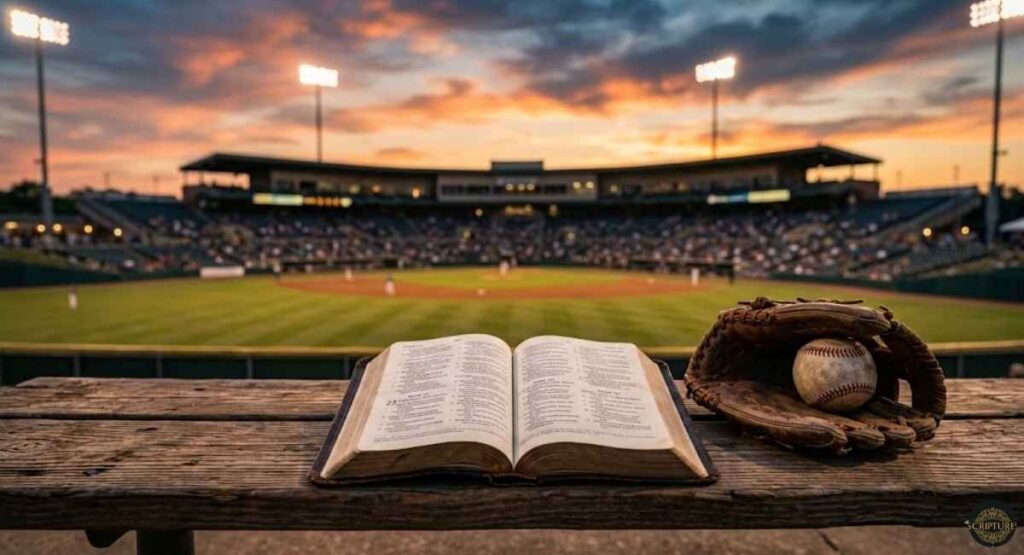
Scripture does not mention baseball by name, and that is perfectly fine. The Bible was never meant to be a sports manual. But it speaks with stunning clarity about every spiritual reality that baseball surfaces, including perseverance, unity, discipline, failure, courage, and ultimate victory. The verses in this article are not stretched to fit the game. They speak directly to the heart of every athlete, coach, parent, and fan who has ever loved this sport and loved their God at the same time.
Endurance and Running the Race
Baseball is a long game. A full season means 162 games, and that does not even count spring training or the postseason. Very few sports demand the kind of sustained endurance that baseball does, and that makes it one of the richest illustrations of what Paul wrote about the Christian life as a race.
Hebrews 12:1 “Therefore, since we are surrounded by so great a cloud of witnesses, let us also lay aside every weight, and sin which clings so closely, and let us run with endurance the race that is set before us.”
The writer of Hebrews places this verse immediately after his famous “Hall of Faith” in chapter 11. The cloud of witnesses is not a passive audience, they are proof that endurance is possible. Their lives testify to it. The call to “lay aside every weight” speaks of deliberate preparation, removing what slows you down. For a baseball player, that might mean pride, fear, distraction, or poor habits. For a Christian, it is anything that diminishes devotion to Christ. Both require ruthless honesty about what is holding you back.
2 Timothy 4:7 “I have fought the good fight, I have finished the race, I have kept the faith.”
Paul wrote these words from prison, near the end of his life, knowing execution was near. This was not triumphalism. It was testimony. He did not say he had won every battle or been free from suffering. He said he had finished. In baseball, greatness is often measured not by the perfect game but by who shows up every single day of a long season. Finishing well, with faith intact, is the highest honor a Christian athlete can aspire to.
Romans 5:3-4 “We also glory in our sufferings, because we know that suffering produces perseverance; perseverance, character; and character, hope.”
Paul traces a divine progression here. Suffering is not the enemy of growth, it is the engine of it. Every baseball player knows suffering. A prolonged slump, a torn ligament, a season-ending injury. These moments are not interruptions to growth. According to Scripture, they are the very means of it. Character is not formed in the easy innings. It is forged in the difficult ones.
James 1:12 “Blessed is the man who remains steadfast under trial, for when he has stood the test he will receive the crown of life.”
James was writing to scattered, suffering Jewish Christians. Steadfastness here is not passive survival. It is active, intentional perseverance under pressure. The crown of life is not a trophy on a shelf. It is the eternal reward of a life lived faithfully. A Christian athlete can hold a legitimate trophy with joy, but fix their ultimate hope on something that does not rust or fade.
Galatians 6:9 “Let us not grow weary of doing good, for in due season we will reap, if we do not give up.”
Paul’s agricultural metaphor speaks directly to patience and timing. A farmer does not dig up seeds to check on them every day. He trusts the process. In baseball, young players especially must trust the process of development. In the Christian life, we must trust that faithful obedience always produces fruit in God’s timing, even when we cannot yet see it.
Isaiah 40:31 “But they who wait for the Lord shall renew their strength; they shall mount up with wings like eagles; they shall run and not be weary; they shall walk and not faint.”
This verse comes at the close of one of the most theologically rich chapters in all of Isaiah, where God declares His incomparable greatness over nations, idols, and human frailty. To wait on the Lord is not passive resignation. It is active trust in God’s character and timing. An athlete who plays with this kind of trust is freed from the crushing weight of performance anxiety, because their identity is secured in God, not in their batting average.
Philippians 4:13 “I can do all things through him who strengthens me.”
This is perhaps the most misquoted verse in Christian sports culture. Paul wrote it in the context of contentment, specifically about learning to be at peace in both abundance and scarcity. He was not promising athletic success. He was declaring that Christ is sufficient for every circumstance. For an athlete, that means Christ is sufficient in the winning seasons and the losing ones, in the starting lineup and on the bench.
1 Corinthians 9:24 “Do you not know that in a race all the runners run, but only one receives the prize? So run that you may obtain it.”
Paul was writing to the church in Corinth, a city that hosted the Isthmian Games, one of the prestigious athletic competitions of the ancient world. His audience knew exactly what he meant. Not everyone who enters a race finishes. Paul’s challenge is to run to win, to bring the same focused intensity to spiritual growth that elite athletes bring to their training. Half-hearted discipleship was never the standard.
Hebrews 12:11 “For the moment all discipline seems painful rather than pleasant, but later it yields the peaceful fruit of righteousness to those who have been trained by it.”
The Greek word used here for “trained” is gymnazo, the same root as gymnasium. The writer is drawing directly on athletic imagery to describe spiritual growth. Discipline hurts in the moment. The early morning practices, the corrective coaching, the long sessions of film study, these are not enjoyable. But they yield fruit. The Christian who embraces God’s discipline will find the same truth: the pain of formation precedes the peace of maturity.
Romans 8:18 “For I consider that the sufferings of this present time are not worth comparing with the glory that is to be revealed to us.”
Paul wrote this while navigating persecution, beatings, and imprisonment. His perspective is staggering. Present suffering, no matter how real, is outweighed by eternal glory. For a baseball player enduring a brutal season, this verse offers not cheap comfort but eternal perspective. Your current struggle is real, but it is not the final chapter.
Teamwork, Unity and Cooperation
No player wins a championship alone. Baseball is a team sport at its core, and the Bible has far more to say about community and cooperation than most people realize.
1 Corinthians 12:12 “For just as the body is one and has many members, and all the members of the body, though many, are one body, so it is with Christ.”
This is the theological foundation for all Christian teamwork. Paul spent much of 1 Corinthians 12 building a careful argument, that the body of Christ is not a collection of identical parts, but a diverse community of gifts, roles, and functions working together under one Head. The pitcher cannot say to the catcher, “I don’t need you.” The shortstop cannot dismiss the utility player. Every role is essential by design, and that design reflects the wisdom of God. What is true of the church is equally true of any team that wants to function with excellence.
Ecclesiastes 4:9-10 “Two are better than one, because they have a good reward for their toil. For if they fall, one will lift up his fellow.”
Solomon’s practical wisdom is timeless. Partnership multiplies output and provides safety. On a baseball team, this is the culture of great dugouts, players who pick each other up after errors, who celebrate each other’s wins, who carry each other’s burdens. That is not a coaching technique. It is a biblical principle embedded in the created order.
Romans 12:10 “Love one another with brotherly affection. Outdo one another in showing honor.”
Paul’s instruction here is countercultural in any competitive environment. In sports, the natural impulse is to compete for personal recognition. Paul flips the script entirely. The mark of Christian community is not competing for honor but generously giving it to others. A team built on this principle becomes nearly unbeatable, not because of talent alone, but because of trust.
Philippians 2:3-4 “Do nothing from selfish ambition or conceit, but in humility count others more significant than yourselves. Let each of you look not only to his own interests, but also to the interests of others.”
Paul wrote Philippians from prison, and yet it is the most joy-filled letter in the New Testament. His instructions on humility were not theoretical. They were urgent. For a baseball team, selfish ambition is poison. The player who cares more about his own stats than the team’s success will fracture the clubhouse. Paul’s instruction is the antidote, seeing others as genuinely significant, not just strategically.
Colossians 3:14 “And above all these put on love, which binds everything together in perfect harmony.”
Love is not a sentimental feeling in Paul’s theology. It is a binding agent, the virtue that holds all other virtues in place. A team can have talent, strategy, and discipline, but without love for one another, the whole structure eventually cracks. Christian athletes are called to build something stronger than chemistry. They are called to build community.
Discipline, Training and Self-Control
Paul’s athletic metaphors were not accidental. He wrote in a Greco-Roman world saturated with sports culture. The Olympics, the Isthmian Games, the Pythian Games, these were massive cultural events that shaped how people thought about excellence, endurance, and victory. When Paul used athletic language, his audience felt it in their bones.
1 Corinthians 9:27 “But I discipline my body and keep it under control, lest after preaching to others I should myself be disqualified.”
Paul uses the Greek word hypopiazo, which literally means to “strike under the eye”, a boxing term. He was not speaking gently. He was describing the brutal, intentional work of subduing bodily desires for the sake of spiritual mission. For a baseball player, physical and mental discipline is the engine of excellence. For a Christian, self-control is listed as a fruit of the Spirit for a reason, it is evidence of the Spirit’s work, and a weapon against spiritual compromise.
Proverbs 12:1 “Whoever loves discipline loves knowledge, but he who hates reproof is stupid.”
Solomon does not soften this. The ability to receive correction is the mark of wisdom. The athlete who cannot accept coaching will never reach their potential. The Christian who cannot receive rebuke will stagnate spiritually. Humility before a coach or a mentor is not weakness. It is the beginning of real growth.
2 Timothy 2:5 “An athlete is not crowned unless he competes according to the rules.”
This verse carries a sobering warning. In the ancient games, competing illegally meant disqualification regardless of finishing position. For a Christian athlete, the rules are not just the rulebook of the game. They include integrity, honesty, and Christlike conduct. Winning at any cost is not victory. It is disqualification disguised as success.
Proverbs 13:4 “The soul of the sluggard craves and gets nothing, while the soul of the diligent is richly supplied.”
Desire without discipline produces nothing. Every athlete who wishes they were better but refuses to train knows this truth painfully. Solomon’s wisdom is direct. The diligent get results. For the Christian, faithful spiritual disciplines, prayer, Scripture, community, worship, are not legalistic burdens. They are the pathways through which God richly nourishes the soul.
Hebrews 12:1 “Let us also lay aside every weight, and sin which clings so closely, and let us run with endurance the race that is set before us.”
The discipline of elimination is just as important as the discipline of addition. Great athletes know what to cut from their life. Early nights instead of late ones. Careful eating instead of careless habits. The Christian life demands the same. Identifying and removing what slows spiritual growth is an act of worship, not mere self-improvement.
Strength, Courage and Confidence
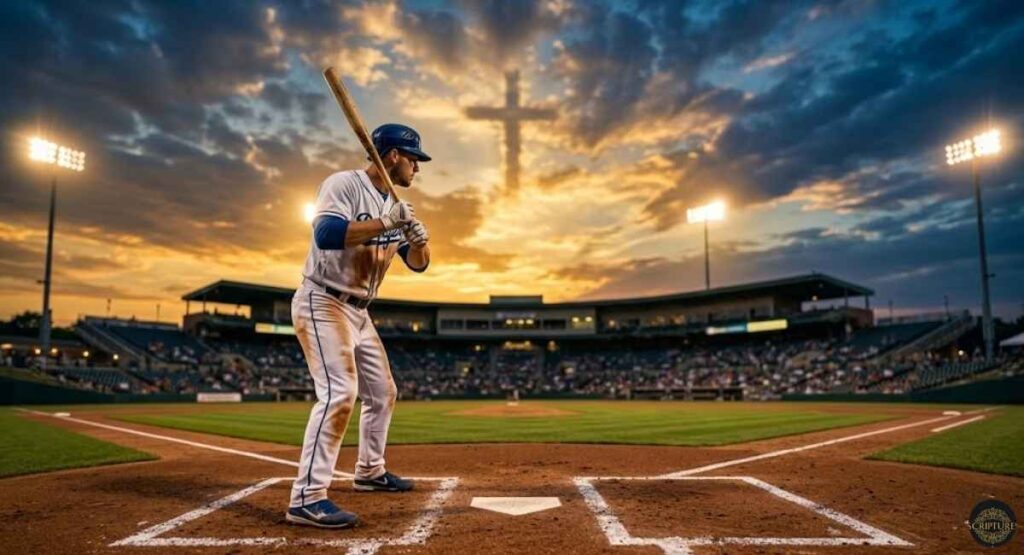
Stepping to the plate when everything is on the line requires a different kind of courage. Scripture speaks directly to that moment.
Joshua 1:9 “Have I not commanded you? Be strong and courageous. Do not be frightened, and do not be dismayed, for the Lord your God is with you wherever you go.”
God spoke these words to Joshua as he stood at the threshold of leading Israel into Canaan, a task of overwhelming magnitude. The command to be strong and courageous appears four times in Joshua 1 alone, which tells us it was not assumed to come naturally. True courage is not the absence of fear. It is the decision to move forward because God is present. For a Christian athlete facing high-pressure moments, this is not a motivational poster. It is a theological reality.
Isaiah 41:10 “Fear not, for I am with you; be not dismayed, for I am your God; I will strengthen you, I will help you, I will uphold you with my righteous right hand.”
Three separate promises in one verse. God does not simply encourage Israel from a distance. He declares personal presence, personal strength, and personal upholding. The Christian athlete does not take the field alone. The same God who upheld Israel through exile is present in every moment of competition and pressure.
Psalm 27:1 “The Lord is my light and my salvation; whom shall I fear? The Lord is the stronghold of my life; of whom shall I be afraid?”
David wrote this Psalm in the context of genuine danger, enemies, adversaries, and armies. His confidence was not rooted in his own ability. It was rooted in the character of God. For the athlete, the opponent is real. The pressure is real. But the stronghold of God is more real than either, and that reorients everything.
Deuteronomy 31:6 “Be strong and courageous. Do not fear or be in dread of them, for it is the Lord your God who goes with you. He will not leave you or forsake you.”
Moses spoke these words to an entire nation standing at the edge of the unknown. The promise of God’s presence is the only ground on which lasting courage is built. Self-confidence is fragile. God-grounded confidence endures because it is not dependent on performance.
Ephesians 6:10 “Finally, be strong in the Lord and in the strength of his might.”
Paul is very specific here. The strength is in the Lord, not in personal resolve or positive thinking. This matters enormously for Christian athletes who are tempted to conflate confidence with self-reliance. True spiritual strength is a gift received through surrender, not something manufactured through willpower alone.
Focus, Strategy and Mental Discipline
The mental side of baseball is legendary. Hitting a 95-mph fastball requires a decision made in less than half a second. Pitching with precision requires complete mental presence. Scripture speaks powerfully to the disciplined mind.
Romans 12:2 “Do not be conformed to this world, but be transformed by the renewal of your mind, that by testing you may discern what is the will of God.”
The word “transformed” here is the Greek metamorphoo, the same word used for the Transfiguration of Jesus. Paul is describing a deep, ongoing, Spirit-driven renewal of how we think. For an athlete, mental transformation is not just about sports psychology. It is about aligning every thought with God’s perspective. When the mind is renewed, decision-making sharpens, both on the field and in life.
Proverbs 16:3 “Commit your work to the Lord, and your plans will be established.”
The Hebrew word for “commit” here literally means to roll your burden onto God. This is not a vague spiritual sentiment. It is a daily, practical act of surrendering your preparation and your performance to God’s purposes. A baseball player who commits his game plan to the Lord is free to execute without the paralysis of outcome-dependence.
2 Corinthians 10:5 “We destroy arguments and every lofty opinion raised against the knowledge of God, and take every thought captive to obey Christ.”
Paul is writing in the context of spiritual warfare, but the principle applies to the mental battles every athlete faces. Negative self-talk, fear after failure, the voice that says you are not good enough, these are thoughts that must be actively captured and submitted to Christ’s truth. Mental discipline in sports and spiritual discipline in faith are more connected than most people realize.
Colossians 3:2 “Set your minds on things that are above, not on things that are on earth.”
This is not an instruction to ignore earthly responsibilities. It is an instruction to anchor your attention at the level of eternal values. An athlete who plays with this mindset competes freely, because their ultimate hope is not riding on the outcome of a game.
Psalm 119:105 “Your word is a lamp to my feet and a light to my path.”
The Psalmist describes Scripture as immediate and directional guidance. A lamp to the feet illuminates the next step, not the whole road. For a Christian athlete, consistent engagement with God’s Word sharpens discernment, focus, and clarity of purpose in ways that no amount of sports psychology can replicate.
Victory, Reward and Finishing Well
Championship culture is intoxicating. But the Bible has a richer, more eternal understanding of victory than any trophy can represent.
Matthew 25:21 “His master said to him, ‘Well done, good and faithful servant. You have been faithful over a little; I will set you over much. Enter into the joy of your master.'”
This is the greatest victory speech in all of Scripture. Notice that the master does not say “well done, successful servant” or “well done, talented servant.” He says faithful. Faithfulness, not talent, not results, is the currency of eternity. A Christian athlete who finishes their career faithfully, win or lose, will one day hear these words. That is the ultimate championship.
Revelation 2:10 “Be faithful unto death, and I will give you the crown of life.”
Jesus spoke these words to a suffering church facing real persecution. The crown of life is not a reward for achievement. It is a reward for faithfulness under pressure. Every athlete who has competed with integrity under pressure, who has honored God in defeat as well as victory, is storing up something that no championship ring can provide.
1 Corinthians 9:25 “Every athlete exercises self-control in all things. They do it to receive a perishable wreath, but we an imperishable.”
Paul here draws a direct contrast between the rewards of athletic competition and the rewards of faithful Christian living. The winners of the Isthmian Games received a wreath of celery or pine, beautiful in the moment, gone within days. Paul says the Christian trains for something eternal. This does not diminish athletic effort. It sanctifies it by placing it within a greater narrative.
2 Timothy 4:8 “Henceforth there is laid up for me the crown of righteousness, which the Lord, the righteous judge, will award to me on that day, and not only to me but also to all who have loved his appearing.”
Paul’s confidence here is not arrogance. It is gospel assurance. The crown of righteousness is received by grace through faith, by those who have loved Christ’s appearing and lived accordingly. A Christian athlete can compete with deep, settled confidence, not because they are the best player on the field, but because they know who holds the final verdict.
Psalm 37:4 “Delight yourself in the Lord, and he will give you the desires of your heart.”
This verse is often misapplied to mean God will give you whatever you want. The context is richer. When you genuinely delight in God, He reshapes your desires to align with His own. A Christian athlete who delights in God will find that their deepest desire is not simply to win games but to honor God, serve others, and finish faithfully.
Handling Failure, Strikes and Setbacks
In baseball, failure is built into the game. The greatest hitters in history fail seven out of ten times. No other major sport normalizes failure the way baseball does, and that makes it a profound teacher for the Christian life.
Micah 7:8 “Rejoice not over me, O my enemy; when I fall, I shall rise; when I sit in darkness, the Lord will be a light to me.”
This is one of the most defiant and faith-filled verses in all of Scripture. Micah is not in denial about his fall. He acknowledges it plainly. But he refuses to let the fall have the final word. For a Christian athlete who has failed publicly, been benched, been traded, or simply had a terrible season, this verse is a declaration. The enemy does not get to write your story. God does.
Proverbs 24:16 “For the righteous falls seven times and rises again, but the wicked stumble in calamity.”
Solomon is not saying the righteous are failure-prone. He is saying that what distinguishes the righteous is not the absence of falling but the consistency of rising. Character is revealed not in the falling but in what happens next. A Christian athlete who gets back up, who shows grace after failure, who refuses to be defined by a bad game or a bad season, is displaying genuine righteousness.
Romans 8:28 “And we know that for those who love God all things work together for good, for those who are called according to his purpose.”
Paul does not say all things are good. He says they work together for good. This is the theology of providence. God is actively weaving even the most painful chapters of our story into something purposeful. An athlete who loses their starting position, suffers a significant injury, or watches their dream unravel can hold onto this promise, not as spiritual optimism, but as a theological anchor.
Lamentations 3:22-23 “The steadfast love of the Lord never ceases; his mercies never come to an end; they are new every morning; great is your faithfulness.”
Jeremiah wrote these words in the rubble of Jerusalem’s destruction, surrounded by evidence that everything had fallen apart. And yet he chose to anchor himself in God’s steadfast love. Every morning is a fresh start. Every game is a new opportunity. The mercy of God does not run out after a bad season. It is waiting, fresh and ready, with the sunrise.
John 16:33 “In the world you will have tribulation. But take heart; I have overcome the world.”
Jesus said this to His disciples on the night before His crucifixion, the most honest warning and the most powerful comfort in one sentence. He did not promise an easy path. He promised His overcoming presence within every difficulty. The Christian athlete who faces setback can face it knowing that the One who overcame death is on their side.
Our Thoughts On What the Bible Says About Baseball and Faith
The deeper you look, the more clearly you see that baseball and the Christian life speak the same language. Both are long, both are hard, both are full of failure, and both are shaped by something greater than individual performance. The Christian faith does not promise athletes a winning season. It promises something far more valuable: the formation of character that endures beyond any season.
What Scripture invites every Christian athlete into is not a transaction. It is a transformation. God uses the grinding realities of athletic competition to sand down pride, to build patience, to teach submission to authority, trust in teammates, and dependence on Him. These lessons are not learned in comfort. They are forged on the diamond, in the gym, and in the quiet moments of surrender after a difficult loss.
For coaches, the Bible’s model of servant leadership is the highest standard. Coaches who lead with integrity, who build character over championships, who speak truth with grace, are not just developing better players. They are shaping human beings made in the image of God. That is a sacred responsibility.
For parents watching their children play, the invitation is to model what winning and losing with grace actually looks like. Your child is watching how you respond to the umpire’s call, how you handle a rough game, how you speak about opponents. Your faith is never more visible than in the stands on a Saturday morning.
For fans, the temptation is to make sport an idol, a source of identity and meaning that only God can provide. Enjoying sport is a gift. Worshipping it is a distraction from the only One worthy of worship. The fan who cheers with joy and grieves with perspective is a fan whose identity is properly ordered under God.
Ultimately, the Bible’s message to everyone involved in baseball is this. Play with all your heart, compete with integrity, serve your teammates, honor your opponents, handle both victory and defeat with humility, and keep your eyes fixed on the One who is writing a story far greater than any box score can capture.
Say This Prayer
- Heavenly Father, thank You for the gift of sport, for the joy of competition, and for the bodies, minds, and abilities You have given us to play. We acknowledge that every strength we have comes from You, and every opportunity to compete is a gift from Your hand.
- Lord, form in us the character of Christ as we compete. Teach us to run with endurance and not give up when the season is long and the losses are many. Teach us to embrace discipline, to welcome coaching, to receive correction with humility rather than pride. When we step to the plate in the great moments, let our confidence be in You and not in our own strength.
- Build in us a love for our teammates that goes beyond strategy. Teach us to honor one another, to carry each other’s burdens, to celebrate each other’s successes even when our own performance disappoints. Let the unity we build on the field be a reflection of the unity of Your Spirit in the body of Christ.
- When we fail, Lord, and we will fail, remind us that Your mercies are new every morning. Remind us that our identity is not in our batting average or our ERA but in being called Your children. Give us the courage to rise again after every setback, not with manufactured confidence but with faith in Your faithfulness.
- Use this game, this team, and this season to shape us into men and women who reflect Your character. May those who watch us play see not just skilled athletes but followers of Jesus, whose joy runs deeper than any trophy and whose peace holds steady through any loss.
- In every game, in every at-bat, in every inning, may we hear You whisper, “Well done, good and faithful servant.” That is the only victory that will last forever.
- In the name of Jesus Christ, our Lord and ultimate champion. Amen.
Last Words
Whether you are a player, a coach, a parent, or a fan, the game of baseball is pointing you toward something eternal. The endurance it demands, the humility it teaches, the teamwork it requires, and the grace it offers after failure, these are not accidental. They are echoes of a divine design woven into the fabric of how God grows His people.
You were made for more than a good season. You were made to be conformed to the image of Christ, and God is willing to use every pitch, every practice, every painful loss, and every stunning victory to accomplish that work in you. So play hard. Compete with integrity. Love your teammates well. Glorify God in how you win and how you lose. And keep running the race, because the finish line is worth every step.
The God who called you to faith is the same God who is with you on the field. And one day, when the final out is made and the last season is over, what will matter most is whether you finished faithfully, loved others well, and kept your eyes fixed on Jesus. That is the game worth playing with everything you have.
Frequently Asked Questions
Does the Bible talk about baseball?
The Bible does not mention baseball by name, but it speaks directly to every spiritual reality that baseball involves, including endurance, teamwork, discipline, failure, and the pursuit of excellence for God’s glory.
What Bible verses encourage athletes?
Some of the most powerful verses for athletes include Joshua 1:9, Philippians 4:13, Isaiah 40:31, and Hebrews 12:1, all of which speak to courage, endurance, and reliance on God’s strength rather than one’s own.
How can Christians glorify God in sports?
Christians glorify God in sports by competing with integrity, humility, and love for teammates and opponents, treating both victory and defeat as opportunities to reflect the character of Christ.
What does running the race mean in the Bible?
Paul uses the metaphor of running a race to describe the entire Christian life, calling believers to pursue spiritual growth with focused endurance, discipline, and perseverance until they finish faithfully before God.
How should a Christian handle losing in sports?
A Christian handles losing by anchoring their identity in Christ rather than in results, trusting that God works all things together for good, and rising again with the grace and mercy that is new every morning (Romans 8:28, Lamentations 3:22-23).
Are sports and faith compatible for Christians?
Absolutely. Scripture affirms that the body is God’s temple (1 Corinthians 6:19-20) and that everything we do, including competing in sport, should be done for God’s glory (1 Corinthians 10:31). Sport becomes an act of worship when played with the right heart.
What does the Bible say about a Christian athlete’s character?
Scripture calls Christian athletes to humility, self-control, integrity, and love, forming the kind of character that honors God on and off the field, because the goal of the Christian life is sanctification, not just success.