


Family is one of God’s most sacred designs. From the very beginning, He did not create man to walk alone. He built the first home, established the first covenant, and placed people in relationship with one another because He knew that love, when shared under one roof, becomes one of the most powerful forces on earth. Yet in today’s world, families face pressures that previous generations could hardly imagine. Busyness, broken trust, digital distractions, and deep emotional wounds can quietly pull a household apart. That is why the Bible verses about family unity we explore in this article are not just ancient words. They are living truth for your home right now.
God’s vision for the family has always been covenant, not convenience. Scripture shows us a family built on faith, rooted in forgiveness, and sustained by love that chooses to stay. Whether you are a newlywed couple building your foundation, a parent raising children in a culture that pushes back, a blended family learning to trust, or someone believing for a prodigal to come home, God’s Word speaks directly to your situation. These Scriptures will not only encourage you. They will equip you.
Bible Verses About Family Unity

Psalm 133:1 – “How good and pleasant it is when God’s people live together in unity!”
Ephesians 4:2-3 – “Be completely humble and gentle; be patient, bearing with one another in love. Make every effort to keep the unity of the Spirit through the bond of peace.”
Colossians 3:13-14 – “Bear with each other and forgive one another if any of you has a grievance against someone. Forgive as the Lord forgave you. And over all these virtues put on love, which binds them all together in perfect unity.”
Unity in the home does not happen by accident. Psalm 133 uses the word “good” and “pleasant” together, meaning family harmony is both morally right and emotionally refreshing. The Hebrew word for unity here is “yachad,” pointing to a deep togetherness of purpose. Paul builds on this in Ephesians by revealing that unity is something we must actively maintain, not passively receive. Forgiveness, as Colossians teaches, is the thread that holds the fabric of family together. Without it, even love begins to fray.
Joshua 24:15 – “But as for me and my household, we will serve the Lord.”
Deuteronomy 6:6-7 – “These commandments that I give you today are to be on your hearts. Impress them on your children. Talk about them when you sit at home and when you walk along the road, when you lie down and when you get up.”
Proverbs 22:6 – “Start children off on the way they should go, and even when they are old they will not turn from it.”
Joshua’s declaration is one of the most courageous statements of faith in all of Scripture. It was made publicly, before an entire nation. A family united under God’s authority and purpose becomes spiritually anchored against every storm. Deuteronomy 6 reveals that discipleship in the home is not a Sunday activity. It is a daily, woven-into-life practice. Proverbs 22:6 carries enormous hope for parents who fear their children are drifting. Godly training leaves a mark that does not disappear.
1 Corinthians 1:10 – “I appeal to you, brothers and sisters, in the name of our Lord Jesus Christ, that all of you agree with one another in what you say and that there be no divisions among you, but that you be perfectly united in mind and thought.”
Romans 12:16 – “Live in harmony with one another. Do not be proud, but be willing to associate with people of low position. Do not be conceited.”
Romans 12:18 – “If it is possible, as far as it depends on you, live at peace with everyone.”
Paul’s words in Romans 12 are deeply practical for everyday family life. Harmony is not the absence of disagreement. It is the commitment to pursue peace even when emotions run high. Pride is named as the primary threat to unity. In a Christian home, humility is not weakness. It is the spiritual strength that keeps relationships intact.
Genesis 2:24 – “That is why a man leaves his father and mother and is united to his wife, and they become one flesh.”
Hebrews 13:4 – “Marriage should be honored by all, and the marriage bed kept pure, for God will judge the adulterer and all the sexually immoral.”
1 Peter 3:7 – “Husbands, in the same way be considerate as you live with your wives, and treat them with respect as the weaker partner and as heirs with you of the gracious gift of life, so that nothing will hinder your prayers.”
Biblical marriage is the cornerstone of family unity. Genesis 2:24 establishes that marriage is a leaving, cleaving, and becoming process. The word “united” in Hebrew is “dabaq,” meaning to cling, to hold fast. Hebrews 13 reminds us that this covenant is sacred and protected by God. Peter’s instruction to husbands is striking because he links how a husband treats his wife directly to the health of his prayer life. A home where the marriage is honored is a home where God’s presence flows freely.
Proverbs 17:17 – “A friend loves at all times, and a brother is born for a time of adversity.”
Galatians 6:2 – “Carry each other’s burdens, and in this way you will fulfill the law of Christ.”
Ecclesiastes 4:9-10 – “Two are better than one, because they have a good return for their labor: if either of them falls down, one can help the other up. But pity anyone who falls and has no one to help them up.”
These three verses paint a beautiful picture of what family is meant to be. Not a group of individuals sharing a space, but a covenant community that shows up for one another in hard seasons. Galatians 6 connects burden-bearing to the law of Christ, meaning when we carry each other’s weight, we are expressing the very heart of Jesus. Ecclesiastes reminds us that two are stronger than one, and family is God’s primary way of ensuring we do not face life alone.
Psalm 127:1 – “Unless the Lord builds the house, the builders labor in vain.”
Proverbs 14:26 – “Whoever fears the Lord has a secure fortress, and for their children it will be a refuge.”
Isaiah 54:13 – “All your children will be taught by the Lord, and great will be their peace.”
A faith-centered home must be built on more than good intentions. Psalm 127 is a warning and a comfort at the same time. Without God at the center, every effort to maintain a strong Christian family will eventually run dry. Proverbs 14:26 reveals that a parent who walks in reverence before God creates a spiritual inheritance of security for their children. Isaiah 54:13 carries one of the most encouraging promises a parent can hold onto, especially when praying over a struggling child.
1 Corinthians 13:4-7 – “Love is patient, love is kind. It does not envy, it does not boast, it is not proud. It does not dishonor others, it is not self-seeking, it is not easily angered, it keeps no record of wrongs. Love does not delight in evil but rejoices with the truth. It always protects, always trusts, always hopes, always perseveres.”
Romans 12:10 – “Be devoted to one another in love. Honor one another above yourselves.”
1 John 4:7 – “Dear friends, let us love one another, for love comes from God. Everyone who loves has been born of God and knows God.”
The love described in 1 Corinthians 13 is not a feeling. It is a daily choice. Every quality Paul lists is an action, not an emotion. This passage is often read at weddings, but it was written for the whole Body of Christ, which includes your family. Romans 12:10 adds that honor must be deliberately extended. In a healthy Christian home, each member looks for ways to lift the other higher, not push themselves forward.
Proverbs 31:28 – “Her children arise and call her blessed; her husband also, and he praises her.”
Titus 2:4-5 – “Then they can urge the younger women to love their husbands and children, to be self-controlled and pure, to be busy at home, to be kind, and to be subject to their husbands, so that no one will malign the word of God.”
Malachi 4:6 – “He will turn the hearts of the parents to their children, and the hearts of the children to their parents.”
These verses affirm the irreplaceable role of mothers and fathers in the spiritual ecosystem of a family. Proverbs 31 is not a standard of perfection but a portrait of devoted, purposeful love. Malachi 4:6 is especially powerful. It is the very last verse of the Old Testament, and it speaks of restored relationship between generations. If your family has experienced a painful break, this verse carries the promise of God’s redemptive work.
Psalm 112:1-2 – “Blessed is the man who fears the Lord, who finds great delight in his commands. His children will be mighty in the land; the generation of the upright will be blessed.”
Psalm 103:17-18 – “But from everlasting to everlasting the Lord’s love is with those who fear him, and his righteousness with their children’s children.”
Proverbs 13:22 – “A good person leaves an inheritance for their children’s children.”
Generational faith is one of the most profound themes in Scripture. These verses reveal that the spiritual choices you make today have consequences beyond your lifetime. The fear of the Lord is not terror. It is deep reverence that shapes how you live, lead, and love. When you build your home on God’s Word, you are not just affecting your children. You are planting seeds in your grandchildren’s lives before they are even born.
Exodus 20:12 – “Honor your father and your mother, so that you may live long in the land the Lord your God is giving you.”
Ephesians 6:1-3 – “Children, obey your parents in the Lord, for this is right. Honor your father and mother, which is the first commandment with a promise, that it may go well with you and that you may enjoy long life on the earth.”
Colossians 3:20 – “Children, obey your parents in everything, for this pleases the Lord.”
The command to honor parents appears in both the Old and New Testaments, making it one of the most consistently repeated instructions in all of Scripture. The Greek word for honor is “timao,” meaning to value, to prize highly. This is a call not just to outward obedience but to a deep, heart-level respect. For families navigating tension between generations, this principle is the foundation of restored peace.
Deuteronomy 5:16 – “Honor your father and your mother, as the Lord your God has commanded you, so that you may live long and that it may go well with you.”
Deuteronomy 11:18-19 – “Fix these words of mine in your hearts and minds; tie them as symbols on your hands and bind them on your foreheads. Teach them to your children, talking about them when you sit at home and when you walk along the road, when you lie down and when you get up.”
Proverbs 20:7 – “The righteous lead blameless lives; blessed are their children after them.”
Godly parenting is not about raising perfect children. It is about walking faithfully before God so that your children have a living example to follow. Deuteronomy 11 echoes the earlier call of chapter 6, showing that spiritual instruction at home is not a one-time conversation. It is a lifestyle of constant, intentional teaching. The blessing on your children flows from the integrity of your own walk with God.
Psalm 68:6 – “God sets the lonely in families, he leads out the prisoners with singing.”
1 Timothy 5:8 – “Anyone who does not provide for their relatives, and especially for their own household, has denied the faith and is worse than an unbeliever.”
Proverbs 11:29 – “Whoever brings ruin on their family will inherit only wind.”
These verses carry both grace and responsibility. Psalm 68:6 is a beautiful reminder that family is God’s antidote to loneliness. This is especially meaningful for blended families, adoptive families, and those who have been estranged. God places the solitary into family because He designed us for belonging. First Timothy 5:8 reminds us that providing for family is not optional for a believer. It is a direct expression of faith lived out.
Proverbs 15:17 – “Better a small serving of vegetables with love than a fattened calf with hatred.”
Psalm 128:3-4 – “Your wife will be like a fruitful vine within your house; your children will be like olive shoots around your table. Yes, this will be the blessing for the man who fears the Lord.”
John 13:34-35 – “A new command I give you: Love one another. As I have loved you, so you must love one another. By this everyone will know that you are my disciples, if you love one another.”
The atmosphere of a home matters more than its size or comfort. Proverbs 15:17 teaches that love in a simple home is worth far more than wealth without peace. Psalm 128 paints a tender picture of a table surrounded by children, a wife flourishing, and a husband whose reverence for God has made his home a garden. Jesus in John 13 elevates love to the level of testimony. When a family loves the way Christ loves, the world notices.
Proverbs 31:10 – “A wife of noble character who can find? She is worth far more than rubies.”
Genesis 18:19 – “For I have chosen him, so that he will direct his children and his household after him to keep the way of the Lord by doing what is right and just.”
Matthew 19:19 – “Honor your father and mother, and love your neighbor as yourself.”
Psalm 78:4 – “We will not hide them from their descendants; we will tell the next generation the praiseworthy deeds of the Lord, his power, and the wonders he has done.”
Proverbs 4:1 – “Listen, my sons, to a father’s instruction; pay attention and gain understanding.”
Joshua 4:21-22 – “He said to the Israelites, ‘In the future when your descendants ask their parents, what do these stones mean? Tell them, Israel crossed the Jordan on dry ground.'”
God’s instruction to Israel to pass down testimony from generation to generation shows that family unity is built not just through love but through shared spiritual memory. When parents tell children what God has done, faith becomes a family legacy rather than a personal preference. Genesis 18:19 reveals that Abraham was chosen specifically because God knew he would pass faith to his household. This is the call of every believing parent.
Our Thoughts On What the Bible Says About Family Unity
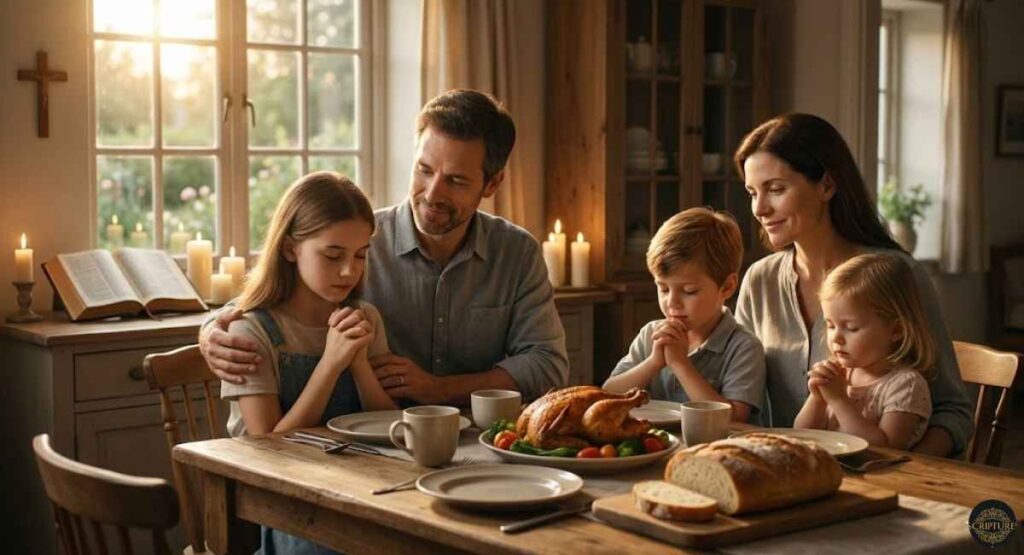
The Bible’s vision for family is not simply that people live peacefully together. It is that families become living expressions of God’s covenant love. From Genesis to Revelation, Scripture weaves a consistent theme: God builds families, protects them, redeems them, and uses them to reflect His kingdom on earth.
Family as Covenant, Not Contract
The world treats relationships as contracts. When the terms are broken, the relationship ends. But Scripture calls the Christian family to covenant, which means commitment that stays even when it is costly. This is why forgiveness is so central to family unity. Colossians 3:13 does not say forgive when you feel like it. It says forgive as the Lord forgave you. That is a grace-based, unconditional release that only the power of the Holy Spirit can sustain.
The Role of Forgiveness in Unity
Many families are fractured not by dramatic events but by small, unresolved offenses that accumulate over years. Bitterness disguises itself as boundaries, and pride disguises itself as self-respect. Scripture consistently calls us to break these cycles. Forgiveness does not erase consequences or demand trust is immediately restored. But it does release the spiritual weight that keeps a family stuck. Where forgiveness flows, healing can begin.
Discipleship Starts at Home
Deuteronomy 6 and 11 both make clear that the home is the primary place of spiritual formation. The church supports and strengthens what parents are building, but it cannot replace it. When fathers lead in prayer, when mothers speak Scripture over their children, when families worship and discuss faith together, something spiritually powerful is established. Children who are discipled at home carry that foundation into every season of life, even the rebellious ones.
Marriage as the Foundation
A family’s unity is deeply connected to the health of the marriage. When a husband and wife are spiritually aligned, emotionally connected, and mutually honoring, the atmosphere of the home shifts. Children feel it. Peace increases. Conflict still comes, but it does not destroy. Scripture gives both spouses clear, loving instructions not as burdens but as blueprints for a marriage that actually works.
Generational Faith and Spiritual Legacy
One of the most motivating truths in all of Scripture is that your faithfulness today has generational reach. Psalm 103 and Proverbs 13 both speak of God’s goodness extending to children’s children. The choices you make as a family now will shape the spiritual landscape of future generations. This is not pressure. It is privilege.
Unity Without Uniformity
Biblical family unity does not mean everyone thinks the same, has the same personality, or never disagrees. It means the family is bound together by love, faith, and a shared commitment to God. Space is made for different gifts, temperaments, and perspectives. What holds the family together is not sameness but the peace of Christ ruling in every heart, as Colossians 3:15 invites.
Say This Prayer
Heavenly Father, we come before You as a family, and we acknowledge that You are the builder of this home. Without You, everything we build is fragile. With You, even broken things become beautiful. Lord, we thank You for the gift of one another, for the love You placed between us before we even fully understood it.
We pray first over every marriage represented in this prayer. Where there has been distance, draw hearts close again. Where trust has been broken, begin the slow and holy work of rebuilding. Let husbands love with the self-giving love of Christ, and let wives be honored and seen. Remove pride from our homes, and replace it with the humility that protects everything precious.
Father, we pray over every child, the ones who are flourishing and the ones who have wandered. Your Word says You will turn the hearts of the parents to the children and the children to the parents. We stand on that promise today. For every prodigal son or daughter, let the memory of home and the pull of Your Spirit draw them back. Let no enemy keep what belongs to You.
We pray for blended families, for step-parents who are trying, for children who are adjusting, for hearts that are learning new rhythms of love. Cover those homes with extra grace. Where there is confusion, bring clarity. Where there is rejection, bring belonging.
Lord, protect this home from division, from accusation, from the enemy who seeks to steal, kill, and destroy. Let Your peace guard us. Let Your Word anchor us. Let the fruit of the Spirit grow in our conversations, at our tables, in the hard moments and the ordinary ones.
We declare today that as for us and our household, we will serve the Lord. We choose unity. We choose forgiveness. We choose love that bears all things, believes all things, hopes all things, and endures all things. Christ is the center of this home, and nothing formed against it shall prosper.
In the name of Jesus, Amen.
Last Words
Family unity is not a destination you arrive at once and never tend to again. It is a daily garden that requires watering. It needs patience when misunderstandings arise. It needs forgiveness when someone falls short. It needs prayer when the pressure of life crowds out the peace of God. And it needs a consistent, intentional return to Scripture as the standard for how you love one another.
The Bible verses about family unity we have explored in this article are not just inspiration. They are instruction. They carry the authority of God over your marriage, your parenting, your relationships, and your legacy. When you build on them, you are not just creating a better household. You are raising a standard that future generations will be blessed to inherit.
Take one verse at a time. Pray it over your family. Speak it in your home. Let it shape how you respond in moments of conflict and how you celebrate in moments of joy. God is for your family. He is not a distant observer. He is the Builder, the Restorer, and the Sustainer of every home that invites Him in. Trust His design, apply His Word, and watch what He does.
Frequently Asked Questions
What does the Bible say about family unity?
The Bible teaches that family unity is built on love, humility, forgiveness, and a shared faith in God. Psalm 133:1 celebrates the goodness of people living together in unity, while Colossians 3:13-14 identifies forgiveness and love as the core forces that bind a family together. Scripture frames family not as a social structure but as a covenant relationship designed to reflect God’s character.
How can Christian families stay united?
Christian families stay united by keeping Christ at the center of their home. This means praying together, studying Scripture regularly, practicing forgiveness quickly, and honoring one another with humility. Ephesians 4:2-3 urges believers to make every effort to maintain the unity of the Spirit, which means unity requires intentional, daily effort rather than passive hope.
What Bible verse talks about unity in the family?
One of the most powerful verses is Psalm 133:1, “How good and pleasant it is when God’s people live together in unity.” Colossians 3:14 also declares that love “binds everything together in perfect harmony.” Both verses affirm that unity is both a spiritual gift and a practical goal that families must pursue together in faith.
How do you restore unity in a broken family?
Restoring unity in a broken family begins with prayer, humility, and a willingness to forgive. Malachi 4:6 promises that God will turn the hearts of parents and children back to one another, showing that restoration is within God’s redemptive will. Practically, it requires honest conversation, the removal of pride, and often the support of a wise pastor or Christian counselor who can help facilitate healing.
Why is family unity important in Christianity?
Family unity is important because the family is God’s design for community, growth, and witness. A unified Christian home reflects the love of Christ to a watching world, as John 13:35 teaches. It also creates a spiritually safe environment where faith is passed to the next generation. When families are divided, the enemy gains access. When families are united in Christ, they become a fortress that cannot easily be shaken.
Can the Bible help blended families find unity?
Absolutely. Psalm 68:6 declares that “God sets the lonely in families,” which is a direct promise for blended and non-traditional households. The principles of love, patience, honor, and forgiveness found throughout Scripture apply to every family structure. God does not rank families by their origin. He meets every household with the same redemptive grace and offers the same blueprint for unity.
What role does forgiveness play in family unity?
Forgiveness is the single most important practice for maintaining long-term family unity. Colossians 3:13 instructs believers to forgive one another just as Christ forgave them. Without forgiveness, small offenses become permanent walls. With it, even serious wounds can heal. Forgiveness does not minimize what happened. It releases the hold that bitterness has over a family and creates the space where genuine reconciliation can grow.