

When you search for Evelyn in the Bible, you might feel surprised by what you find, or rather, what you don’t find. This beautiful name carries deep spiritual weight for many Christian families, yet its relationship to Scripture isn’t what most expect. Let’s walk through the truth with grace and discover the rich biblical themes woven into this cherished name.
The question “Is there an Evelyn in the Bible verse?” leads many parents and believers on a spiritual journey of discovery. While some search hoping to find direct biblical references, others simply want to understand how this beloved name connects to their faith. The truth about Evelyn in the Bible verse is both surprising and encouraging, revealing deeper spiritual truths than a simple name listing ever could.
As we explore this topic together, you’ll discover that the absence of Evelyn from Scripture doesn’t diminish its profound Christian significance, but rather opens doors to understanding timeless biblical principles about identity, purpose, and God’s heart for His children.
The Hard Truth: Evelyn Doesn’t Appear in the Bible
Let me be direct with you: Evelyn is not a biblical name. You won’t find it in Genesis, the Gospels, or anywhere between. No woman named Evelyn walked with Jesus, prayed in the temple, or received a prophetic word from God’s messengers.
This matters because names in Scripture carried prophetic significance. When God renamed Abram to Abraham, it marked his calling as father of many nations. When Jesus called Simon “Peter,” He spoke identity over the rock upon which He would build His church.
Biblical names emerged from Hebrew, Aramaic, and Greek cultures spanning roughly 1500 BC to 100 AD. Evelyn arrived over a thousand years later through Norman French influences in medieval England. The timeline simply doesn’t align.
But here’s what I want you to understand: the absence of Evelyn from Scripture doesn’t diminish its spiritual value. God works through all kinds of names when parents dedicate their children to Him with faith and intentionality. What matters most is the heart behind the naming and the biblical truths the name can represent.
Etymology: Where Evelyn Actually Comes From
Evelyn’s journey begins in medieval Europe, not the ancient Near East. The name derives from the Old French “Aveline,” which traces back to Germanic roots meaning “desired” or “wished for child.” Some scholars connect it to the Germanic element “avi,” while others link it to the word for hazelnut, a small yet valuable seed containing the potential for growth.
Here’s where the story deepens for believers: another etymological thread connects Evelyn directly to Eve. This isn’t coincidence. Both names share phonetic similarities and thematic resonance centered on the concept of life.
Eve comes from the Hebrew “Chavah,” meaning “living” or “life giver.” Genesis 3:20 tells us Adam named his wife Eve because she would become the mother of all living. That life giving essence flows forward through Evelyn and its variants like Eveline.
Originally a surname, Evelyn transitioned to a first name and even crossed gender lines, initially used for boys before becoming predominantly feminine. Today it ranks among the top names chosen by Christian families, particularly those seeking names that whisper both tradition and grace.
The Name’s Core Meanings:
- Old French origin: desired, wished for child
- Germanic roots: hazelnut (symbol of fruitfulness)
- Eve connection: life, living one
- Spiritual essence: new beginnings, vitality
The Eve Connection: Life Giving Parallels
The link between Evelyn and Eve runs deeper than mere phonetics. It touches the very heart of creation and redemption.
Eve stands as Scripture’s first woman, formed by God’s own hands as a necessary partner for Adam. Genesis 2:18 declares, “It is not good for the man to be alone. I will make a helper suitable for him.” The Hebrew phrase “ezer kenegdo” carries profound weight, suggesting strength and rescue, not subservience.
When Adam first saw Eve, he burst into poetry:
“This is now bone of my bones and flesh of my flesh“ (Genesis 2:23). This wasn’t simple attraction. It was recognition of belonging, completion, and shared identity.
Yes, Genesis 3 records Eve’s role in humanity’s fall. But focusing solely on this misses her redemptive significance. God promised that her offspring would crush the serpent’s head (Genesis 3:15), the first messianic prophecy pointing to Christ. Through Eve’s lineage came the Savior who would restore what was lost in Eden.
Adam named her Eve specifically because she became the mother of all living. Every human being traces their heritage to her. She embodies life itself, fruitfulness, and humanity’s ongoing story.
Evelyn echoes these profound truths:
- Life giving presence in communities and families
- Symbol of new beginnings despite past failures
- Resilience that survives even after Eden’s loss
- Hope grounded in God’s redemptive promises
When parents choose Evelyn, they’re connecting their child to this ancient story of life, hope, and divine purpose woven throughout creation.
Biblical Women Who Echo Evelyn’s Meaning
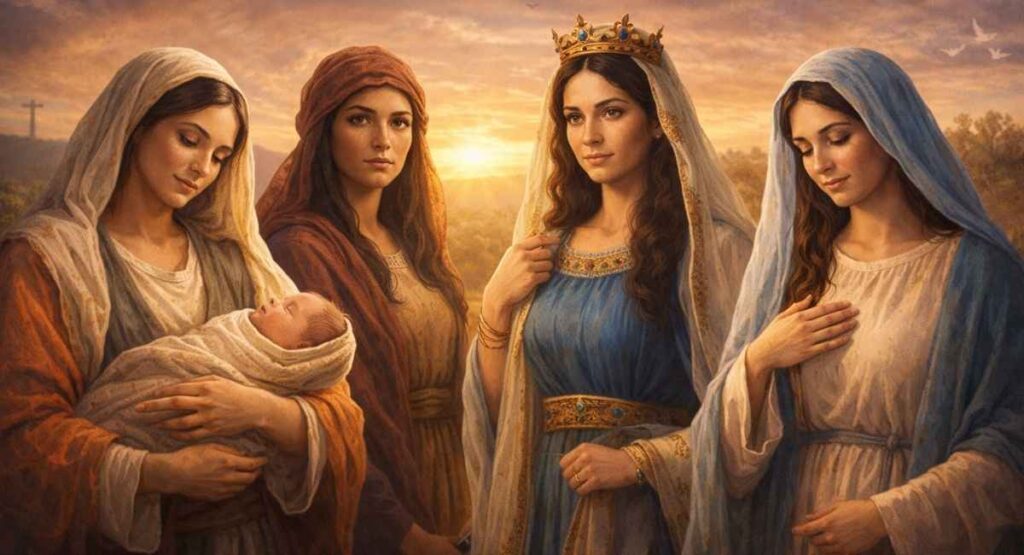
While Evelyn doesn’t appear in Scripture, several women of faith beautifully embody the qualities and themes this name represents.
Hannah: The Desired Child
First Samuel opens with Hannah’s heartbreak. She desperately wanted a child but faced years of barrenness while her rival wife Peninnah mocked her pain. Yet Hannah persisted in prayer with remarkable faith.
Her anguished prayer in 1 Samuel 1:10-11 moves me every time:
“In her deep anguish Hannah prayed to the Lord, weeping bitterly. And she made a vow, saying, ‘Lord Almighty, if you will only look on your servant’s misery and remember me, and not forget your servant but give her a son, then I will give him to the Lord for all the days of his life.'”
God answered. Hannah conceived Samuel, whose name means “heard by God.” She fulfilled her vow, dedicating him to temple service as a young child, and her prayer in 1 Samuel 2 reveals deep understanding that all children are gifts temporarily entrusted to parents.
Ruth: Loyalty and New Beginnings
The Book of Ruth tells one of Scripture’s most beautiful stories of devotion and redemption. Ruth was a Moabite woman, an outsider to Israel. When her Jewish husband died, she could have returned to her birth family. Instead, she made a choice that echoes through millennia.
“Where you go I will go, and where you stay I will stay. Your people will be my people and your God my God” (Ruth 1:16).
This wasn’t mere loyalty to family. Ruth chose faith over comfort, leaving everything familiar to follow Naomi back to Bethlehem.
She worked hard gleaning leftover grain, backbreaking labor reserved for the desperately poor. Yet God rewarded her commitment. Through divine providence, Ruth married Boaz and their union produced Obed, grandfather to King David and ancestor to Jesus Christ.
Ruth embodies Evelyn’s themes perfectly: new beginnings born from loss, courage to step into the unknown, growth through challenges, fruitfulness despite barren circumstances, and identity transformed through covenant relationship with God.
Esther: Hidden Strength Revealed
The Book of Esther never mentions God’s name directly, yet His fingerprints cover every page of this account about a Jewish girl who became Persia’s queen and saved her people from genocide.
Esther’s Hebrew name was Hadassah, meaning “myrtle.” She took the Persian name Esther when her uncle Mordecai raised her in exile. Already we see themes of dual identity bridging cultures, much like Evelyn bridges ancient meanings with modern usage.
When Haman plotted to destroy all Jews in the Persian Empire, Esther faced an impossible choice. Revealing her Jewish identity could cost her life. Saying nothing would doom her people. Mordecai challenged her with words that still inspire:
“Who knows but that you have come to your royal position for such a time as this?” (Esther 4:14).
Esther chose courage. She risked death approaching the king uninvited, used wisdom and timing to expose Haman’s plot, and advocated for her people with strategic brilliance. Her story demonstrates courage under pressure, leadership exercised with wisdom, faith operating through action, and identity embraced at personal cost.
Mary: Grace and Devoted Motherhood
Mary, the mother of Jesus, represents the ultimate example of femininity aligned with divine purpose. When the angel Gabriel appeared to this young virgin in Nazareth, he delivered shocking news: she would conceive by the Holy Spirit and bear the Son of God.
Mary’s response reveals extraordinary faith:
“I am the Lord’s servant. May your word to me be fulfilled” (Luke 1:38).
This wasn’t naive acceptance. Mary understood the risks: an unexplained pregnancy could mean social ostracism, broken engagement, even death under certain interpretations of Jewish law. Yet she trusted God’s grace to carry her through.
Her Magnificat in Luke 1:46-55 shows deep knowledge of Scripture and understanding of God’s redemptive patterns. She saw herself as part of biblical history, not its center, recognizing her role as vessel for divine fruitfulness.
Throughout Jesus’s ministry, Mary demonstrates perseverance. She stood at the cross watching her son die, joined the early church in prayer after the resurrection, and embodied faithful devotion from beginning to end. She exemplifies grace received and extended, faith that trusts against all odds, strength shown through vulnerability, and life giving spiritual motherhood.
Biblical Themes That Resonate With Evelyn’s Essence
Beyond individual women, several core biblical themes align beautifully with Evelyn’s spiritual meaning.
Fruitfulness and Growth
Scripture overflows with fruitfulness imagery. God’s first command to humanity in Genesis 1:28 was “Be fruitful and multiply.” This goes beyond biological reproduction to encompass growth, expansion, and multiplying kingdom impact.
Psalm 1:3 paints a picture of the blessed person: “That person is like a tree planted by streams of water, which yields its fruit in season and whose leaf does not wither, whatever they do prospers.” This fruitfulness flows from being rooted in the right source.
Galatians 5:22-23 describes the fruit of the Spirit: “love, joy, peace, forbearance, kindness, goodness, faithfulness, gentleness and self-control.” These aren’t optional add-ons but the natural growth pattern when the Holy Spirit dwells within someone.
Desired by God
One of Evelyn’s core meanings points to being “desired” or “wished for.” This connects profoundly to biblical teaching about our value to God.
Ephesians 1:4-5 declares:
“For he chose us in him before the creation of the world to be holy and blameless in his sight. In love he predestined us for adoption to sonship through Jesus Christ, in accordance with his pleasure and will.”
You weren’t an accident. God desired you before time began.
Isaiah 43:4 reinforces this:
“Since you are precious and honored in my sight, and because I love you, I will give people in exchange for you, nations in exchange for your life.”
Your value to God flows from His unchanging character, not your performance.
For those named Evelyn, this meaning carries special resonance. The name itself declares, “You are wanted. You are valued. You belong.” In a world that constantly questions worth based on appearance or achievement, Evelyn’s spiritual significance points to unshakeable identity in God’s love.
New Life and Transformation
The concept of new beginnings pulses through Scripture from Genesis to Revelation. Second Corinthians 5:17 promises: “Therefore, if anyone is in Christ, the new creation has come: The old has gone, the new is here!” This isn’t minor renovation. God specializes in complete transformation.
John 10:10 records Jesus’s mission statement:
“I have come that they may have life, and have it to the full.
“ Not mere existence or survival mode, but abundant life overflowing with purpose, joy, and meaning.
Romans 6:4 explains baptism’s symbolism:
Every believer experiences resurrection, new beginnings that mirror Christ’s victory over death.
Evelyn’s connection to Eve, the life giver, takes on deeper meaning here. The name points beyond physical birth to spiritual rebirth, speaking of transformation, second chances, and God’s habit of creating beauty from ashes.
Resilience and Hope
Resilience doesn’t mean avoiding difficulty but bouncing back stronger when trials come. Jesus warned in John 16:33: “In this world you will have trouble. But take heart! I have overcome the world.” Hope anchored in Christ doesn’t deny pain but transcends it.
Romans 5:3-5 reframes suffering: “Not only so, but we also glory in our sufferings, because we know that suffering produces perseverance; perseverance, character; and character, hope. And hope does not put us to shame, because God’s love has been poured out into our hearts through the Holy Spirit.”
Resilience grows through hardship, not despite it. Each challenge overcome builds stronger faith. Each disappointment survived deepens trust. Each loss endured expands capacity for hope.
Women throughout Scripture demonstrate this resilience: Sarah waiting decades for a promised child, Rahab risking everything to shelter spies, Mary watching her son crucified yet trusting God’s plan. Evelyn carries this heritage, suggesting the strength to weather storms, hope that outlasts despair, and resilience that refuses to quit.
The Proverbs 31 Woman: Evelyn’s Biblical Mirror
No discussion of biblical womanhood and spiritual meaning connected to Evelyn would be complete without examining Proverbs 31. This passage has inspired Christian women for centuries, offering rich insight into virtue, strength, and identity aligned with God’s design.
Proverbs 31:10 begins: “A wife of noble character who can find? She is worth far more than rubies.” Notice the value statement upfront. This woman’s worth isn’t determined by external measures but possesses intrinsic value exceeding precious gems.
The passage catalogs her activities with remarkable scope: she works with eager hands, provides for her household, considers fields and buys them, plants vineyards with her earnings, sets about her work vigorously, trades profitably, extends hands to the poor and needy, makes coverings and fine garments, speaks with wisdom and faithful instruction, and watches over household affairs.
What emerges isn’t a one-dimensional domestic figure but a multifaceted woman of strength, wisdom, courage, and commitment. She’s entrepreneurial, charitable, industrious, and wise. Her husband trusts her completely, her children respect her, and her community benefits from her presence.
The poem concludes with perhaps its most important verse: “Charm is deceptive, and beauty is fleeting; but a woman who fears the Lord is to be praised” (Proverbs 31:30). Real virtue flows from faith, not superficial attributes.
Key Proverbs 31 characteristics that align with Evelyn’s meaning
| Proverbs 31 Quality | Scripture Reference | Connection to Evelyn |
|---|---|---|
| Noble character | Proverbs 31:10 | Identity as “desired” and valued |
| Diligent work | Proverbs 31:13 | Fruitfulness through faithful effort |
| Business wisdom | Proverbs 31:16 | Growth and provision for family |
| Physical strength | Proverbs 31:17 | Resilience and vitality |
| Wise speech | Proverbs 31:26 | Grace in communication |
| Household leadership | Proverbs 31:27 | Life giving presence |
| Fear of the Lord | Proverbs 31:30 | Faith as foundation |
Just as the Proverbs 31 woman brings life, growth, and fruitfulness to everyone around her, Evelyn carries that same potential for kingdom impact. The name points beyond surface qualities to deeper identity rooted in divine purpose.
Naming Your Child Evelyn: Biblical Perspective

Should Christian parents choose Evelyn for their daughter? Let’s explore this question through biblical wisdom about names and identity.
Biblical Philosophy on Names
The Bible reveals a consistent pattern: names matter. They carry prophetic weight and shape identity formation. Scripture records multiple instances where God directly renamed people to reflect transformed identity and calling.
Abram became Abraham, father of many nations. Sarai became Sarah, princess. Jacob became Israel, one who wrestles with God. Simon became Peter, the rock. Saul became Paul, the apostle to the Gentiles. These weren’t arbitrary changes but divine declarations of new purpose.
Yet here’s what many miss: most biblical characters received standard cultural names without direct divine intervention. Joseph means “he will add.” David means “beloved.” Ruth means “friend.” These were simply good names parents chose, trusting God to fulfill whatever potential they contained.
The principle is clear: choose names thoughtfully and consider their meanings, but don’t obsess over finding explicitly biblical names. God works powerfully through all kinds of names when parents dedicate their children to Him with faith and intentionality.
The Case for Evelyn
Evelyn offers several compelling advantages as a faith inspired name choice for Christian families.
Strong positive meaning: Whether emphasizing the “desired child” aspect or the life giver connection to Eve, Evelyn speaks blessing over a daughter. You’re declaring, “You are wanted, valued, and designed to bring life wherever you go.”
Biblical theme alignment: While not appearing in Scripture itself, Evelyn resonates with core biblical concepts like new beginnings, fruitfulness, grace, resilience, and hope. These themes saturate God’s Word from Genesis through Revelation.
Historical Christian usage: Many believers throughout history have chosen Evelyn, including prominent faith leaders. Evelyn Underhill (1875-1941) wrote extensively on Christian spirituality, influencing countless believers. The name carries legitimate Christian heritage.
Cultural accessibility: Some biblical names sound foreign in modern contexts. Evelyn provides a bridge, meaningful without being unusual, traditional without being outdated. It works beautifully in faith communities while remaining accessible in secular settings.
Clear pronunciation: Unlike some biblical names, Evelyn poses no pronunciation challenges. This practical consideration matters for a child who will introduce herself countless times throughout life.
Speaking Destiny Over Children
The most important aspect of naming isn’t the name itself but what parents do with it afterward. Speak identity over your children. Remind them what their name means. Connect it to biblical themes and God’s character. Pray Scripture over them using their name.
For Evelyn, you might pray:
“Lord, just as Eve was the mother of all living, let our daughter bring life and vitality wherever she goes. May she embody new beginnings for those trapped in despair. Let her life be fruitful, displaying the fruit of the Spirit. Give her resilience to bounce back from setbacks and hope that never fades. May she walk in the strength of the Proverbs 31 woman, bringing grace and wisdom to every situation. Let her identity be firmly rooted in Your love, knowing she is desired and valued by You.”
This kind of intentional blessing matters far more than whether a name appears in Scripture. It shapes destiny, builds faith, and establishes identity in Christ from the earliest days.
Verses to Pray Over Someone Named Evelyn
Here are specific Scripture passages to personalize for someone named Evelyn, speaking biblical truth over their life.
Jeremiah 29:11 –
“For I know the plans I have for you, declares the Lord, plans to prosper you and not to harm you, plans to give you hope and a future.”
Use your left or right arrow keys or drag and drop with the mouse to change the gradient position. Press the button to change the color or remove the control point.
Father, You have specific plans for Evelyn filled with hope and purpose. Help her trust Your timing and direction throughout her life.
Psalm 139:13-14 –
“For you created my inmost being; you knit me together in my mother’s womb. I praise you because I am fearfully and wonderfully made.”
Lord, thank You for crafting Evelyn with such care. You desired her before she was born. Help her see herself as You see her, fearfully and wonderfully made.
Proverbs 31:25 –
“She is clothed with strength and dignity; she can laugh at the days to come.”
Clothe Evelyn with strength and dignity. Give her confident hope about her future, knowing You hold every day in Your hands.
Ephesians 2:10 –
“For we are God’s handiwork, created in Christ Jesus to do good works, which God prepared in advance for us to do.”
Evelyn is Your masterpiece, created for specific good works. Guide her into the purposes You prepared for her before time began.
Isaiah 43:1 –
“Fear not, for I have redeemed you; I have summoned you by name; you are mine.”
You know Evelyn by name. She belongs to You. Remove every fear and remind her constantly of her secure identity as Your beloved daughter.
Romans 8:28 –
“And we know that in all things God works for the good of those who love him, who have been called according to his purpose.”
Even when circumstances look difficult, work all things together for Evelyn’s good. Help her trust Your purposes, knowing You waste nothing.
Galatians 5:22-23
“But the fruit of the Spirit is love, joy, peace, forbearance, kindness, goodness, faithfulness, gentleness and self-control. Against such things there is no law.”
Prayer: May Evelyn’s life display the fruit of the Spirit in abundance. Let her be known for love that sacrifices, joy that endures, peace that passes understanding, and all the beautiful qualities that flow from Your presence within her. As she grows, may others see Jesus reflected in her character, her choices, and her compassion for those around her.
Conclusion
Evelyn doesn’t appear in the Bible as a literal name, and that’s the honest truth we must acknowledge. But this doesn’t diminish its spiritual significance or value for Christian families. The name carries powerful biblical themes through its connection to Eve and meanings centered on life, new beginnings, and being desired by God.
These concepts saturate Scripture from creation to new creation. They speak to the heart of the gospel: that God desired relationship with humanity so deeply that He sent His Son. That He specializes in new beginnings and transformation. That He brings life where death once reigned.
If you’re named Evelyn or considering it for your daughter, embrace its rich spiritual meaning. Let the name remind you of your identity in Christ. You’re wanted, valued, and designed to bring life, hope, and fruitfulness wherever you go. Walk in the strength of biblical women who demonstrated faith, courage, resilience, and devotion. Embody the Proverbs 31 woman who feared the Lord and whose works praised her.
Most importantly, remember that your name is written in heaven if you belong to Christ. That’s the identity that matters eternally, the belonging that can never be shaken, and the hope that will carry you through every season of life.
FAQs
Does the name Evelyn have Hebrew origins?
No, Evelyn comes from Old French and Germanic roots, not Hebrew. It emerged in medieval Europe centuries after biblical times ended.
How popular is Evelyn among Christian families today?
Evelyn consistently ranks in the top 10 girls’ names in the United States, with over 9,000 babies receiving this name annually, particularly popular in Christian communities.
What is the spiritual meaning of the name Evelyn?
Evelyn means “desired child” or “life giver,” connecting to biblical themes of being valued by God, new beginnings, fruitfulness, and the life giving essence of Eve.
Can Evelyn be paired with biblical names?
Absolutely. Many parents pair Evelyn with biblical first or middle names like Sarah Evelyn, Ruth Evelyn, or Evelyn Grace, creating meaningful combinations.
Are there any Christian historical figures named Evelyn?
Yes, Evelyn Underhill (1875-1941) was a renowned Anglican writer on Christian mysticism whose work significantly influenced modern spiritual formation and worship practices.
What Bible verses best represent someone named Evelyn?
Jeremiah 29:11, Psalm 139:13-14, Proverbs 31:25, Galatians 5:22-23, and Ephesians 2:10 beautifully capture Evelyn’s themes of being desired, fruitful, and purposefully created.
Is Evelyn mentioned anywhere in Scripture?
No, Evelyn does not appear in the Bible. The name emerged over a thousand years after biblical times through Norman French and Germanic influences in medieval England.

Sheela Grace is a devoted Christian writer at KindSoulPrayers, sharing prayers and scripture insights she has studied to inspire and uplift every heart