

If you have been watching the Lucifer TV series or reading Neil Gaiman’s comics and found yourself asking, “Who is Mazikeen in the Bible?” — you are not alone. Thousands of Christians are searching for answers, and they deserve Biblical truth, not just folklore. Let’s settle this clearly, compassionately, and with the full authority of Scripture.
Is Mazikeen a Real Demon?
Here is the short answer: Mazikeen is not a real demon. She is a fictional character created by Neil Gaiman for DC Comics in 1989. There is no mention of Mazikeen anywhere in the Bible, in any translation, in any canon.
However, the name itself is not entirely invented. It is rooted in ancient Jewish folklore, specifically in a class of spirits called Mazikin, referenced in certain Talmudic writings. This distinction matters enormously for the Christian believer. There is a vast difference between rabbinical legend and the inspired Word of God.
As Christians, our authority is Scripture. And Scripture gives us everything we need to understand the spiritual realm accurately.
What the Talmud Says
The Talmud is not the Bible. It is a vast collection of ancient Jewish rabbinical commentary, legal discussion, and oral tradition. Some of it overlaps with biblical themes; much of it does not.
Within Talmudic literature, the Mazikin are described as invisible spirits said to have been created on the sixth day, but left without physical form when the Sabbath began. They are portrayed as harmful, mischievous beings that cause accidents, illness, and misfortune.
Christians should approach these texts with careful discernment. While Jewish tradition offers cultural and historical context, it does not carry the authority of God’s inspired Word. The Bible is our final standard, and it speaks about the demonic realm with clarity and without sensationalism.
Mazikeen Mythology
The broader mythology surrounding Mazikeen draws from a rich but complex tradition of Jewish demonology. Ancient Jewish communities believed in a range of supernatural beings, including:
- Mazikin — mischievous, harmful spirits
- Shedim — demons mentioned briefly even in Scripture (Deuteronomy 32:17)
- Dybbuks — dislocated souls said to possess the living
- Lilith — a figure from post-biblical folklore, sometimes linked to Isaiah 34:14
| Folkloric Entity | Biblical Basis? | What Scripture Actually Says |
|---|---|---|
| Mazikin | None | Scripture describes no such spirit class by this name |
| Shedim | Partial (Deut. 32:17) | Linked to idol worship, not a defined demon category |
| Dybbuks | None | The Bible describes possession differently, with Christ’s authority over it |
| Nephilim | Yes (Genesis 6:4) | Described factually, not glorified or elaborated into mythology |
| Lilith | Disputed (Isaiah 34:14) | Likely refers to a night creature, not a demon queen |
These beings occupied the spiritual imagination of ancient communities. But mythology, no matter how old or culturally significant, is not a substitute for Biblical revelation. The God of the Bible does not leave His people to navigate the spiritual world through folklore. He gives us His Word, His Spirit, and His Son.
Mazikeen Origin
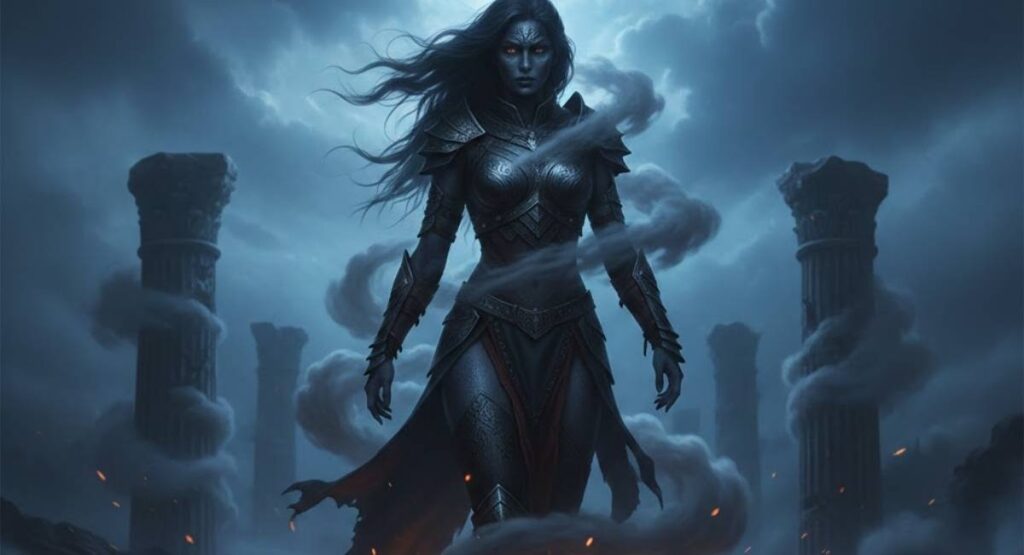
Mazikeen, as most people now know her, was created by Neil Gaiman in The Sandman comics series in 1989. She later appeared prominently in Mike Carey’s Lucifer comic series and then on the Netflix drama Lucifer, played by Lesley-Ann Brandt.
Her popularity has exploded. And with that popularity comes genuine spiritual confusion, especially among younger believers who encounter these characters without Biblical grounding.
Understanding the Origin of the Name Mazikeen
The name Mazikeen is derived from the Hebrew root mazik (מזיק), meaning “one who harms” or “damaging one.” The plural, Mazikin, refers to those harmful spirits described in Talmudic writings.
Neil Gaiman intentionally borrowed this term to give his character ancient, mythological weight. It was a creative choice, not a theological one.
Cultural and Spiritual Significance of the Name Mazikeen
In Jewish mystical tradition, names carried enormous power. Knowing the name of a spiritual being was believed to grant authority over it. This idea resonates, interestingly, with the Biblical truth that there is power in a name, particularly the name of Jesus Christ.
Philippians 2:10 declares that “at the name of Jesus every knee should bow, in heaven and on earth and under the earth.” No folkloric demon, no fictional character, no spirit of any kind operates outside the authority of that name.
Who is Mazikeen in Sandman
In Neil Gaiman’s Sandman universe, Mazikeen serves as a half-faced demon and loyal companion to Lucifer Morningstar. Her face is split: one side beautiful, the other side exposed sinew and bone, a visual representation of her dual existence between the human and demonic realms.
She is portrayed as fiercely devoted, morally complex, and increasingly self-aware. In later storylines, she grapples with identity, purpose, and love. These themes make her compelling fiction. But compelling fiction is not spiritual reality, and Christians must hold that line with grace and confidence.
What Kind of Demon is Mazikeen in the Bible?
To be direct: Mazikeen is not in the Bible at all. Not as a name. Not as a character. Not as a concept.
The Bible does describe demonic beings, but with a very different framework from mythology and pop culture. Scripture presents demons as fallen angels who rebelled against God, now under the authority of Satan, and already defeated by the cross of Jesus Christ.
Ephesians 6:12 makes this clear: “For our struggle is not against flesh and blood, but against the rulers, against the authorities, against the powers of this dark world and against the spiritual forces of evil in the heavenly realms.”
This is spiritual warfare as God defines it: real, serious, but never something the believer faces unequipped or unprotected.
Closest Biblical Parallels
If we are looking for Biblical concepts that parallel Mazikeen’s cultural archetype, we might consider:
- Fallen angels (Revelation 12:7-9) — angels who followed Satan in his rebellion and were cast out of heaven
- Shedim (Deuteronomy 32:17) — demonic beings associated with idol worship in the Old Testament
- Unclean spirits (Mark 5:1-13) — the New Testament’s consistent description of demons encountered by Jesus
- Satan himself (Luke 10:18) — described by Jesus as one who “fell like lightning from heaven”
None of these Biblical beings resemble the morally nuanced, romantically complex character of Mazikeen. The Bible does not romanticize the demonic. It exposes it and points us to the One who has overcome it.
Mazikeen of Lilith
In various adaptations of the Lucifer story, Mazikeen is revealed to be a daughter of Lilith. In Jewish folklore, Lilith is portrayed as Adam’s rebellious first wife who became the mother of demons. She appears briefly in Isaiah 34:14, though the Hebrew term used (lilit) more likely refers to a type of night creature or owl in its original context.
The Lilith as mother of demons narrative is post-biblical tradition, not Scripture. It developed in later Jewish mystical texts, particularly the Alphabet of Ben Sira, written between the 8th and 11th centuries AD.
Christians can acknowledge these traditions as culturally interesting while firmly recognizing they carry no theological authority. The Bible’s account of creation, the fall, and the demonic realm is complete and sufficient.
Who is the Father of Mazikeen?
Within the fictional world of Lucifer, Mazikeen’s father is never clearly identified. Her mother, Lilith, is confirmed; her father remains ambiguous by design, feeding the character’s identity struggle.
From a Biblical standpoint, this ambiguity reflects something real: the spiritual realm is not fully disclosed to us, and we are not called to speculate beyond what God has revealed. Deuteronomy 29:29 reminds us that “the secret things belong to the Lord our God, but the things revealed belong to us and to our children forever.”
We do not need to know the mythology of fictional demons. We need to know the truth of the living God.
Her Relationship with Lucifer
In both comics and television, Mazikeen’s relationship with Lucifer Morningstar is the emotional center of her story. She is devoted, fierce, and increasingly independent as the narrative progresses.
Loyal Demon
Her loyalty is portrayed as almost sacred in the story. She serves Lucifer not out of fear, but out of chosen devotion. The narrative frames this as admirable.
But Scripture offers a sobering contrast. Satan, the one the character of Lucifer is drawn from, does not inspire true loyalty. He inspires bondage. Jesus said in John 8:44 that Satan “was a murderer from the beginning” and “the father of lies.” Those who serve him in Scripture are not fulfilled. They are destroyed.
Strong and Independent Woman
The Mazikeen of the TV series is unquestionably portrayed as strong, emotionally complex, and growth-oriented. Many viewers, including Christians, find her compelling. And that is precisely why discernment matters.
A character can be fictional, well-written, and genuinely interesting while still promoting a spiritually dangerous view of the demonic. Strength and independence are God-given qualities. But the Bible never celebrates demons, however sympathetically they are portrayed.
Complexities of Existence
Mazikeen’s inner struggles with purpose, identity, and belonging are deeply human themes. And that is the genius of good storytelling: embedding relatable struggles in supernatural characters.
But Christians must remember that the demonic realm in Scripture is not searching for identity. It is opposed to God, defeated by Christ, and subject to the authority of every believer who walks in faith. Colossians 2:15 tells us that God “disarmed the powers and authorities” through the cross, “triumphing over them.”
That is not a complex story. That is complete victory.
Mazikeen Demon Face

One of Mazikeen’s most iconic traits is her face: half beautiful, half exposed bone and muscle. In the comics, this duality is literal. In the TV series, it is handled through prosthetics and later as a shiftable demonic appearance.
Symbolically, this split face represents duality, hidden truth, and the tension between what is shown to the world and what lies beneath. It is visually powerful storytelling.
Biblically, the idea of hidden spiritual reality is not new. But Scripture reveals it differently. What lies beneath in the spiritual realm is not grotesque ambiguity. It is either the image of God in redeemed humanity, or the corruption of sin in those who reject Him. There is no demonic “beauty beneath the horror.” There is only the saving grace of Jesus Christ.
What Happened to Mazikeen’s Face?
In the Lucifer TV series, one of the most discussed scenes involves Mazikeen cutting off part of her own face to reclaim her identity and break free from her perceived bondage to Lucifer. She later heals. The act is framed as empowerment through self-sacrifice.
It is a striking narrative device. But Christians should be aware that self-destruction is never the path to freedom. True liberation, Biblically defined, comes from one source: “If the Son sets you free, you will be free indeed” (John 8:36).
No wound we inflict on ourselves, no dramatic act of rebellion or independence, brings the freedom our souls crave. Only Christ does.
The Bigger Picture: Mazikeen’s Cultural Impact
Mazikeen has moved from comic panels to global television, from niche mythology to mainstream conversation. Her cultural impact is significant and worth taking seriously as Christians.
Why She Resonates
She resonates because she asks questions that matter:
- Who am I beyond what others expect of me?
- Can I change my nature?
- Is loyalty worth the cost?
- What does it mean to be truly free?
These are profoundly human questions. And they deserve profoundly Biblical answers.
The Christian message is uniquely equipped to answer every one of them: identity rooted in Christ, transformation through the Holy Spirit, love defined by the cross, freedom found in surrender to God.
Themes She Embodies
| Theme | Cultural Message | Biblical Truth |
|---|---|---|
| Identity | Found through independence | Found in Christ (Galatians 2:20) |
| Loyalty | Can become bondage | True love casts out fear (1 John 4:18) |
| Freedom | Achieved through rebellion | Given by Christ (John 8:36) |
| Redemption | Earned through struggle | Freely given through grace (Ephesians 2:8-9) |
Mazikeen’s story is compelling precisely because it touches the edges of truths that Scripture answers completely and perfectly.
What Does the Bible Say About Demons and Spiritual Warfare?
This is the question that matters most for every Christian encountering the Mazikeen conversation. The Bible does not leave us in the dark about spiritual warfare, and it certainly does not leave us fearful.
Ephesians 6:12 tells us the battle is real: we wrestle against spiritual forces of evil. But 1 John 4:4 reminds us of something even more powerful: “Greater is He who is in you than he who is in the world.” The Holy Spirit residing in every believer is greater than any demonic force, real or fictional.
James 4:7 gives us a practical command: “Submit yourselves therefore to God. Resist the devil, and he will flee from you.” No complex mythology needed. No protective amulets. No ancient folklore rituals. Submission to God and resistance through faith is the complete Christian strategy.
Revelation 12:7-9 describes the war in heaven where Satan and his angels were cast down. The outcome was never in question. God won. God wins. And in Christ, so do we.
Deuteronomy 18:10-12 is equally clear. God explicitly forbids His people from engaging with the occult, communicating with spirits, or consulting demonic sources. Not because demons are powerful, but because God is holy and His people are set apart.
The Christian does not need Mazikeen’s mythology. The Christian has the armor of God (Ephesians 6:10-18), the blood of Jesus, the Word of truth, and the Holy Spirit as guide and protector. That is infinitely more than enough.
Frequently Asked Questions
Is Mazikeen mentioned in the Bible?
No. Mazikeen is not mentioned anywhere in the Bible. She is a fictional character created by Neil Gaiman in 1989, loosely inspired by ancient Jewish folklore.
What kind of demon is Mazikeen?
Mazikeen is a fictional demon based on Jewish folkloric spirits called Mazikin. She has no Biblical basis or theological standing in Christian doctrine.
Is Mazikeen a real demon in Jewish folklore?
The Mazikin as a class of harmful spirits appear in Talmudic literature, but “Mazikeen” as a specific named demon is a modern fictional creation, not an ancient religious entity.
What does the name Mazikeen mean in Hebrew?
It derives from mazik, meaning “one who damages” or “harmful one,” referencing the class of mischievous spirits in ancient Jewish tradition.
Should Christians be afraid of Mazikeen or demons like her?
No. First John 4:4 assures every believer: “Greater is He that is in you than he that is in the world.” Christians are protected, equipped, and victorious in Christ.
What does the Bible say about demons?
The Bible presents demons as real but defeated. They are fallen angels under Satan’s authority, already overcome by Christ’s death and resurrection (Colossians 2:15)
Conclusion
The question “Who is Mazikeen in the Bible?” has a simple answer: she is not there. Not by name, not by description, not by any Biblical precedent. She is a creative, culturally fascinating fictional character rooted in ancient Hebrew folklore and shaped by decades of comic book storytelling.
But this conversation matters far beyond trivia. It is an opportunity for every Christian to anchor themselves in Biblical truth rather than cultural mythology. The spiritual world is real. Demonic activity is real. But so is the complete, total, and irreversible victory of Jesus Christ over every force of darkness.
You do not need to fear Mazikeen, her mythology, or the spiritual questions her character raises. You need to know your Bible, trust your Savior, and walk in the authority that Christ has already won for you.
Luke 10:18 records Jesus saying,
“I saw Satan fall like lightning from heaven.” The enemy has already fallen. Christ has already won. And in Him, you already stand in victory.
That is the Biblical truth about Mazikeen. And it is the truth that sets you free.

Sheela Grace is a devoted Christian writer at KindSoulPrayers, sharing prayers and scripture insights she has studied to inspire and uplift every heart