

The name Tristan carries a rare kind of weight. It sounds ancient, feels literary, and moves through conversation with a quiet intensity that many modern names simply lack. Parents across the USA, UK, Canada, and Australia are drawn to it for its depth, its romance, and the sense that it belongs to something larger than just a given name. But what does the name Tristan actually mean, and does it have a genuine connection to the Greek language or Greek culture?
This article answers those questions with honesty and care. Tristan is not originally a Greek name, and it does not appear anywhere in Scripture. But that does not make it meaningless. For Christian families especially, understanding a name’s true origin is the beginning of wisdom, not the end of the conversation. A name’s spiritual value is shaped far more by the character and calling of the person who bears it than by any dictionary entry. As Proverbs 22:1 reminds us, a good name is more desirable than great riches, and that goodness is built through a life lived with integrity before God.
Tristan Meaning in Greek
Tristan is not originally a Greek name. That needs to be said clearly and kindly, because many websites imply otherwise without proper qualification. The name belongs to the Celtic and medieval European tradition, rooted in the ancient Pictish name “Drust” or “Drustan,” which carried the meaning of tumult, noise, or commotion. As it traveled through Wales and into medieval French literature, it picked up the emotional coloring of the French word “triste,” meaning sad or sorrowful.
When Greek speakers encounter the name today, they write it as Τρίσταν and some associate it with the Greek word “tristos” meaning sorrowful. However, this is a popular interpretive connection, not a formal etymological one. The resemblance is phonetic, not historical. For Christian readers, this distinction matters because good discernment begins with accurate information. A name chosen in truth and prayer will always carry more spiritual weight than one selected based on an appealing but uncertain story.
The Greek Etymology of Tristan
Examining Tristan through a Greek linguistic lens reveals something worth noting: while the name has no Greek roots, its themes resonate naturally with Greek literary and philosophical traditions. The Greek word “tristos” carries the meaning of deep sorrow, and because Tristan sounds similar and carries associated emotional meanings, many people draw a loose connection between the two.
Scholars of etymology are careful here. The name does not derive from any Greek word or Greek cultural practice. What Greek speakers recognize in Tristan is thematic resonance, not linguistic ancestry. The name sounds at home alongside classical names because of its strong consonants, its two-syllable rhythm, and its association with heroic, romantic storytelling. That feeling of familiarity is real, but it is cultural rather than etymological.
For Christian families, this is actually an encouraging truth. A name does not need ancient Greek credentials to carry meaning. Identity in Christ is rooted in something far more enduring than name folklore.
Foundational Linguistic Origins
Understanding where Tristan genuinely comes from requires separating several distinct threads:
- Probable historical root: The Pictish name “Drust” or “Drustan,” meaning tumult, uproar, or commotion. This was a warrior name common among Celtic tribes in ancient Britain.
- Medieval literary evolution: As the legend of Tristan and Isolde spread through France, the name absorbed the French word “triste,” shifting its emotional tone toward sorrow and tragic love.
- Popular emotional interpretation: Many people today associate Tristan with sadness, sensitivity, and depth. This interpretation is shaped more by the legend than by etymology.
- Greek phonetic association: The similarity to “tristos” is noted by some, but this is symbolic observation, not documented linguistic origin.
- Christian spiritual reflection: Scripture consistently reframes sorrow as a path toward growth, compassion, and hope. Romans 5:3 to 5 reminds believers that suffering produces perseverance, character, and ultimately hope that does not disappoint.
The Historical Origin of the Name Tristan
The historical roots of Tristan reach back to the Celtic tribes of ancient Britain, specifically to the Pictish people of what is now Scotland. The name “Drust” or “Drustan” was used among warriors and kings, and several Pictish rulers carried variations of it. It was a name associated with strength, not sorrow.
The transformation came through storytelling. The medieval romance of Tristan and Isolde, one of the most influential love stories in Western literary history, carried the name across Europe and reshaped its meaning. As the tale traveled through France, the name merged phonetically and emotionally with “triste,” anchoring it to themes of tragic devotion and noble sacrifice. By the time the legend had spread through English, German, and eventually Greek-speaking literary circles, Tristan had become a name synonymous with passionate loyalty and heartbreaking love.
This evolution is itself a lesson in how culture shapes language. A warrior’s name became a lover’s name, and then a parent’s choice. Names carry history, and Tristan’s history is rich.
Tristan in Greek Mythology and Ancient Stories
Tristan does not appear in classical Greek mythology. This should be stated clearly. There is no ancient Greek hero named Tristan, no myth bearing his story, and no textual evidence connecting him to the Greek world of the ancient period.
What does exist are striking thematic parallels. The story of Tristan and Isolde shares its emotional architecture with some of the most powerful narratives in Greek literature. A heroic warrior torn between loyalty and love, a forbidden romance sealed by fate, and a tragic ending that transcends death: these are not uniquely Celtic or French themes. They are universal human experiences that Greek poets and playwrights understood deeply.
For Christian readers, these parallels confirm something Scripture already teaches. The great stories of humanity, across cultures and centuries, return again and again to the same aching questions about love, loyalty, sacrifice, and redemption. These longings point toward something deeper than mythology. They point toward the God who is described in 2 Corinthians 1:3 to 4 as the Father of compassion and the God of all comfort.
Tristan’s Parallels to Greek Mythology
| Greek Hero or Story | Tristan Parallel | Shared Theme |
|---|---|---|
| Orpheus and Eurydice | Tristan and Isolde’s doomed love | Love that persists beyond separation and death |
| Achilles | Tristan as warrior and devoted lover | The tension between duty and personal longing |
| Paris and Helen | Tristan and Isolde’s forbidden bond | Love that defies social expectation and brings consequence |
| Odysseus | Tristan’s journeys and long separations | Loyalty tested across distance and time |
| Jason and Medea | Love entangled with obligation and betrayal | Magical or fateful forces complicating devotion |
| Theseus | Tristan’s heroic quests | A noble hero navigating dangerous missions and complex loyalties |
Cultural Significance of Tristan in Greek History
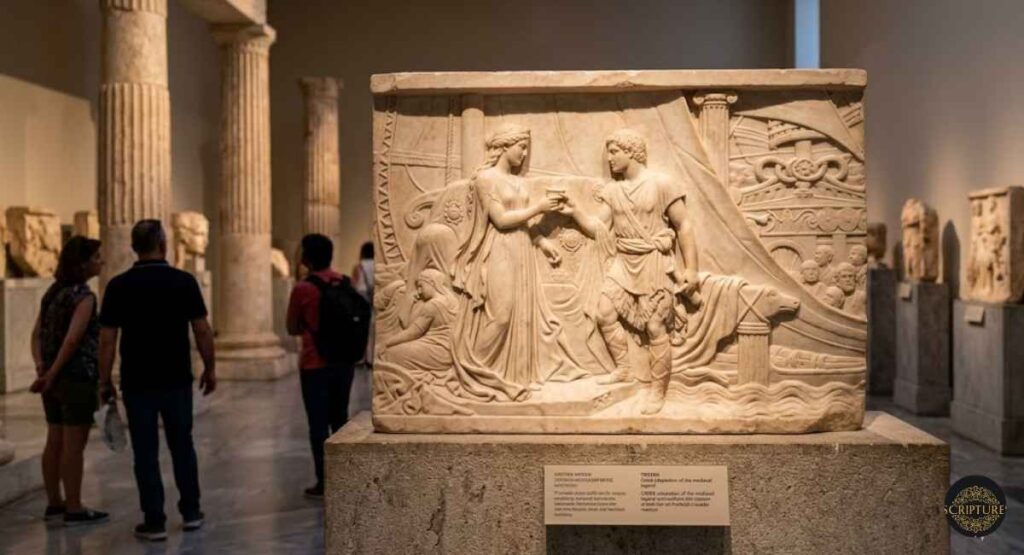
Tristan has no documented role in ancient Greek history. The name emerged centuries after the height of classical Greek civilization, and ancient Greeks would not have known it. Any connection between Tristan and Greek antiquity is a modern interpretive framework, not historical fact.
Where a genuine cultural encounter did occur was in the Byzantine period, when Greek-speaking scholars and literary circles encountered Western European romance literature. Byzantine readers who came across the Tristan legend would have recognized its tragic structure and appreciated its themes. However, there is no strong evidence that Byzantine Greeks adopted the name for personal use. They maintained their own rich tradition of names rooted in Orthodox Christianity and classical heritage.
In contemporary Greek culture, Tristan is occasionally used among cosmopolitan families who value its international character. This is a modern adoption, not an ancient tradition, and honest treatment of the subject requires that distinction.
How Ancient Greeks Used the Name
Ancient Greeks did not use the name Tristan. This is not a gap in the historical record; it is simply the truth. The name belongs to a later era and a different cultural branch. Greek naming conventions drew from mythology, virtue, divine attributes, and honored ancestors. Names like Alexander, Nikolaos, and Theodoros carried meaning in the Greek language and connected bearers to Greek cultural identity.
If Byzantine Greeks encountered the name through translated literature, they would have treated it as a foreign name worth noting for its literary associations, not one to give their own children. It is only in the modern era, with Greece’s deeper integration into European and global culture, that names like Tristan have entered the orbit of Greek family naming decisions.
The Connection Between Tristan and Greek Language
When Tristan enters the Greek linguistic world today, it does so smoothly. Greek speakers write it as Τρίσταν, and the transliteration is natural. The two-syllable structure fits comfortably within Greek phonological patterns, and the strong consonants give it a masculine clarity that Greek naming traditions value.
The deeper connection, though, is thematic rather than linguistic. Greek culture has always valued names that carry emotional and philosophical weight. A name associated with sorrow, endurance, and heroic love fits naturally into the Greek literary imagination, even if it did not originate there. This cultural compatibility is real and meaningful, as long as it is understood as resonance rather than origin.
Linguistic Features
- Phonetic compatibility: Tristan’s sound structure aligns naturally with Greek phonology and is easy for Greek speakers to pronounce.
- Syllabic rhythm: The two-syllable format mirrors common Greek naming patterns.
- Smooth transliteration: The name transfers into Greek letters as Τρίσταν without awkward letter combinations.
- Masculine ending: The “-an” ending fits established conventions for masculine names in Greek.
- Thematic resonance: The name’s emotional associations connect with values Greek literary culture has long celebrated.
- International recognition: Modern Greek families appreciate names that function well across European and global contexts.
Tristan vs. Greek Names: Similarities and Differences
Understanding how Tristan compares to traditional Greek names helps parents make informed, thoughtful decisions. The two naming traditions come from entirely different linguistic roots, but they share certain qualities that make Tristan feel at home among them. Both traditions value strength, heroic association, and names that carry historical or literary meaning.
The differences are equally important. Greek names are deeply embedded in a specific cultural, religious, and linguistic tradition. Tristan is a borrowed presence in that world, admired for its qualities rather than organically produced by Greek culture.
Tristan vs. Greek Names Comparison
| Aspect | Tristan | Traditional Greek Names |
|---|---|---|
| Origin | Celtic and medieval French | Ancient Greece, rooted in mythology and language |
| Core meaning | Tumult, sorrow, bold spirit | Virtues, divine attributes, heroic deeds |
| Historical usage | Medieval European literary tradition | Thousands of years in Greek civilization |
| Cultural association | Romance, chivalry, tragic devotion | Philosophy, mythology, Christian saints |
| Religious context | Celtic origin, medieval Christian literary setting | Pagan mythology, later Orthodox Christian tradition |
| Modern popularity | Growing in English-speaking and cosmopolitan communities | Dominant in Greece, varying internationally |
| International familiarity | Widely recognized across the Western world | Varies; some Greek names are globally known |
Modern Usage of Tristan in Greek-Speaking Countries
In Greece and Cyprus today, Tristan is occasionally chosen by urban, internationally minded families. It does not rank among the top names in either country. Traditional choices like Yiannis, Georgios, Dimitris, and Konstantinos continue to lead. However, in cosmopolitan areas like Athens and Thessaloniki, there is growing openness to names that reflect broader European and global culture.
The name’s modern presence in Greek-speaking communities is best described as an emerging minority choice. It is recognized, accepted, and occasionally used, but it is not mainstream. Rural communities and families with strong ties to Greek Orthodox traditions tend to maintain more traditional naming practices, making Tristan primarily a metropolitan and internationally oriented choice.
Why Parents Choose Tristan: Greek Heritage Perspective
Greek parents who choose Tristan are typically motivated by a desire to give their children names that carry both strength and global relevance. These families often appreciate that Tristan shares the heroic and romantic qualities of classical Greek heroes while offering a fresh alternative to common names.
There is also a practical dimension. Greek families with international connections or children likely to live and work beyond Greece often choose names that travel well. Tristan maintains its character, dignity, and recognizability across European languages, which is a meaningful consideration for globally minded parents.
Key Reasons Greek Parents Choose Tristan
- International versatility: The name works across European languages without losing its identity.
- Literary sophistication: Its connection to classical romance appeals to educated and culturally aware families.
- Distinctive character: It stands apart from common Greek names without feeling strange or foreign.
- Masculine clarity: It carries the strength and dignity Greek parents seek in names for sons.
- Easy adaptation: It fits naturally into Greek pronunciation and script as Τρίσταν.
Famous People Named Tristan with Greek Heritage

Verifiable examples of well-known individuals named Tristan with documented Greek heritage are limited. This is worth stating honestly rather than padding with vague or unconfirmed claims. As the name gradually gains presence in Greek-speaking communities, particularly in diaspora contexts where Greek families have married across cultures, more individuals with Greek connections and the name Tristan will likely emerge in coming generations.
What can be said clearly is that the name Tristan has been carried by notable figures across sport, music, and culture in Western countries, and its gradual adoption into Greek-speaking families reflects the same international cultural movement that has brought many European names into Greek homes over recent decades.
Tristan Name Variations Across Greek Regions
Because Tristan is not a name of Greek origin, it does not carry regional variations across Greece in the way that native Greek names do. The standard form, Τρίσταν, is used consistently wherever the name appears.
Minor pronunciation differences do exist between mainland Greece and Cyprus, where the Greek dialect carries distinct phonetic qualities. Vowel lengths and stress patterns may shift slightly, but these differences are subtle and do not alter the name’s fundamental character. In more conservative rural communities across the Greek islands and mainland, Tristan is rarely used at all. Its presence is concentrated in urban and internationally oriented households where traditional naming conventions are held more loosely.
The Symbolism Behind Tristan in Greek Culture
Within contemporary Greek culture, Tristan has come to represent a particular kind of cultural bridge identity. Families who choose it are often making a quiet statement about their openness to the world while remaining rooted in their heritage. The name’s associations with heroic courage, romantic devotion, and noble suffering resonate with values that Greek culture has celebrated across centuries.
The symbolic alignment between Tristan’s emotional themes and Greek cultural values is genuine. Greeks have long honored stories of passionate love, loyalty tested by suffering, and heroes who endure tragedy with dignity. These themes appear throughout Greek mythology, Byzantine literature, and the Greek Orthodox tradition of honoring saints who suffered for their faith.
For Christian families within Greek culture, there is a further symbolic layer worth considering. Scripture does not cast sorrow as shameless or meaningless. Psalm 34:18 says the Lord is close to the brokenhearted, and James 1:2 to 4 describes trials as the pathway to maturity and completeness. A name associated with sorrow can carry spiritual depth when interpreted through that biblical lens.
Symbolic meanings of Tristan in a Greek cultural context:
- Cultural openness: A name that honors heritage while embracing the wider world.
- Heroic endurance: Courage in the face of loss, echoing Greek ideals of noble suffering.
- Romantic depth: The kind of devoted, all-consuming love that Greek literature has always honored.
- Spiritual resonance: Through a biblical lens, sorrow transformed into wisdom and compassion.
- Literary refinement: A signal of cultural and educational awareness valued in Greek society.
How to Pronounce Tristan in Greek
In Greek, Tristan is pronounced very close to its international standard: TRIS-tan, with primary stress on the first syllable. Greek speakers write it as Τρίσταν, where Τ represents the “T” sound, ρ gives the Greek rolled “r,” ι produces the “i” sound, σ and τ carry the remaining consonants, and αν closes the name.
The Greek rolled “r” gives the name a slightly warmer texture than the English pronunciation, and native speakers may soften the final “n” slightly. These are subtle differences that do not affect the name’s recognizability. Greek speakers familiar with international names generally aim to honor the original pronunciation, treating it as a borrowed name rather than adapting it into a fully Greek form.
Is Tristan a Popular Name in Greece Today?
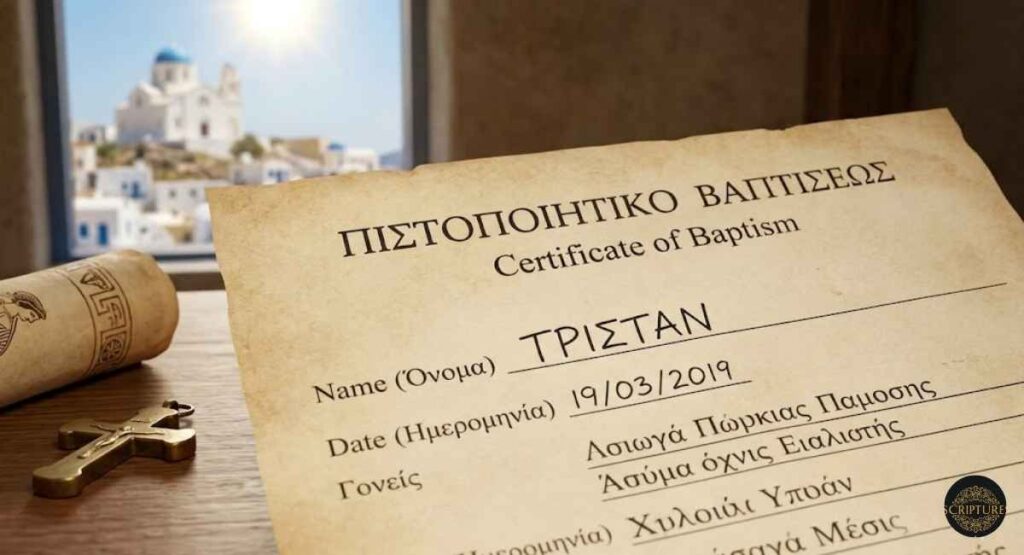
Tristan is not a mainstream name in Greece. Official naming records in Greece show it does not rank among the top fifty or even top one hundred boys’ names. Traditional choices like Yiannis, Georgios, Dimitris, and Konstantinos continue to dominate across the country.
That said, the name’s profile has been quietly growing over the past two decades, particularly among younger, urban, cosmopolitan parents. In upscale neighborhoods in Athens, among Greek families living in Western Europe, and in international school communities, Tristan is a recognized and occasionally chosen name. It occupies the space of an emerging alternative: not common enough to feel familiar to most Greeks, but not unusual enough to provoke strong objection.
Tristan’s Role in Greek Literature and Poetry
Tristan’s presence in Greek literature is primarily a translated and borrowed presence. The legend of Tristan and Isolde reached Greek literary circles through European Romanticism, particularly during the nineteenth and twentieth centuries when Greek writers engaged deeply with the broader Western literary canon. Greek scholars translated and adapted the legend, and Greek poets occasionally referenced Tristan as an archetypal tragic lover, drawing parallels with figures from their own mythological tradition.
However, Tristan has not achieved the iconic status in Greek literary culture that it holds in French, German, or English traditions. It remains a respected borrowed symbol, used when Greek writers want to invoke European romantic themes rather than a figure rooted in the Greek literary imagination itself.
The Greek Influence on Tristan’s Meaning Over Time
While Greek culture did not produce the name Tristan, the Greek intellectual and literary tradition has shaped how the name’s legend is understood and interpreted across Western culture. Greek concepts of tragic fate, the tension between eros and duty, and the hero’s journey provided the philosophical vocabulary through which European scholars analyzed the Tristan story for centuries.
In a more immediate sense, as Tristan enters Greek-speaking communities, it absorbs subtle inflections from Greek cultural values. The emphasis on heroic endurance, on noble suffering, and on love that dignifies rather than diminishes the person experiencing it aligns naturally with both Greek cultural ideals and Christian spiritual understanding. This is a bidirectional exchange. Tristan brings something into Greek naming culture, and Greek culture lends it a new layer of interpretive depth.
Is Tristan a Biblical or Greek Name? Complete Origin Analysis
This question deserves a clear, honest, and compassionate answer. Tristan is neither a biblical name nor a Greek name in the strict historical sense. Both claims require careful qualification.
Tristan is not a biblical name because:
- It appears nowhere in the Old Testament, New Testament, or any recognized scriptural text.
- Its etymology has no Hebrew, Aramaic, or Greek scriptural roots.
- It emerged centuries after the biblical canon was completed.
- There is no documented theological or devotional meaning attached to it in Christian tradition.
Tristan is not a Greek name because:
- Its etymology derives from the Pictish Celtic name “Drust,” with no documented Greek linguistic origin.
- It does not appear in classical Greek mythology or ancient Greek literature.
- Greek use of the name is modern and international, not rooted in ancient Greek cultural tradition.
- The similarity to the Greek word “tristos” is a phonetic coincidence, not an etymological connection.
For Christian parents, this raises a natural question: can we still choose this name with good conscience? The answer is yes, with discernment. Scripture does not restrict believers to names found within its pages. What it calls us to is thoughtful, prayerful reflection. Just as God renamed Abram to Abraham to mark a new identity and calling in Genesis 17:5, names can carry spiritual significance when chosen with intention. And just as Hannah named Samuel in 1 Samuel 1:20 as an act of faith and testimony, naming can be an act of worship.
A name like Tristan, with its associations of sorrow, endurance, and loyal love, is not spiritually harmful. When filtered through a biblical framework, those themes connect beautifully to the kind of character Scripture values most.
| Question | Clear Answer |
|---|---|
| Is Tristan found in the Bible? | No, it does not appear in any scriptural text |
| Is Tristan originally a Greek name? | No, it is Celtic in origin, from the Pictish “Drust” |
| Does Tristan have a Greek linguistic connection? | Only phonetically, through similarity to “tristos,” not by etymology |
| Can Christians use the name Tristan? | Yes, with prayerful discernment and intentional reflection |
| Does a sorrow-related meaning disqualify the name? | No, Scripture consistently redeems suffering into growth and hope |
| What should guide a Christian parent’s choice? | Biblical wisdom, character, prayer, and the identity they hope their child carries |
Frequently Asked Questions
What does the name Tristan mean in Greek?
Tristan has no formal Greek meaning, but it is phonetically associated with the Greek word “tristos,” meaning sorrowful. This connection is interpretive rather than etymological.
Is Tristan originally a Greek name?
No. Tristan originates from the Celtic Pictish name “Drust,” meaning tumult or commotion. Greek speakers use it as an adopted international name.
Why is Tristan associated with a Greek meaning?
Because of its phonetic similarity to the Greek word “tristos,” people draw a loose connection to sorrow or sadness. This is a popular association, not a documented linguistic origin.
What does “tristos” mean in Greek?
In Greek, “tristos” means sad, sorrowful, or mournful. The word exists in Greek but is not the origin of the name Tristan.
Does the Greek meaning affect the name Tristan spiritually?
When interpreted through a biblical lens, associations with sorrow can point toward depth, compassion, and the kind of character shaped by endurance. Romans 5:3 to 5 describes this transformation beautifully.
Is Tristan used as a Greek name today?
It is occasionally chosen by cosmopolitan families in urban areas of Greece and Cyprus, but it is not a mainstream or traditional Greek name.
What personality traits connect to the Greek meaning of Tristan?
People often associate Tristan with emotional depth, sensitivity, resilience, and a thoughtful, compassionate nature.
Is the Greek meaning of Tristan negative?
Not necessarily. Greek philosophical tradition understood sorrow as a teacher. Scripture agrees: suffering produces character, and character produces hope.
How does Greek culture view names tied to emotion?
Greek culture has long valued names that carry depth and human experience. Names connected to emotional truths are often seen as more meaningful, not less.
What is a positive interpretation of Tristan’s Greek meaning?
Tristan can be understood as one who has walked through difficulty and emerged with wisdom, compassion, and a capacity for faithful love. That is a deeply biblical picture of maturity.
Can Christians use the name Tristan?
Yes. Christians are not restricted to biblical names. What matters most is choosing a name prayerfully, with thoughtful reflection on the character and testimony you hope your child will grow into.
What should Christian parents consider before choosing the name Tristan?
Consider the associations the name carries, the spiritual intentions you bring to the choice, and how you will speak meaning and identity over your child as they grow. Pray over the name, seek wisdom, and trust that God shapes character far more powerfully than etymology ever could.
Conclusion
The name Tristan is not Greek in origin and it does not appear in the pages of Scripture. But it carries something rare: a sense of emotional weight, historical depth, and literary richness that resonates across cultures and centuries. Its true roots lie in the Celtic world, shaped by medieval romance into a name associated with loyal love, noble endurance, and the kind of sorrow that forges character rather than breaking it.
For Christian families, the most important truth is this. A name’s spiritual power comes not from its etymology but from the life lived beneath it. God does not evaluate his children by the linguistic roots of their names. He calls them by name, shapes them through his Word, and builds their identity through grace and faithfulness. If you are drawn to the name Tristan, bring that choice before God in prayer. Let biblical wisdom guide you, let the associations of the name inspire the kind of person you hope your child will become, and trust that a name chosen with discernment and love is a gift that honors both the child and the God who made them.

Sheela Grace is a devoted Christian writer at KindSoulPrayers, sharing prayers and scripture insights she has studied to inspire and uplift every heart