

Many Christians come across the name Atticus and immediately wonder if it belongs to a figure from Scripture. It sounds ancient, dignified, and wise, which naturally makes people curious about its biblical roots. That curiosity is completely understandable, and it deserves an honest, careful answer.
The truth is that who was Atticus in the Bible is one of those questions that deserves a direct response: the name does not appear anywhere in the canonical Bible. Not in the Old Testament. Not in the New Testament. Not in any inspired Scripture that the church recognizes as God’s Word. But that does not mean the name has no value or history worth exploring. Understanding where the name truly comes from can actually deepen your appreciation for the world in which the early church was born and grew.
Is Atticus Mentioned in the Bible?
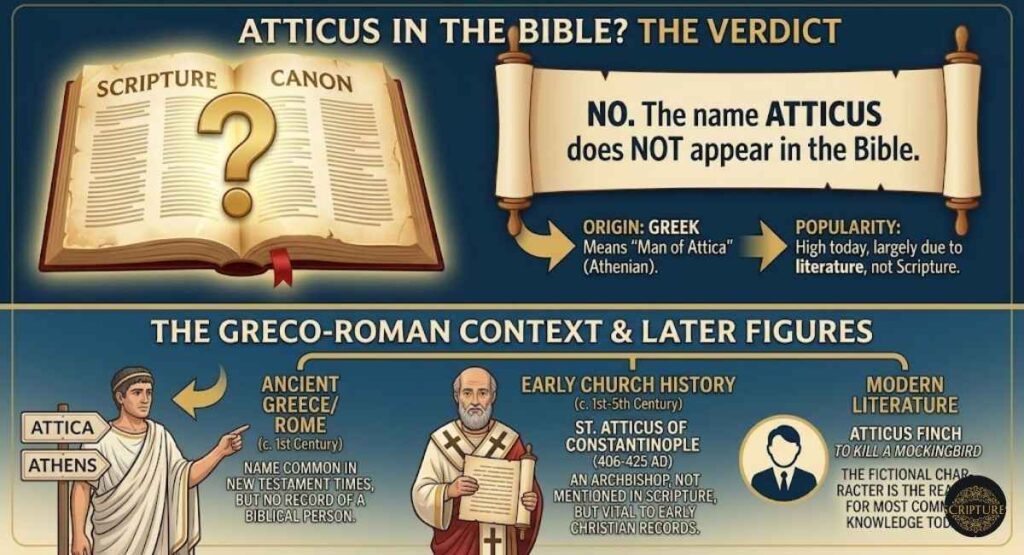
No. Atticus is not mentioned in the Bible. The name does not appear in any book of the Old or New Testament, and no biblical prophet, apostle, judge, king, or disciple carried this name. If you search a concordance or Bible search tool, you will find no result for Atticus in canonical Scripture.
Some readers assume the name must be biblical simply because it sounds old and classical. Others may have encountered it in religious discussions or early church writings and assumed it crossed over into Scripture. That confusion is worth addressing directly, because biblical accuracy matters, especially when exploring names that carry spiritual weight for families and believers.
Where exactly does the name appear?
The name Atticus appears in three distinct places outside the Bible, and it is important to understand the difference between them.
First, it appears in classical Roman and Greek history, where it was a respected and educated-sounding name used by noble families and scholars. Second, it appears in early church history, most notably with Atticus of Constantinople, who served as Archbishop of Constantinople in the early fifth century. He was a significant figure in post-biblical church leadership, but he lived centuries after the New Testament was completed and is not a figure of Scripture. Third, the name may appear in extra-biblical writings, which are historical or religious texts written around the time of the early church but never included in the inspired canon.
None of these are the same as the Bible. Church history is valuable. Classical history is fascinating. But neither one is inspired Scripture, and Christians should hold that distinction carefully. When someone says a name appears in religious writings, that does not automatically mean it appears in God’s Word.
The Meaning and Origin of the Name Atticus
Atticus is a name with deep classical roots, but those roots are Greek and Roman, not Hebrew or covenantal. It does not carry the kind of meaning that biblical names like Joshua, meaning God is salvation, or Samuel, meaning heard by God, carry. Its origin is cultural and geographical rather than theological.
Understanding where the name comes from does help explain why it sounds so noble and why it has endured through centuries of Western history.
What does the name Atticus mean in Greek/Latin?
The name Atticus comes from the Latin word for Attica, the region of ancient Greece that surrounds Athens. In its most direct sense, Atticus simply means man from Attica or one belonging to Attica. But because Attica was the heart of Greek philosophy, rhetoric, learning, and culture, the name came to carry connotations far beyond geography.
To call someone Atticus in the Roman world was to suggest they were educated, refined, and intellectually serious. It was a name associated with wisdom and cultural prestige. The Roman statesman Titus Pomponius Atticus, a close friend of Cicero, is perhaps the most famous historical bearer of the name, known for his love of learning and his even-tempered character.
From a Christian perspective, the name itself does not carry biblical meaning, because the Bible never defines it. However, Christians who appreciate the name can reflect on the virtues it has historically suggested, such as wisdom, integrity, and a pursuit of truth, and anchor those virtues in Scripture rather than in etymology alone. Proverbs 4:7 reminds us that wisdom is the principal thing. James 1:5 promises that God gives wisdom generously to those who ask. These truths are biblical. The name Atticus is not, but the virtues it evokes can still point a believer toward God’s Word.
Is Atticus in the Bible the Same as Atticus Finch?
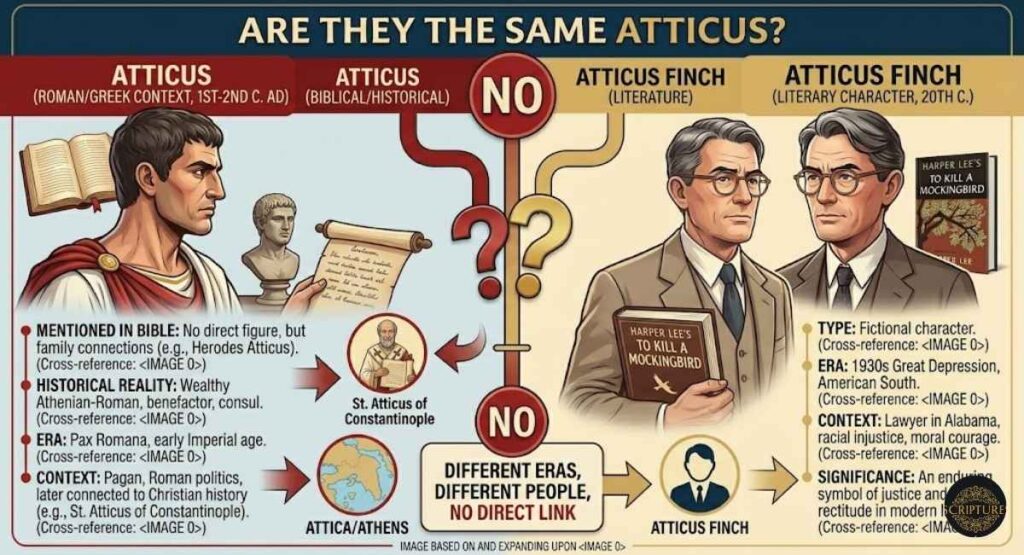
No. Atticus in any biblical or historical discussion has absolutely no connection to Atticus Finch, the fictional lawyer from Harper Lee’s novel To Kill a Mockingbird. They share a name, but nothing else.
Atticus Finch is a literary character created in the twentieth century. He is admired for his moral courage, his commitment to justice, and his quiet, principled dignity. Those qualities are beautiful and reflect values that Christians also hold dear. But he is not a biblical figure, not a church figure, and not a historical person. He is a product of one author’s imagination.
Clearing the confusion with To Kill a Mockingbird
The confusion often happens because the name Atticus now carries such strong associations with justice and moral courage that people instinctively connect it to spiritual or biblical themes. When a name feels virtuous, the mind can mistakenly reach for a biblical connection that is not there.
Micah 6:8 calls believers to act justly, love mercy, and walk humbly with God. Philippians 4:8 urges us to think on whatever is true, noble, right, and pure. The qualities that Atticus Finch represents in literature do echo these biblical virtues, but that echo is a literary resonance, not a scriptural origin. Christians can appreciate good literature for reflecting God’s moral order in the world without needing to claim it as Scripture. Discernment means knowing the difference between what is inspired and what is merely admirable.
Atticus in Historical and Religious Contexts
During the first few centuries of the Christian era, the church spread rapidly through the Roman Empire. This means that many early believers did not have Hebrew names. They had Greek names, Latin names, and Roman names, because that was the culture they lived in. A new Christian convert in Corinth, Rome, or Ephesus might carry a classical name and still be a faithful follower of Christ. The New Testament itself reflects this reality. Figures like Tertius, Quartus, Asyncritus, and Phlegon in Romans 16 show how diverse and Greco-Roman the early church community was.
The name Atticus fits naturally into that world. While no one named Atticus appears in the New Testament, it is entirely plausible that believers in the early church carried the name. As the church grew and organized in the centuries that followed, the name appears more clearly in church records. Atticus of Constantinople, who served as Archbishop from around 406 to 425 AD, is one documented example. He was a real church leader, but he belongs to the era of church history, not to the era of biblical canon.
This distinction matters. The Bible was completed by the end of the first century. Church history continues for centuries beyond that. Both are worth knowing, but they are not the same thing, and a name appearing in one does not place it in the other.
Rare and Overlooked Names in the Bible
While Atticus is not among them, the Bible is genuinely full of lesser-known names that carry profound spiritual lessons. These overlooked figures deserve more attention than they typically receive.
Onesiphorus appears in 2 Timothy 1:16-17. Paul wrote that this man often refreshed him and was not ashamed of Paul’s chains. He searched earnestly for Paul in Rome and found him. His name means bringing profit, and his life matched it. He is a model of loyal, sacrificial friendship in the faith.
Bezalel is mentioned in Exodus 31:1-5. God specifically filled him with the Spirit, with wisdom, understanding, and knowledge in all kinds of crafts. He was the master craftsman appointed to build the Tabernacle. His story reminds us that creative gifts are given by God and meant for His glory.
Demas is a sobering example. He is mentioned in Colossians 4:14 as a fellow worker, but by the time of 2 Timothy 4:10, Paul writes that Demas deserted him because he loved this present world. His story is a quiet but serious warning about the danger of divided affection.
Jabez appears briefly in 1 Chronicles 4:9-10, yet his prayer has resonated with generations of readers. He asked God to enlarge his territory and keep him from harm, and God granted his request. His name meant he will cause pain, but his faith rewrote his story.
These names remind us that every person in Scripture, no matter how briefly mentioned, was a real human being whose life carried meaning in God’s plan.
Key Takeaways About Atticus in the Bible
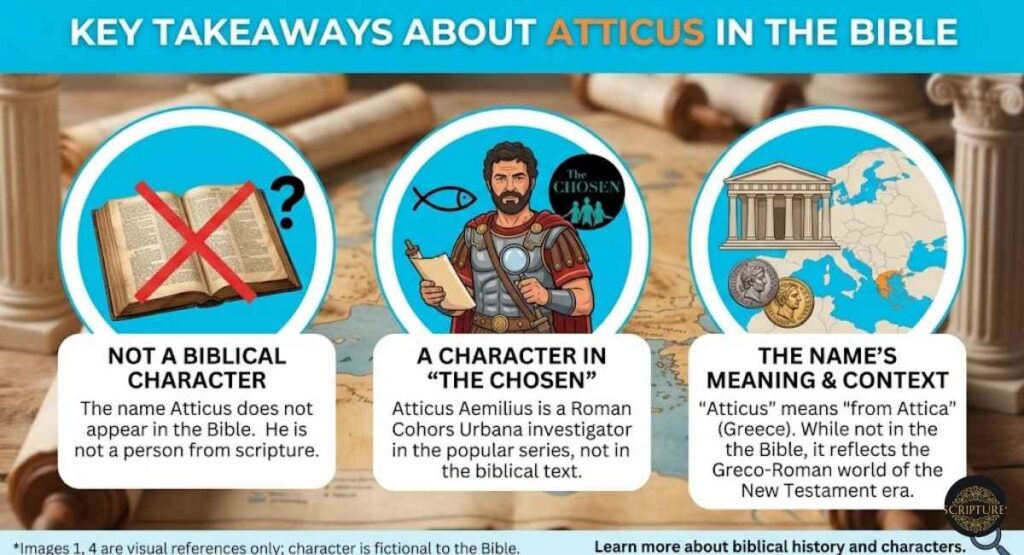
- Atticus does not appear in the Bible. The name is absent from both the Old and New Testaments.
- It is not a biblical name in any canonical sense. It has Greek and Latin origins, not Hebrew covenant roots.
- The name means man from Attica, reflecting the region surrounding Athens in ancient Greece.
- It may appear in post-biblical church history, most notably with Atticus of Constantinople in the fifth century, but that is church history, not Scripture.
- Christians can appreciate the virtues associated with the name, such as wisdom and integrity, while grounding those values in Scripture rather than in the name itself.
- Biblical discernment matters. Knowing the difference between canonical Scripture, church history, extra-biblical writings, and cultural tradition is part of reading well and believing accurately.
- A name does not need to be biblical to be meaningful. But calling something biblical when it is not does a disservice to the truth that Scripture deserves.
What Christians Can Learn From Names That Sound Biblical But Are Not
Many names in circulation today sound ancient, noble, or spiritually weighty but simply do not appear in the Bible. Atticus is one of them. Others include names like Cassius, Cressida, Thaddeus in some usages, or even names drawn from early Christian tradition that never made it into the biblical text itself.
This is not a problem. It is actually an invitation to think more carefully about what makes something biblical. A name being old does not make it scriptural. A name sounding wise does not make it covenantal. A name inspiring moral reflection does not make it inspired.
Christians are called in 2 Timothy 2:15 to handle the Word of truth accurately. That same care applies to how we talk about names, meanings, and history. It is perfectly fine to appreciate a name for its cultural richness or moral associations. It is a different matter entirely to claim biblical authority for something that Scripture never addresses.
The beauty of biblical literacy is that it frees you from needing to inflate or reinvent. The Bible is rich enough on its own. When you know what it actually says, you do not need to borrow unearned significance from names or traditions outside it.
How to Think About Names as a Christian
Choosing or reflecting on a name is a meaningful act for many Christian families. Names carry identity, memory, and in many traditions, a sense of calling or blessing. The Bible itself takes names seriously. God renamed Abram to Abraham, Jacob to Israel, and Simon to Peter. These were not cosmetic changes. They were covenantal declarations about identity and purpose.
When a name like Atticus is not in the Bible, that does not mean Christians should avoid it or distrust it. It simply means the name should be appreciated on its own terms, for its historical character and the virtues it has come to represent, without forcing a biblical origin that does not exist.
If you name a child Atticus because you admire wisdom, justice, and moral clarity, those are beautiful values. Root them in Proverbs, in Micah 6:8, in Philippians 4:8, and you will raise a child shaped by Scripture. The name can be the door. Scripture is the foundation.
Ultimately, no name gives a person their identity before God. It is faith in Christ that defines the believer. As Galatians 3:26 reminds us, we are all children of God through faith. That is the name that matters most.
Frequently Asked Questions
Who was Atticus in the Bible?
There was no person named Atticus in the Bible. The name does not appear in any book of the Old or New Testament, and no biblical figure carried this name. It is a classical Greek and Roman name, not a scriptural one.
Is Atticus a biblical name?
No, Atticus is not a biblical name. It has Greek and Latin origins meaning man from Attica. It does not appear in canonical Scripture and carries no covenantal or Hebrew meaning.
What does Atticus mean in the Bible?
The Bible does not define the name Atticus because it never appears in Scripture. Outside the Bible, the name means man from Attica, referring to the Greek region surrounding Athens.
Is Atticus mentioned in any Bible verse?
No. Atticus does not appear in any Bible verse across any major translation, including the KJV, NIV, ESV, or NKJV. A concordance search will return no results for this name.
Was Atticus a follower of Jesus?
There is no biblical record of anyone named Atticus being a follower of Jesus. The name does not appear in the Gospels, the book of Acts, or any New Testament letter.
What is the spiritual meaning of Atticus?
The Bible does not assign a spiritual meaning to Atticus. Christians may appreciate that the name has historically been associated with wisdom, learning, and integrity, and those virtues are deeply biblical, even if the name itself is not.
Is Atticus a Christian name?
Atticus is not a Christian name in the biblical sense, but it was used by some Christians in the Roman era and early church period. Atticus of Constantinople was a fifth-century archbishop, though he belongs to church history, not Scripture.
Why do people think Atticus is in the Bible?
People often assume the name is biblical because it sounds ancient and dignified. The widespread fame of the character Atticus Finch, who embodies justice and moral courage, may also lead readers to connect the name with spiritual or scriptural themes. Neither assumption is accurate.
Is Atticus mentioned in church history?
Yes. Atticus of Constantinople served as Archbishop of Constantinople from approximately 406 to 425 AD. He is a documented figure in early church history, but church history is distinct from the inspired biblical canon.
Can Christians use the name Atticus?
Absolutely. Christians can use names that are not biblical in origin. What matters is the character and faith a person builds throughout their life. Names can be appreciated for their virtue and meaning while identity is anchored in Christ.
Conclusion
The name Atticus carries real dignity and a long history, but that history belongs to classical Greece and Rome, not to the pages of Scripture. There is no Atticus in the Bible. No prophet, apostle, or disciple carried this name. That is simply the honest, biblical answer, and truth deserves to be handled with care.
For Christians, this is not a disappointment. It is an opportunity to practice discernment, one of the most undervalued spiritual disciplines. Knowing the difference between what Scripture says and what culture or tradition suggests is part of growing in biblical maturity.
The virtues that people associate with the name, wisdom, justice, integrity, and moral courage, are genuinely beautiful. But they find their truest expression in God’s Word, not in a name. Proverbs 4:7 calls wisdom the principal thing. Micah 6:8 calls us to justice and mercy. Philippians 4:8 asks us to dwell on what is true and noble. Those verses are your foundation.
A name can open a conversation. Scripture shapes a life. Anchor yourself there, and you will never need to borrow meaning from outside the Word that God has already given so richly.

Sheela Grace is a devoted Christian writer at KindSoulPrayers, sharing prayers and scripture insights she has studied to inspire and uplift every heart