

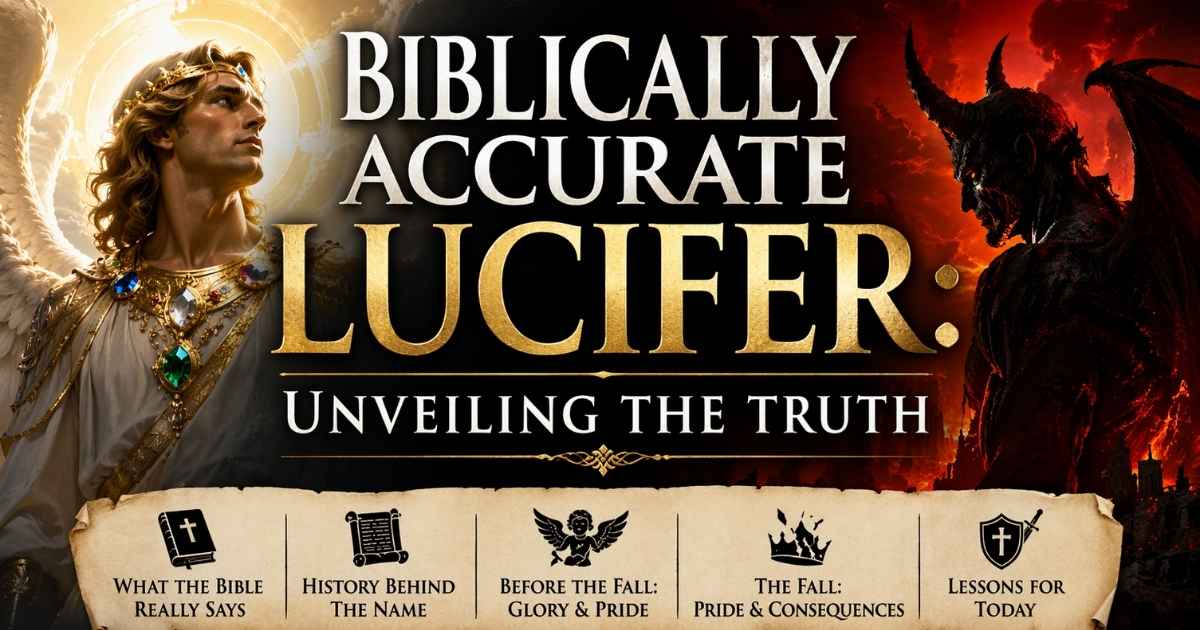
Most people carry a picture of Lucifer painted by Hollywood, medieval folklore, and centuries of artistic tradition rather than Scripture. The biblically accurate Lucifer looks nothing like the red-horned figure sold in costume shops every October. He carries no pitchfork. His skin is not scarlet. And the Bible never crowns him ruler of hell. Understanding who Lucifer truly is demands something harder than assumption. It demands returning to the Hebrew text, reading the Latin translation history, and allowing Scripture to speak without the noise of tradition.
This article strips away those centuries of myth and gives you the Lucifer in the Bible as Scripture actually presents him: a being of staggering beauty, catastrophic pride, and eternal consequence.
Biblically Accurate Understanding of Lucifer’s Identity
Common Misconceptions About Lucifer in Modern Culture
Walk into any bookstore or streaming platform and you will find Lucifer portrayed as a charming antihero, a terrifying monster, or a sympathetic rebel. None of those portraits come from the Bible. They come from Dante, Milton, Victorian theatre, and modern entertainment. Common misconceptions that have no scriptural basis include:
- Lucifer possessing red skin, horns, or a tail (derived from medieval European folklore, not Hebrew texts)
- A pitchfork and bat-like wings (literary inventions from Dante’s Inferno and Renaissance drama)
- Lucifer reigning as ruler of hell (the Bible assigns him no such role; Matthew 25:41 describes hell as prepared for him, not governed by him)
- The automatic equation of Lucifer with Satan (a theological merger built through tradition, not direct Scripture)
- Lucifer appearing repeatedly throughout the Bible (the word appears exactly once in the King James Version)
These images feel religious because they have lived inside churches, sermons, and sacred art for so long. But feeling religious and being biblical truth are two entirely different things.
What Scripture Actually Reveals About Lucifer
The Bible’s actual treatment of Lucifer is concentrated and precise. The two primary texts are Isaiah 14:12–15 and Ezekiel 28:12–17. Outside those passages, direct references are remarkably thin. Most of what Christians believe about Lucifer is constructed from interpretation layered upon interpretation, shaped by literary genius and cultural fear rather than careful exegesis vs eisegesis in Bible study.
Scripture reveals a being of unmatched created perfection whose corruption originated entirely from within. His tragedy is not forced upon him. It is chosen.
The Hebrew Original: Helel and Its True Meaning
The word “Lucifer” does not exist in the Hebrew Bible. What Isaiah 14:12 contains is the Hebrew term הֵילֵל (Helel), derived from the root halal, meaning “to shine” or “to radiate brightly.” Biblical scholars confirm that Helel ben Shachar translates most accurately as “shining one, son of the dawn.” This is astronomical language pointing directly to the planet Venus as the morning star, which blazes brilliantly before sunrise and vanishes when the sun rises.
This morning star Bible meaning carries enormous weight. The imagery describes someone who rises in dazzling prominence only to be eclipsed and cast down. It is a poetic taunt, not a proper name. Understanding the Hebrew word Helel dismantles the assumption that “Lucifer” is a name Scripture repeatedly uses to identify a specific angelic being.
Jerome’s Latin Vulgate and the Birth of ‘Lucifer’
In the late 4th century, the scholar Jerome translated the Hebrew Scriptures into Latin, producing what became known as the Jerome Latin Vulgate. When he reached Helel in Isaiah 14:12, he chose the Latin word Lucifer, which carries the Lucifer Latin meaning of “light-bearer” or “light-bringer.” This was a legitimate and reasonable translation choice. Lucifer was a common Latin title for the morning star and held no inherently demonic meaning at that point in history.
The problem arose not from Jerome’s translation but from what came after it. As the Vulgate became the dominant Bible of Western Christianity, the word Lucifer gradually absorbed the theological weight of centuries of teaching about Satan’s fall. A descriptive title became a personal name. A poetic metaphor became a biography.
King James Translation and English Christian Tradition
When the King James Version was produced in 1611, the translators retained “Lucifer” from the Latin tradition rather than rendering the Hebrew Helel directly. This King James Lucifer translation cemented the name in English-speaking Christianity for over four centuries. Most modern Bible translations, including the NIV, ESV, and NASB, have abandoned “Lucifer” entirely, instead translating the verse as “morning star,” “day star,” or “son of the dawn,” restoring the original morning star symbolism Bible intended.
This translation history is not a minor footnote. It explains why the name Lucifer carries enormous theological baggage it was never meant to carry in the original Hebrew.
Biblically Accurate Description of Lucifer’s Appearance
Lucifer’s Pre-Fall Glory According to Ezekiel
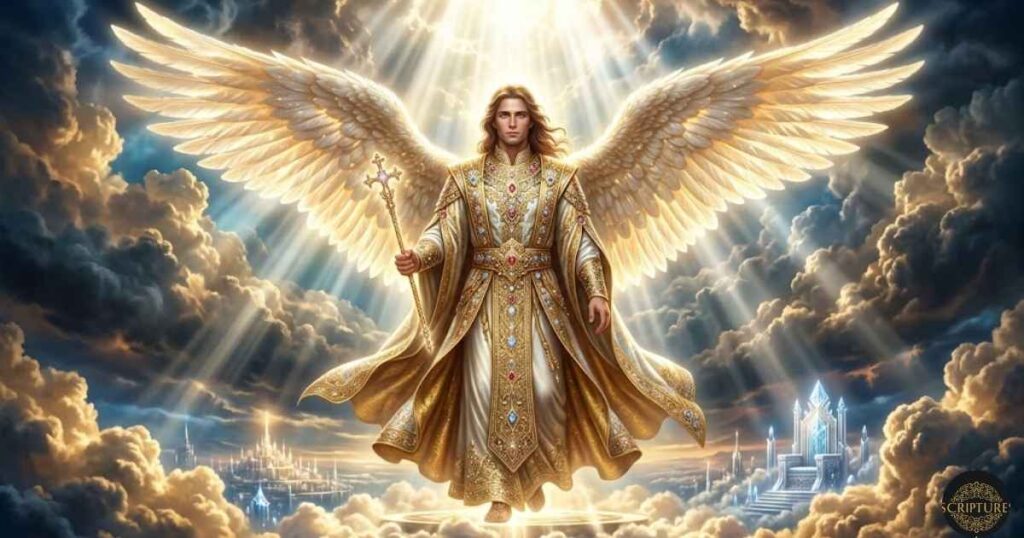
Ezekiel 28 interpretation provides the most detailed portrait of Lucifer’s original state. Though the passage is addressed to the King of Tyre prophecy in its immediate context, many theologians read a dual reference that reaches beyond any earthly monarch into the spiritual realm. The description is breathtaking:
- Called the “seal of perfection” in wisdom and beauty
- Covered with every precious stone: sardius, topaz, diamond, beryl, onyx, jasper, sapphire, emerald, and carbuncle
- Described as the “guardian cherub” placed on the holy mountain of God
- Walking in the midst of fiery stones with a perfection that remained “from the day you were created”
The anointed cherub meaning here is significant. He was not merely an angel among many. He held a position of proximity to the divine presence that Scripture reserves for the highest order of angelic beings. The cherub meaning Bible points to a guardian role of extraordinary honor and closeness to God.
The Morning Star Imagery in Isaiah’s Prophecy
Isaiah 14:12 explanation uses cosmic imagery to describe a catastrophic reversal. The morning star symbolism captures the trajectory precisely: a being that once shone brighter than any other, rising above all other created lights, is now cast to the ground. The Venus morning star analogy works because Venus appears to rule the night sky, outshining every star, only to disappear completely when the true sun arrives. Pride imagined permanence. Reality delivered exile.
The biblical symbolism in Isaiah functions as a taunt against the arrogance of greatness that forgets its dependence. Whether the primary referent is the King of Babylon prophecy or a cosmic spiritual being, the theological warning remains identical: exaltation without humility ends in ruin.
Does Lucifer Possess Physical Form After His Fall
Scripture refuses to satisfy curiosity on this point, and that silence is itself instructive. The Bible emphasizes the nature of angelic rebellion and its moral consequences rather than physical descriptions. Does Satan have a body after his fall? The biblical evidence suggests that spiritual beings may manifest in various forms when interacting with the physical world, but no fixed biblical description of the devil exists. What 2 Corinthians 11:14 does tell us is far more unsettling: Satan masquerades as an angel of light. The danger is not a monster you can see coming. The danger is deception dressed in beauty.
What Biblical Silence Tells Us Lucifer Is Not
The biblical description of the devil is notable for what it excludes. Scripture never describes:
- Red skin or demonic horns (medieval European folklore)
- A pitchfork (theatrical prop from Renaissance opera)
- Bat-like wings (Dante’s literary invention in Inferno)
- A fixed dwelling in hell as its ruler (the Bible presents hell as his future judgment, not his current throne)
The red devil origin is traceable to pagan imagery, specifically conflation with the Greek god Pan, blended with artistic horror traditions in medieval Europe. None of it appears in the Hebrew or Greek biblical texts.
Symbolism and Meaning Behind Lucifer’s Role in Biblical Texts

Lucifer’s role in biblical cosmology is not incidental. It is deeply symbolic and carries layered theological meaning that extends far beyond a simple story of one angel’s rebellion. Scripture uses his narrative as a lens through which to examine pride, created beauty, free will, and the origin of evil in ways that speak directly to human experience.
The morning star Bible meaning assigned to Lucifer is not accidental. In the ancient Near Eastern world, Venus as the morning star represented the pinnacle of created brilliance. It outshines every other star. It rises first and burns brightest. That image applied to Lucifer communicates something precise: among all created spiritual beings, he was considered the most radiant, the most gifted, and the most honored. Biblical symbolism in Isaiah chooses this image deliberately to sharpen the contrast between what he was and what he became.
His role as guardian cherub in Ezekiel 28 carries additional symbolic weight. The cherubim in the Bible are consistently associated with the immediate presence of God, guarding the divine throne and the holy of holies. Placing Lucifer in this role signals that his proximity to God was unmatched among created beings. This makes his rebellion not merely a moral failure but a theological statement: no amount of closeness to God, no level of gifted excellence, guarantees faithfulness without a humble will surrendered to the Creator.
Lucifer’s symbolic function across biblical texts also serves as a warning about spiritual deception in the Bible. His fall demonstrates that the most dangerous corruption does not announce itself. It begins silently, internally, in the private architecture of comparison and self-exaltation. For this reason, 2 Corinthians 11:14 is among the most theologically significant statements about his ongoing nature: he disguises himself as an angel of light. The symbolism is complete. He was light. He lost light. And now he counterfeits light. Understanding this role is essential for spiritual warfare Bible discernment.
Common Misinterpretations About Lucifer in Modern Culture
Modern culture has not simply misunderstood Lucifer in the Bible. It has systematically replaced the biblical portrait with something more dramatic, more visually arresting, and far less theologically accurate. These misinterpretations are not harmless. They shape how millions of people think about evil, deception, and the nature of spiritual adversaries.
The most widespread misinterpretation is the red devil image itself. Red skin, horns, a pointed tail, and a pitchfork appear nowhere in the Hebrew or Greek Scriptures. They originate from a centuries-long blending of pagan Pan imagery with medieval artistic horror conventions. When Christians unconsciously accept this image, they end up looking for evil in the wrong form. The Bible’s actual warning, articulated in 2 Corinthians 11:14, is that the adversary appears as light and beauty, not as an obvious monster.
The second major misinterpretation is that Lucifer rules hell as his kingdom. This idea, popularized through Dante’s Inferno Satan and absorbed into common Christian imagination, has no biblical foundation. Matthew 25:41 meaning is unambiguous: the eternal fire was prepared for the devil and his angels as their punishment, not their domain. He is a prisoner awaiting sentence, not a king managing a realm.
A third persistent misinterpretation is reading Milton Satan character in Paradise Lost as a theological source. Milton was a poet of extraordinary genius and sincere Christian faith, but Paradise Lost is literature, not Scripture. His Satan is a tragic, articulate, emotionally complex figure whose famous line “Better to reign in hell than serve in heaven” reads as courageous defiance. The biblical Satan is an adversary and accuser whose pride and rebellion in Scripture leads only to ruin. Absorbing Milton’s portrait as biblical truth creates a Lucifer that is sympathetic, relatable, and subtly admirable, which is precisely the opposite of what Scripture intends to communicate.
A fourth misinterpretation involves Lucifer myths vs truth regarding his power. Popular culture often portrays him as nearly omnipotent, a near-equal to God engaged in a cosmic struggle of balanced forces. This reflects dualism, a philosophical framework foreign to biblical theology. The Satan limited power Bible presents consistently. In Job 1, Satan requires God’s permission before touching Job. He operates within divine limits. He is formidable. He is not God’s equal.
Critical Distinction Between Lucifer and Satan in Scripture
This is one of the most theologically significant and most frequently ignored distinctions in popular Christianity. Lucifer vs Satan difference is not a minor academic debate. It has real consequences for how Scripture is interpreted.
| Feature | Lucifer | Satan |
|---|---|---|
| Language of origin | Hebrew (Helel) via Latin (Lucifer) | Hebrew (Satan) |
| Meaning | “Shining one” or “light-bearer” | “Adversary” or “accuser” |
| Appearances in KJV | Once (Isaiah 14:12) | 58 times across Scripture |
| Primary context | Pre-fall glory and pride | Post-fall role as accuser and adversary |
| Key passages | Isaiah 14, Ezekiel 28 | Job 1, Zechariah 3, New Testament |
Biblical Evidence Supporting Their Distinction
Satan in the Bible is described consistently as an adversary and accuser. The biblical meaning of Satan appears in Job 1 Satan role, where he stands before God accusing a righteous man. In Zechariah 3 Satan accusation, he functions as a legal prosecutor against the high priest Joshua. These portraits show a being engaged in accusation and temptation, not a figure being described in terms of former glory and luminous beauty.
Lucifer as a title describes radiance and position. Satan as a word describes function and relationship. One points to what was created. The other points to what was chosen.
How Christian Tradition Merged These Figures
The merger happened gradually. Church fathers, writing in the early centuries, began connecting Isaiah 14 and Ezekiel 28 with New Testament statements about Satan’s fall, particularly Luke 10:18 Satan fall, where Jesus says, “I saw Satan fall like lightning from heaven.” Over time, sermons layered interpretation upon interpretation. By the medieval period, the connection was treated as settled doctrine rather than theological tradition. Works like Dante’s Inferno Satan and Paradise Lost Lucifer by Milton Satan character then gave the merged figure a vivid cultural life that made correction nearly impossible.
Protestant Reformers’ Rejection of the Equation
The Protestant Reformation introduced a critical shift. Reformed teachers emphasizing sola scriptura began questioning traditions built on church interpretation rather than explicit biblical statements. Hermeneutics Bible study principles demanded asking: does Scripture actually say this, or has tradition assumed it? Some reformers insisted that Isaiah 14 should be read primarily as a taunt against the King of Babylon prophecy in its historical context, not as a hidden cosmic narrative about angelic rebellion.
This was not a denial of Satan’s reality. It was a commitment to exegesis vs eisegesis and biblical context interpretation over accumulated tradition.
Why This Theological Distinction Matters Today
Understanding Lucifer identity debate correctly protects the integrity of biblical interpretation. When symbolic poetry is treated as systematic theology, spiritual deception in the Bible becomes easier rather than harder to recognize. The most dangerous adversary is the one 2 Corinthians 11:14 describes: not a red monster, but an entity that disguises itself as truth. Ephesians 6:12 meaning reminds believers that the real warfare is not physical. The enemy operates through deception, not obvious horror.
Biblically Accurate Account of Lucifer’s Fall and Significance
The Narrative of the Fallen Angel in Scripture
The fallen angel in Scripture narrative centers on Isaiah 14:12–15. The language is poetic and cosmic. A being of supreme created glory, positioned at the heights of heavenly honor, makes a catastrophic choice driven entirely by pride. The angelic rebellion narrative is not presented as God’s failure. It is presented as the creature’s choice, which makes it both more sobering and more instructive.
Lucifer’s Five ‘I Will’ Declarations of Pride
Isaiah 14:13–14 records five declarations that form the theological core of pride before the fall Bible teaching. These five “I will” statements Isaiah reveal a progressive escalation of self-exaltation:
- “I will ascend to heaven“
- “I will raise my throne above the stars of God”
- “I will sit on the mount of assembly in the far reaches of the north”
- “I will ascend above the heights of the clouds”
- “I will make myself like the Most High“
Each statement moves closer to the ultimate transgression: claiming equality with God. The pride and rebellion in Scripture displayed here is not impulsive anger. It is deliberate, progressive, and self-constructed. This is what Proverbs 16:18 warns: “Pride goes before destruction, and a haughty spirit before a fall.”
The Nature of Sin: Pride in God-Given Perfection
Here lies one of theology’s most profound paradoxes. The origin of evil theology asks: how does a perfect being in a perfect environment choose evil? The answer lies in the nature of free will and angels. Classical theology distinguishes between integrity perfection, created without flaw but capable of falling, and confirmed perfection, established in goodness and unable to fall. Lucifer possessed the first. He used that freedom to elevate the gifts above the Giver.
The origin of evil in Scripture is not external contamination. It is internal corruption, specifically the corruption of a God-given excellence through the pride of claiming it as self-originated. He forgot his dependent status and mistook derived glory for inherent glory.
Catastrophic Consequences of Angelic Rebellion
The consequences of pride Bible reveals in Lucifer’s story are absolute and irreversible. Unlike humanity, which receives the offer of redemption through Christ, fallen angels in Bible teaching indicates no such provision exists. Matthew 25:41 meaning is sobering: eternal fire was prepared for the devil and his angels, not as his kingdom but as his judgment.
Luke 10:18 records Jesus’ statement, “I saw Satan fall like lightning from heaven,” suggesting a catastrophic and sudden removal from heavenly standing. The being described as walking “in the midst of the stones of fire” in Ezekiel is now described in 1 Peter 5:8 meaning as prowling like a roaring lion, seeking those to devour. The trajectory from glory to predator is Scripture’s most devastating character arc.
The Scope of Rebellion: One-Third of Angels
Revelation 12 dragon symbolism introduces the imagery of the dragon sweeping a third of the stars from heaven with his tail, which many theologians interpret as the one-third of angels fall who joined Lucifer’s rebellion. The fallen angels meaning here points to a cosmic spiritual catastrophe that preceded human history. These beings, now described as demonic influence Scripture warns about, form the spiritual forces Paul describes in Ephesians 6:12 meaning: “We wrestle not against flesh and blood, but against principalities, against powers, against the rulers of the darkness of this world.”
Lucifer in Apocryphal and Non-Canonical Texts

Outside the canonical Bible, apocryphal literature like 1 Enoch, the Life of Adam and Eve, and 2 Enoch expand the Lucifer narrative dramatically. These texts give him a backstory, motivations, and detailed descriptions that never appear in Scripture. They shaped early Jewish and Christian imagination significantly. However, their status as non-canonical means they represent tradition and speculation, not biblical truth vs tradition as defined by the canon. Theologians value them for historical insight into how beliefs developed while refusing to grant them the authority of Scripture.
Cultural Impact of Lucifer in Literature and Media
Artistic Evolution of Lucifer’s Image Throughout History
The Lucifer artistic depictions that dominate modern imagination did not emerge from the Bible. They emerged from art responding to cultural anxiety, theological allegory, and dramatic storytelling across different historical periods.
Early Medieval Period: The Ethereal Blue Angel
Medieval Lucifer imagery in its earliest form was remarkably close to biblical description. Byzantine artists from the 6th century portrayed Lucifer as an ethereal blue angel of celestial beauty, visually indistinguishable from other heavenly beings except by narrative context. The famous 6th-century mosaic at Sant’Apollinare Nuovo in Ravenna depicts angelic figures in blue, representing heavenly origin. This period honored the scriptural portrait of a radiant, beautiful being.
High Medieval Transformation to Grotesque Forms
By the High Medieval period, cultural fears about demonic possession, plague, and spiritual warfare transformed the image dramatically. Artists began depicting Lucifer as monstrous, grotesque, and physically terrifying. Dante’s Inferno Satan became the definitive image of this era: a three-faced, ice-bound giant at the very center of hell, chewing on traitors for eternity. This was theological allegory expressed through horror, not biblical description.
Renaissance Romanticization: Milton’s Tragic Rebel
Paradise Lost Lucifer by John Milton, published in 1667, represents the most influential reimagining in English literary history. Milton Satan character is not a monster. He is a tragic hero, defiant, eloquent, and emotionally complex, declaring “Better to reign in hell than serve in heaven.” Millions absorbed this as biblical truth. It was brilliant literature written by a man of genuine faith, but it was not Scripture. It was imagination, and its influence on how Christians picture Lucifer is impossible to overstate.
Victorian Era Through Modern: The Theatrical Red Devil
Victorian devil symbolism borrowed from pagan mythology, blending horned gods from ancient fertility traditions with loosely biblical framing. Theatre, opera, and eventually cinema locked in the red devil origin as popular iconography. Modern television and film completed the transformation, turning the biblical vs cultural Lucifer gap into a canyon. Today’s screen Lucifer ranges from charming crime-solver to cosmic supervillain, each version more distant from the Hebrew text than the last.
Contrasts Between Artistic and Biblical Portrayals
| Category | Biblical Lucifer | Cultural/Artistic Lucifer |
|---|---|---|
| Appearance | Radiant, gem-covered, glorious | Red, horned, winged, monstrous |
| Role | Exalted guardian cherub | Ruler of hell |
| Fall cause | Pride and self-exaltation | Rebellion against tyranny (Milton) |
| Current nature | Adversary and deceiver | Monster or antihero |
| Power | Limited under God’s sovereignty | Often near-omnipotent |
Theological Insights from a Biblically Accurate Lucifer
The Paradox of Created Perfection and Free Will
The free will and angels question sits at the heart of Lucifer’s story. Genuine freedom means genuine alternatives. Without the capacity to choose wrongly, choosing rightly carries no moral weight. God created Lucifer with real freedom, which made his perfection a genuine virtue rather than programmed behavior. But real freedom also made his rebellion genuinely possible. This is the paradox: the same gift that made his original goodness meaningful made his eventual rebellion possible.
The Origin of Evil Within a Perfect Being
Origin of evil theology locates sin not in external corruption but in the misuse of internal freedom. Evil did not enter Lucifer from outside. It arose from within a being who had every reason for gratitude and chose comparison instead. This has enormous implications for Christian theology on Lucifer: evil is not a co-equal force with God. It is a parasite on goodness, a corruption of what was originally excellent. Biblical cosmology does not support dualism. God remains sovereign even over the adversary.
Pride’s Specific Temptation: Giftedness and Position
The five “I will” statements Isaiah reveals the specific form pride took for Lucifer: not the pride of mediocrity, but the pride of genuine excellence. He was the most brilliant, the most beautiful, the most honored. His temptation was to mistake the gifts for the Giver, to treat created glory as self-generated identity. This makes his story a warning not primarily for the insignificant but for the gifted and positioned. Those with the most to be thankful for face the subtlest and most dangerous temptation to pride.
Cosmic Implications: Corrupting Others and Spiritual Warfare
Lucifer did not fall alone. His rebellion drew one-third of angels into catastrophic defection. Spiritual warfare Bible passages like Ephesians 6:10–18 exist precisely because of this cosmic reality. The demonic influence Scripture describes throughout the New Testament reflects the ongoing activity of fallen beings who once stood in the presence of God. 1 Peter 5:8 meaning warns believers to be sober and vigilant because the adversary is active and strategic.
Lessons for Humanity: Humility and Dependence on God
Lucifer’s story functions throughout Scripture as a warning applied directly to human experience. Humility vs pride teaching appears consistently in both Testaments. Romans 12:3 meaning instructs believers not to think of themselves more highly than they ought, but with sober judgment. Proverbs 16:18 explanation states it plainly: pride precedes destruction. Dependence on God teaching rooted in Lucifer’s example reminds believers that gifts are always derivative. The Giver remains the source. The moment a created being treats its gifts as self-originated, it has begun walking Lucifer’s path.
Humility is not false modesty or self-deprecation. It is accurate accounting: knowing what you have, knowing where it came from, and refusing to confuse the two.
Frequently Asked Questions
Is Lucifer and Satan the same person in the Bible?
Scripture maintains distinct identities for these figures. Lucifer vs Satan difference is rooted in etymology and context: Lucifer describes pre-fall radiance while Satan describes post-fall function as adversary and accuser.
What does the name Lucifer actually mean in Hebrew?
The Hebrew word Helel (Helel ben Shachar) means “shining one, son of the dawn,” referring to Venus morning star analogy as the morning star that vanishes at sunrise.
Where does the red devil image come from?
The red devil origin traces to medieval European folklore blended with pagan imagery of the horned god Pan, later amplified by Renaissance theatre and Victorian entertainment. It has no scriptural foundation.
Did Lucifer actually rule over one-third of the angels?
Revelation 12 dragon symbolism is interpreted by many scholars as indicating a one-third of angels fall in rebellion, though this text uses apocalyptic imagery and interpretations vary among theologians.
What does Ezekiel 28 say about Lucifer?
Ezekiel 28 meaning describes a being called the “seal of perfection” and the guardian cherub, covered in precious stones and walking in God’s holy mountain, whose pride led to corruption and exile.
Why does the Bible say so little about Lucifer’s appearance after his fall?
Scripture consistently redirects attention from physical description to moral and spiritual reality. The biblical focus is on the nature of rebellion, its consequences, and its warnings for humanity, not on satisfying curiosity about angelic appearance.
Does Satan rule hell according to the Bible?
No. Matthew 25:41 meaning is clear: eternal fire was prepared for the devil and his angels, meaning hell is his future judgment, not his current throne. He is not the ruler of hell in any biblical text.
Last Words
The biblically accurate Lucifer that emerges from careful Scripture study is far more theologically powerful than any cultural caricature. He is not a red-horned monster easily dismissed or a charming antihero to admire. He is a being of unparalleled created perfection whose catastrophic choice to exalt himself above his Creator became the first and most devastating act of pride in the history of existence.
His story is not primarily about him. It is a mirror held up to every created being entrusted with gifts, position, and proximity to God. The warning embedded in Isaiah 14 and Ezekiel 28 is not ancient history. It is a live theological charge: remember your dependence, honor the Giver, and guard against the subtle corruption of treating grace as personal achievement.
Returning to biblical truth vs tradition on Lucifer is not about winning academic arguments. It is about knowing your adversary accurately, understanding the real nature of spiritual deception in the Bible, and standing firm in the humility that Lucifer abandoned. As 1 Peter 5:8 warns: be sober. Be watchful. The adversary prowls. And he does not announce himself with horns and a pitchfork. He comes dressed in light.