

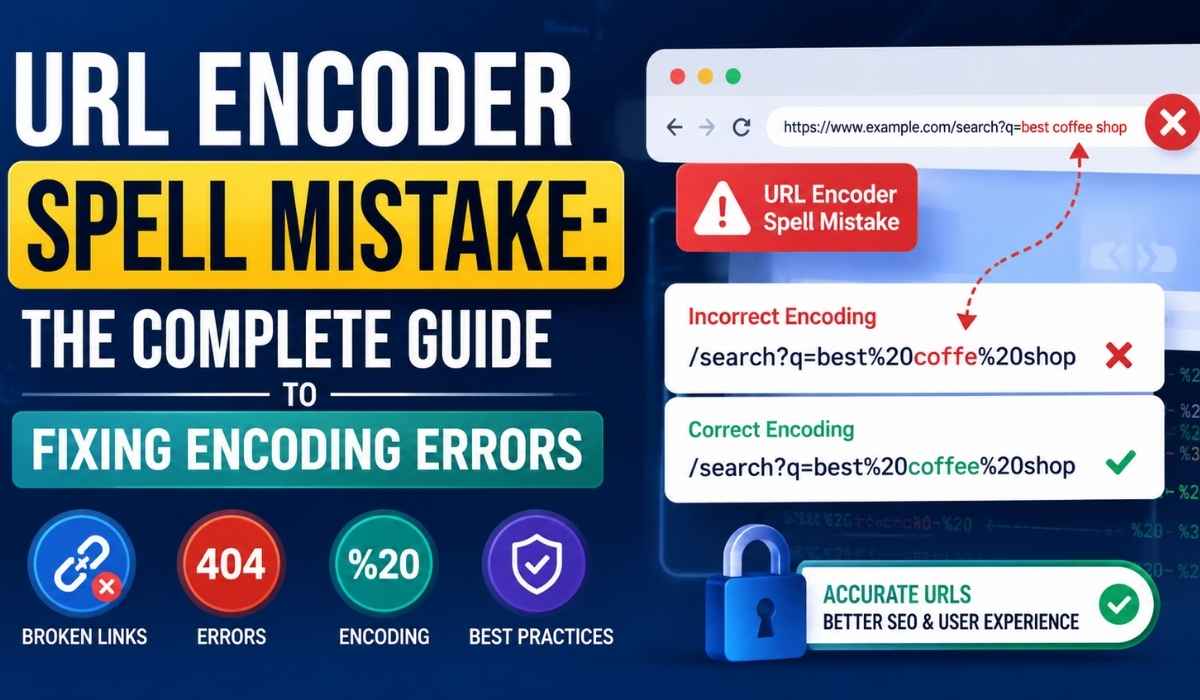
In today’s web-driven world, even a tiny error in a URL can cause a broken site or failed API call. A URL Encoder Spell Mistake occurs when characters in a link are incorrectly encoded, leading to broken URLs and failed HTTP requests. In practice, this means a misplaced percent sign or a double-encoded space might turn a working link into a 404 Not Found error or a corrupted query.
In this guide, we explain what these mistakes are and how to fix them with clear, step-by-step instructions. We cover the underlying percent encoding system, how search engines see URLs, and the best tools and practices for keeping your links clean and error-free.
What Is a URL Encoder Spell Mistake
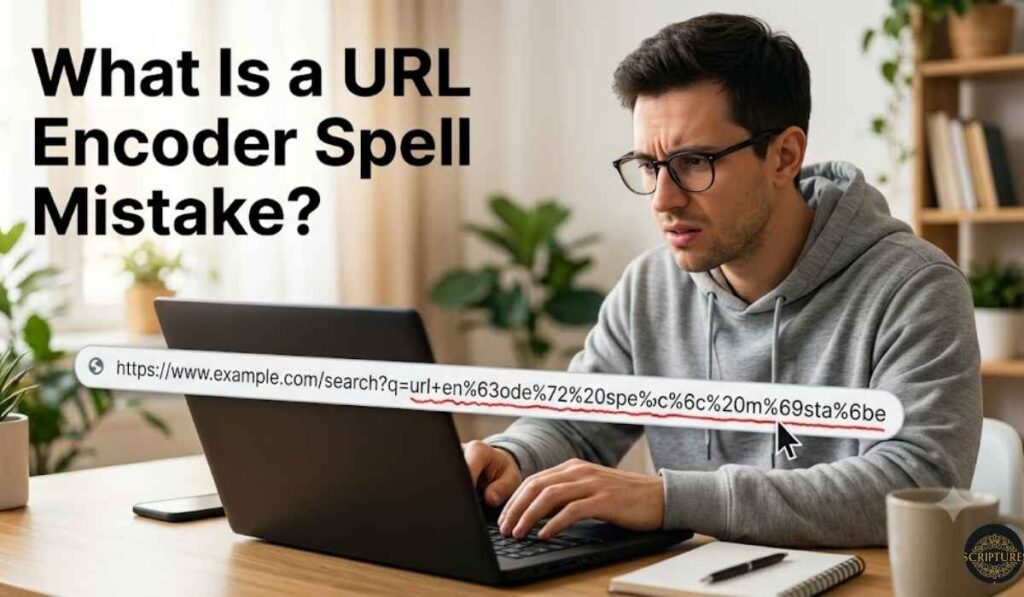
A URL encoder spell mistake is essentially a typo or logic error in how a URL is percent-encoded. URLs can only safely include a limited set of characters, so all unsafe characters (spaces, symbols, non-ASCII letters) must be converted into a percent sign followed by two hexadecimal digits. For example, a space becomes %20 under URL encoding.
A spellmistake happens when this process goes wrong – perhaps a developer manually types %2 instead of %20, or a script double-encodes a string (turning % into %25). In short, it’s not an English spelling error at all, but an encoding syntax error inside a link.
This mistake usually surfaces as broken or invalid URLs. A search for the term “URL encoder spellmistake” often comes from developers seeing strange behavior: pages that fail to load, missing query string parameters, or API calls returning errors. At a technical level, the mistake means the browser and server cannot parse the URL correctly. Web servers and browsers operate on ASCII or UTF-8 encoding, so any mis-encoded character can break the entire data transmission pipeline.
Importance of Correct URL Encoding in Web Systems
Correct URL formatting is absolutely critical for web development and SEO. Every time data is sent via a URL – whether in an HTTP GET request, a search query, or an API call – it must follow the strict rules of RFC 3986 (the Internet standard for URIs). Proper encoding ensures that each reserved character (like ?, &, #) is interpreted correctly. When URLs are clean and well-formed, systems and search engine crawlers can reliably read them.
From an SEO-friendly perspective, clean URLs make a big difference. Googlebot and other crawlers prefer clean URLs that do not produce errors. If a site has many broken links caused by encoding errors (for example, a recursive %2520 instead of a single %20), crawlers may skip those pages or waste precious crawl budget on infinite loops. This degrades search visibility and indexing. In practice, a corrupted URL can mean a product or blog post becomes invisible to search engines.
Correct encoding also affects user experience and data integrity. Modern web apps pass data in URLs constantly: search queries, form values, UTM tracking parameters, session tokens, etc. If a special character (like an ampersand or equal sign) is not encoded properly, the browser or server might misread the parameters. For example, a product name “Dolce & Gabbana” would break a link if the ampersand isn’t encoded, splitting the query incorrectly. Users will see a broken page or missing results. In secure backend systems, even a minor encoding slip can cause a payment API or login flow to fail.
Key Takeaway: Correct percent-encoding ensures reliable data transmission and protects SEO. A single encoding mistake can turn a friendly URL into an invalid URL, causing 400-404 errors and lost traffic.
Common Causes of URL Encoder Spell Mistakes
Several factors contribute to URL encoding mistakes.
Human Error
Developers manually editing URLs may introduce:
- Spelling errors
- typo in URL
- Missing encoding characters
Copy-Paste Artifacts
Text copied from documents may include:
- Hidden spaces
- Invalid symbols
- Unexpected Unicode characters
Incorrect Encoding Functions
Using encodeURI when encodeURIComponent is needed can create parsing issues.
Double Encoding
A common issue where already encoded text gets encoded again.
Example:
Original: hello world
Encoded: hello%20world
Double Encoded: hello%2520world
This creates recursive encoding problems.
Hardcoded URLs
Poorly maintained hardcoded URLs often contain outdated encoding logic.
How URL Encoding Works in Simple Terms
At its core, URL encoding (or percent-encoding) is a simple table lookup defined by the ASCII character set and the URI standard (RFC 3986). Any character that is not a letter (A–Z, a–z), digit (0–9), or one of the few URL-safe characters (like -, _, .) must be converted into a three-character sequence: a percent sign (%) followed by two hexadecimal digits representing the character’s ASCII code.
- Example: A space character (ASCII 32) is encoded as
%20. A#(ASCII 35) becomes%23. An emoji or accented character (likeéin UTF-8) is broken into bytes and each byte is encoded (foréit becomes%C3%A9). This ensures that the URL only contains the limited ASCII characters that all browsers and servers can handle consistently.
This scheme guarantees that web-safe characters remain literal (like alphanumerics), while any unsafe or reserved characters (such as , ?, &, =) are safely escaped. When a browser sends a URL, it actually sends these percent codes in the HTTP request header, so the server gets a clean, standardized address. For example, the file my report.pdf on a server would be requested as my%20report.pdf, preventing the space from being misinterpreted as a delimiter.
In practice, all modern web frameworks and browsers handle most encoding automatically. Still, it’s helpful to remember the basics:
| Character | Encoded Form | Purpose |
|---|---|---|
Space ( ) | %20 | Replaces blank space |
| & | %26 | Escapes ampersand in query values |
| = | %3D | Escapes equals sign |
| ? | %3F | Escapes question mark |
| # | %23 | Escapes fragment/hash symbol |
é | %C3%A9 | Example of UTF-8 international char |
Each percent-encoded value has a clear purpose: to let browsers transmit unsafe URL characters without confusing them for URL syntax. As one guide puts it, encoding “preserves structure while safely transmitting dynamic data”. Keeping this simple percent encoding logic in mind helps you identify where mistakes happen.
How to Identify URL Encoder Spell Mistakes
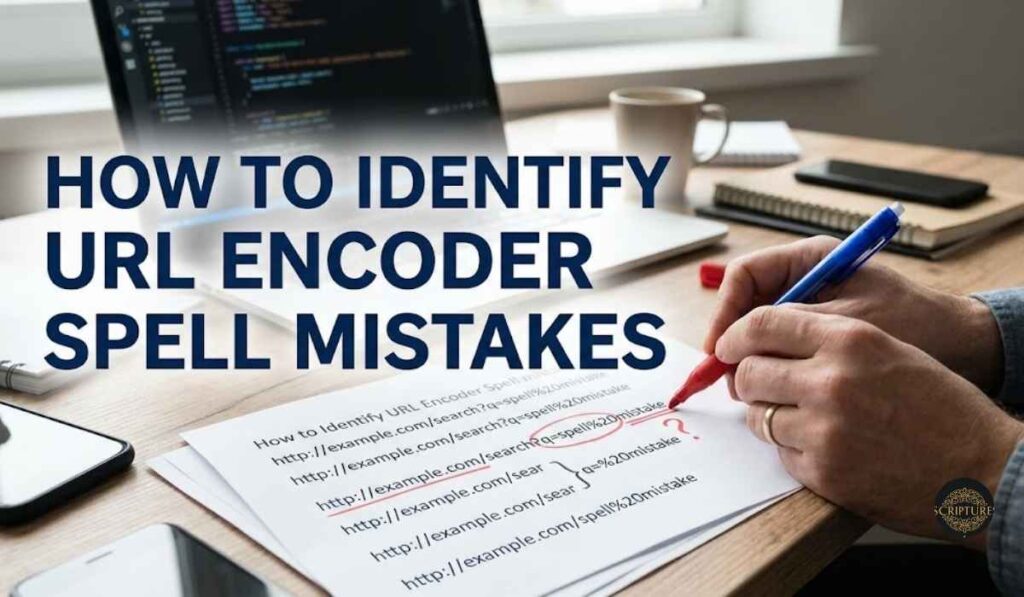
Catching encoding errors early saves a lot of trouble. Here are common symptoms of a URL encoder spell mistake:
- Error codes: A page that once loaded fine now returns HTTP 400 (Bad Request) or 404 Not Found. These often signal that the URL had unexpected characters.
- Garbled URL display: In the browser’s address bar or logs, you see unusual
%sequences like%25or%2520, or broken-out words. For instance, a double-encoded space might show%2520. These sequences mean the link isn’t being read as intended. - Missing parameters: Some query values are missing or truncated. For example, a search URL for
Blue & Redreturning only “Blue” suggests that the ampersand was not encoded, splitting the query at the&. - Broken redirects: A URL that should redirect to another page sends you to an error instead.
- SEO crawl issues: In Google Search Console or site audit tools, you might see crawl errors or “Invalid URL” warnings.
- Testing anomalies: Automated tests, or tools like Postman/cURL, report malformed URL errors when trying to fetch a link.
To diagnose, developers use several tools:
- Browser Developer Tools: Open the Network tab in Chrome DevTools (or similar). Watch the Request URL of a network call. If you see odd encodings (like
%20turning into%25), it’s a red flag. DevTools shows exactly what the browser is sending. - Server logs (e.g. Nginx logs): These logs record incoming request URLs. If an encoded string differs from what you expect, check logs to see how the server parsed it.
- API testing tools: Use Postman or cURL with the suspect URL to see if the request gets through or returns a syntax error.
- SEO Crawlers: Tools like Screaming Frog or Ahrefs Site Audit will flag broken links or unusual URL patterns as crawl errors.
By combining these methods, you can pinpoint an encoding mistake. For example, if Chrome DevTools shows the request as /page?name=John%20Doe%25 instead of /page?name=John%20Doe%20, you know a % was double-encoded. Once identified, you can decode the URL (using decodeURIComponent or an online URL decoder) and inspect the raw string for errors.
Step by Step Process to Fix URL Encoder Spell Mistakes
Fixing a URL encoder spell mistake isn’t guesswork – it’s a methodical process. Follow these steps:
- Isolate the broken URL: Find the exact URL that’s failing. Look in server logs or browser tools. Note the full request including query string and path.
- Decode the URL: Use a reliable decoding tool or a command like
decodeURIComponent()in JavaScript to convert the URL back to plain text. This reveals which character(s) are wrong. - Identify the syntax flaw: Examine the decoded string. Check for:
- Unescaped characters (spaces,
&,?, etc.) that should have a%code. - Incorrect or incomplete percent sequences (e.g.
%2instead of%20). - Double-encoding signs (
%25in place of%). - Any hidden Unicode characters from copy-paste.
- Unescaped characters (spaces,
- Correct the raw text: Fix the mistake in the decoded string. Ensure that each unsafe symbol gets exactly one encoding. For example, replace every raw space with
%20and&with%26. - Re-encode properly: Use the correct encoding function or tool to encode the fixed string. In code, use built-in functions (e.g.,
encodeURIComponent()in JavaScript orurlencode()in PHP) rather than typing codes by hand. - Validate and test: Put the corrected URL into a browser or test client. Confirm that it returns HTTP 200 OK and that all parameters are received correctly by the server. Check for any new errors.
- Deploy and monitor: If the fix is for a live system, deploy the change and monitor logs or analytics. Ensure no further 400-level errors pop up for that URL.
This systematic approach lets you fix the encoding problem at its root. As the Celebrora guide notes, following a structured process “resolves even the messiest encoded URL problems without pulling your hair out.”.
Examples of URL Encoding Mistakes and Fixes
Seeing real examples makes these errors concrete. Below are some common mistakes and how to correct them:
| Issue | Broken URL | Corrected URL |
|---|---|---|
| Unencoded spaces: Raw space character in path or query. | https://example.com/downloads/annual report 2026.pdf | https://example.com/downloads/annual%20report%202026.pdf |
| Unescaped ampersand: Ampersand in parameter value. | https://example.com/search?brand=Dolce&Gabbana | https://example.com/search?brand=Dolce%26Gabbana |
Double encoding: Already-encoded % is encoded again. | https://example.com/user/John%2520Doe | https://example.com/user/John%20Doe |
| Incorrect hex digit: Mistyped percent code. | https://example.com/item?q=hello%2world | https://example.com/item?q=hello%20world |
| Missing encoding: Special char in query string. | https://example.com/page?title=Red Scarf & Hat | https://example.com/page?title=Red%20Scarf%20%26%20Hat |
- In the first example, a space in “annual report” is replaced by
%20. Without encoding, the space breaks the URL. - In the second, the
&in “Dolce & Gabbana” must be%26; otherwise, the server treats “Gabbana” as a separate parameter. - In the third,
%25is the code for%. The double encoding made%20become%2520. Fix by encoding only once. - The fourth example shows a common typo:
%2worldis invalid. It should be%20(zero, not the letter O). - Finally, combining spaces and
&, we ensure every special character is percent-encoded.
Each correct URL above leads to a successful 200 OK response and the intended content. The broken URL variants would cause errors or wrong data. Catching these in dev or staging environments is much better than letting users and search engines hit broken links.
Technical Explanation of Encoding in Web Development
Under the hood, programming languages and frameworks provide built-in ways to encode URLs, but their behavior varies slightly. Key points:
- JavaScript: Offers two functions:
encodeURI()andencodeURIComponent(). UseencodeURI()for full URLs (it leaves?,&,/untouched) and useencodeURIComponent()for individual query or form values. A common mistake is to use the wrong one and accidentally leave a&unencoded. For example:jsCopyencodeURI("https://site.com/hello world"); // "https://site.com/hello%20world" encodeURIComponent("Dolce & Gabbana"); // "Dolce%20%26%20Gabbana" - Backend languages:
- Python has
urllib.parse.quote()for general encoding. - PHP has
urlencode()for query strings andrawurlencode()for path segments – do not mix them. - Java uses
URLEncoder.encode()for form data. Each uses UTF-8 by default in modern versions.
encodeURIComponent()Encoding individual valuesPythonurllib.parse.quote()Encoding path/queryPHPurlencode()/rawurlencode()Query values / path partsJavaURLEncoder.encode()Form data (UTF-8) - Python has
- Frameworks: Many web frameworks (React, Angular, Laravel, Django, etc.) automatically encode URLs in routing and form helpers. But developers should still be aware of what happens. For instance, React’s
encodeURIComponentshould be used when programmatically building query parameters. - Client vs Server: The front end (browser code) and back end (server code) might have different parsing rules. Always decide where encoding happens (client or server) to avoid double-encoding. For REST APIs, ensure the client sends properly encoded URLs and the server decodes exactly once.
- Standards compliance: All these tools follow RFC 3986 or similar specs. Modern browsers and libraries encode to UTF-8 by default. It’s best practice to stick to UTF-8 encoding and avoid legacy encodings, as stated by many guides.
In essence, encoding is a standardized workflow. The technical takeaway is: always use the provided encoding functions, and apply them to the correct part of the URL. This ensures URL structure stays intact. Encoding just the dynamic parameters (not the domain or protocol) is key.
Troubleshooting URL Encoding Issues in Real Systems

When an encoding problem occurs in a live environment, a careful debugging process is needed. Here’s how engineers typically troubleshoot:
- Compare working vs broken URLs: Find a similar URL that works correctly. Diff the two at the byte level or use an online diff tool. The mismatch will usually jump out (e.g. one has
%20, the other%2520). - Check network requests: In the browser’s Network tab, inspect the exact Request URL and Response. This shows how the browser actually sent the link. If you see a
%25or strange encoding, you’ve found the culprit. - Review server logs: Look at the server or Nginx logs for the failed request. The raw request line or query string in the log may reveal the mis-encoded characters. For instance, if the log shows
%26turning into&, something upstream may have decoded it. - Test in API tools: Use Postman, cURL, or a similar tool to send a GET request to the URL. Tools can more clearly show errors or how the server responds to encoded vs unencoded values.
- Use specialized tools: Some SEO audit tools can scan a site and find URL syntax errors. For example:ToolWhat It ChecksGoogle Search ConsoleCrawl errors & broken URLsScreaming Frog SEO SpiderSite-wide URL syntax & encode issuesPostman / cURLAPI request & response inspectionBrowser DevToolsLive request inspection (Network)Nginx/Apache LogsRaw request & query loggingTable: Common tools and what they help diagnose in URL encoding issues.
- Check intermediary layers: In complex web architecture (CDN, load balancers, API gateways), an intermediate component might be inadvertently decoding or re-encoding URLs. For example, an AWS ALB might decode
%2Fbefore the request hits your server. Try bypassing layers if possible. - Cross-browser testing: Different browsers sometimes handle encodings slightly differently (especially legacy IE vs modern Chrome). Test in Chrome, Firefox, Safari to ensure consistency.
- Look for related errors: An encoding mistake often triggers other errors (e.g. form submissions failing, API returning “parameter missing”). Track down all unusual behavior related to the broken URL.
A systematic approach saves time. As one expert writes, isolate a working URL, compare it against the broken one, and use devtools and logs to reveal where the encoding is misinterpreted. In practice, these steps quickly expose if the issue was a human typo, a double-encode, or a library bug.
Tools and Techniques for URL Encoding and Debugging
Today’s developers have many tools to prevent and diagnose encoding problems:
- Online Encoders/Decoders: Web tools like url-encoder-decoder.org let you paste text or a URL and see the encoded/decoded result instantly. They help test queries and find hidden characters.
- Programming Functions: As mentioned, built-in functions (
encodeURI,encodeURIComponent,urlencode, etc.) should be used in code. These ensure consistency. Many teams wrap them in their own utility functions to avoid mistakes. - Browser Developer Tools: Chrome DevTools (Network tab) or Firefox Developer Edition can break on XHR/fetch calls and show raw URLs. They often have a console where you can run
decodeURIComponent()on a URL to debug on the fly. - Server-Side Logs: Enable detailed logging on servers (e.g. Nginx’s
log_formatto capture full request URIs). This shows exactly what the server saw, which is invaluable for debugging. - Automation & Linters: Some projects use linters or static analysis to catch hardcoded percent signs or raw spaces in URLs within code. For example, a regex-based lint rule could flag
%[0-9A-F]$patterns not matching%20. - Integration Testing: Automated tests that hit important URLs can include checks for HTTP 400/404. Continuous Integration pipelines (CI/CD) can include steps that crawl or query the main links of an application.
- Spell Checkers / Validators: For content management systems, use a spell checker or link validator to catch obvious misspellings in URLs or missing encodings in slugs. A typo in URL often means a missing
%or wrong code. - Logging Tools: Services like Sentry or LogRocket may capture broken URL errors from front-end code. On the back end, scanning logs for frequent 4xx errors can highlight encoding bugs in production.
As the buzzzblogs guide notes, “instead of manually encoding URLs, it is always better to use reliable tools.”. Embrace tools early to prevent “URL syntax errors”.
Best Practices to Prevent URL Encoder Spell Mistakes
Follow Web Standards
Always comply with:
- RFC 3986
- Modern internet protocols
- Industry web standards
Use Trusted Libraries
Avoid custom encoding logic whenever possible.
Implement Validation
Add:
- URL validation
- encoding validation
- Automated checks
Avoid Manual Editing
Reduce risks from:
- manual URL editing
- Copying URLs between systems
Maintain Clean Structures
Focus on:
- Reliable URL structure
- Consistent naming
- Predictable dynamic URLs
Following these practices enforces URL hygiene and application reliability. As one source emphasizes: “Always encode URLs automatically using tools” and keep URLs simple and readable. Clean, predictable links make a site more robust and SEO-friendly.
Long Term Maintenance of URL Encoding Systems
URL encoding isn’t a one-time fix; it’s part of ongoing site maintenance. Over time, websites grow more complex, so it’s important to keep encoding in mind. Key maintenance tasks include:
- Periodic link audits: Schedule regular scans of your site (especially after large updates) to find any broken or malformed URLs. A crawling tool can quickly list all 4xx errors caused by encoding issues. Set a goal of zero new encoding-related 400 errors.
- Keep libraries up to date: Use the latest versions of web frameworks and libraries. They often improve how URLs and parameters are handled. This avoids quirks from old browser or backend behavior.
- Integrate encoding checks in CI/CD: Add a step in your deployment pipeline to validate critical URLs. For example, run a small script or use a testing tool that attempts to fetch key endpoints and fails the build if any 4xx is returned.
- Training and code reviews: When reviewing code or deploying new features, always check how URLs are constructed. Have a checklist that encoding is used whenever user input or dynamic values enter a URL.
- Monitor user feedback: Sometimes real users will report broken links or missing search results. Treat these reports as signs to inspect encoding.
- Log and alert: Maintain monitoring on error rates. Tools like New Relic or custom logging can alert you if a sudden spike of 400 Bad Request errors occurs.
- Backups and rollback plans: In case an encoding change goes wrong, have a rollback ready. Keep databases or configurations backed up so you can restore an older, working URL format if needed.
- Documentation: Keep an internal guide on how your application handles URLs. Include how to write permalink structures in your CMS or site generator to avoid encoding mistakes.
- User testing: Occasionally perform an end-to-end test (especially after architecture changes) to confirm that UTM parameters, login redirects, and API calls function with all expected characters.
Overall, making URL encoding part of your quality assurance process ensures it doesn’t get overlooked. Automated testing and vigilant monitoring in production environments will catch regressions fast. Remember that even well-tested systems can break if unexpected user input arrives, so ongoing checks matter.
SEO Impact of URL Encoding Errors
Search engines treat URLs as a map to your content. Encoding issues can poison that map. Here’s how encoding mistakes affect SEO:
- Crawlability problems: A mis-encoded link may return a 404, causing Googlebot to skip it. Over time, this means content isn’t indexed. Search engines might also see multiple slightly different versions of a URL (due to double encoding) and waste crawl budget indexing duplicates.
- Duplicate content: If the same page is reachable via both encoded and unencoded URLs, it can look like duplicate content to search engines. For example,
page?name=John%20Doeandpage?name=John%2520Doemight appear distinct to a crawler. - Broken internal links: Crawlers follow links on your site. If many internal links are broken by encoding errors, Googlebot may abandon those paths and never discover your pages.
- Poor user experience: Even for SEO, user signals matter. If visitors encounter “404 Not Found” or “Bad Request” errors due to bad encoding, they are likely to bounce. High bounce rates from broken links can hurt rankings indirectly.
- Analytics gaps: Campaign tracking parameters (like UTM tags) also rely on proper encoding. If these fail, your analytics (and thus marketing decisions) can be thrown off, indirectly affecting site quality and SEO strategy.
Fortunately, these impacts are preventable. Ensuring clean URLs helps maintain site indexing. Many SEO experts recommend always using static, readable, SEO-friendly slugs (e.g., using hyphens instead of spaces, and percent-encoding symbols). In summary, link accuracy is foundational to SEO: an encoded URL error is “a genuine threat to your SEO performance” as one expert bluntly put it.
Final Technical Understanding of URL Encoder Spell Mistake
At this point, we have covered every angle of the problem. A URL encoder spell mistake is a subtle but critical kind of bug. Technically, it’s an encoding pipeline error: either the encoding step was applied incorrectly, applied twice, or not applied when needed. The result is that the HTTP request can’t carry out its intended action.
From a developer’s perspective, avoiding these mistakes means understanding the percent-encoding protocol (RFC 3986) and applying it consistently. Use the right tools at the right time: know the difference between encodeURI vs encodeURIComponent, between HTTP path vs query encoding, and ensure frameworks are configured properly. From a user or SEO perspective, it means ensuring every link on your site is valid, leads where it should, and doesn’t confuse any intermediary.
Remember that web standards exist for a reason: they ensure interoperability. When you prevent or fix encoding errors, you’re making your application more reliable. A clean URL is one that can be transmitted “safely across every system”. A spell mistake in an encoder is small in appearance but can have “highly degraded user experiences” consequences. By systematically decoding, analyzing, and re-encoding URLs as needed, and by adopting best practices and tools, you can eliminate these errors for good.
In closing, think of each URL as a precise set of instructions. If there’s a single % out of place, the instructions become gibberish. Fixing encoder spell mistakes is simply returning clarity to those instructions.
FAQs
1. What exactly is a URL encoder spell mistake?
It’s an error where a URL’s percent encoding is done incorrectly. For example, a space might be left unencoded or encoded twice. The result is a broken or malformed link.
2. How do I fix a URL encoding error?
Decode the problematic URL (e.g. with decodeURIComponent()), correct any invalid characters or codes, then re-encode the parts properly (using functions like encodeURIComponent()). Finally, test the URL in a browser or API client.
3. Can encoding mistakes really affect SEO and crawling?
Yes. Search bots may skip or drop incorrectly encoded pages. Broken links waste crawl budget, cause 404 errors, and can hurt your search visibility.
4. What are common URL encoding mistakes to watch for?
Typical mistakes include double encoding (%2520 instead of %20), leaving spaces or & unencoded, typos in hex codes (%2O instead of %20), and mixing up client/server encoding.
5. How can I prevent URL encoding errors?
Use automated URL encoding tools or built-in functions (never hand-code strings), validate all links regularly, follow consistent best practices (like using UTF-8 and testing in dev tools), and train your team to avoid manual URL edits.
Conclusion
A URL encoder spell mistake is small in form but big in impact. It turns a clear web address into gibberish, causing broken links, frustrated users, and lost SEO value. The solution, however, is straightforward: understand how URL encoding works, use the right tools, and follow best practices. By decoding the faulty link, correcting its syntax, and re-encoding with built-in functions, you can restore the link’s integrity.
In practice, fixing these errors is one of the easiest ways to improve website indexing, user experience, and system reliability. Run a quick audit of your high-traffic URLs today: check for any %20 or %2520 issues, verify that query parameters flow correctly, and ensure no invisible characters lurk in your links. With careful URL validation and ongoing monitoring, you can prevent encoder errors from ever slipping back in. Your users and search engines will thank you for clean, error-free URLs.
This guide was crafted with expertise in web development and SEO. By following the steps above, you can diagnose and fix URL encoding issues like a pro, ensuring that your web systems stay robust and your links stay clean.